

TheInterviewTimes.com | March 15, 2026 | 08:37 PM IST
Morgan Stanley warns the oil crisis in Asia could disrupt fertilizers, petrochemicals, semiconductors and autos as West Asia tensions threaten energy supply and growth.
Key Highlights
- Morgan Stanley warns Asia’s oil crisis risks spreading beyond energy to core industries.
- India, Thailand, South Korea and Taiwan are most vulnerable to supply shocks.
- A $10 rise in crude oil prices could cut Asia’s GDP growth by 20–30 basis points.
- Fertilizers, petrochemicals, semiconductors and auto sectors face major disruptions.
- The bank has downgraded India to “equal weight” in Asian equity portfolios.
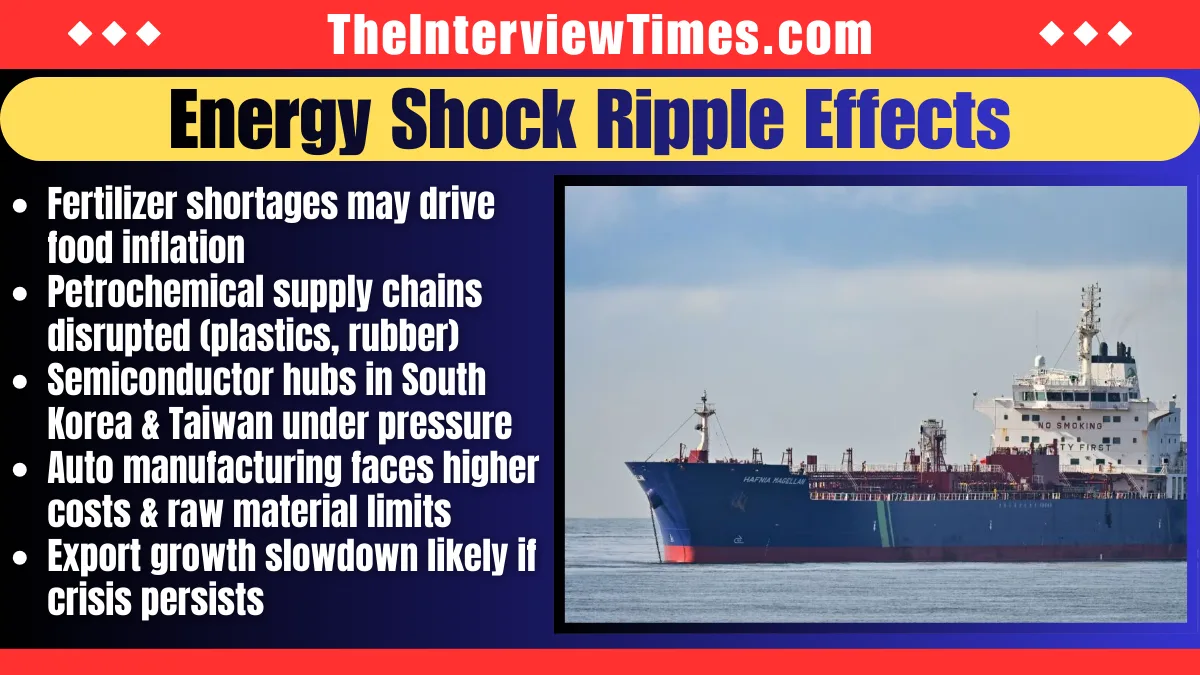
Morgan Stanley Issues Fresh Warning on Asia’s Oil Crisis
Global investment bank Morgan Stanley has warned that the deepening oil supply crisis triggered by escalating tensions in West Asia could begin to disrupt several major industries across Asia.
In a new research note, analysts said prolonged supply interruptions, particularly around the Strait of Hormuz, could send ripple effects far beyond energy markets.
Asia is particularly vulnerable because it imports most of its crude oil and liquefied natural gas from Middle Eastern producers. Even temporary shipping disruptions could trigger production slowdowns and export declines across the region.
Morgan Stanley warned that the risk is “non-linear,” meaning economic damage could accelerate quickly if disruptions persist.
Oil Supply Risks Rising After Shipping Disruptions
The warning comes as geopolitical tensions have already pushed Brent crude oil prices higher while tanker flows through key maritime routes face uncertainty.
According to Morgan Stanley, earlier expectations of a global oil surplus have rapidly shifted toward the possibility of shortages due to logistical bottlenecks.
The report also stresses that the crisis may not be limited to crude oil alone. A potential reduction in liquefied natural gas (LNG) shipments could create deeper energy shortages across Asia’s manufacturing economies.
Early economic indicators already hint at pressure.
Recent purchasing managers’ index (PMI) data, export figures and industrial output readings for March show early signs of weakening activity in energy-intensive sectors.
Countries Most Exposed to the Energy Shock
Morgan Stanley identifies four Asian economies as particularly vulnerable to supply disruptions:
- India
- Thailand
- South Korea
- Taiwan
These countries depend heavily on Middle Eastern energy imports and face potential LNG shortages.
In India, authorities have already begun rationing LNG supplies and raising domestic LPG prices to manage demand.
Refineries in India, China and Thailand have also reduced operating rates to conserve fuel stocks.
Meanwhile several governments are introducing emergency policies:
- South Korea has implemented fuel price caps.
- Thailand has encouraged work-from-home measures.
- The Philippines has shortened government work weeks to conserve fuel.
Key Industries at Risk
Morgan Stanley warns that the oil crisis could quickly spread into multiple industrial sectors.
Fertilizer and Agriculture
Fertilizer manufacturing could face shortages of sulphur and other chemical inputs, raising production costs and affecting farm yields.
Higher fertilizer prices would likely translate into rising food inflation across Asia.
Petrochemicals and Plastics
Petrochemical producers rely heavily on materials such as butadiene and propane, key components used to produce plastics and synthetic rubber.
Supply shortages could disrupt manufacturing supply chains for industries ranging from packaging to consumer goods.
Semiconductors and Automotive
Energy-intensive industries like semiconductor fabrication and automobile manufacturing could face higher power costs and limited raw material availability.
Countries like South Korea and Taiwan-global semiconductor hubs-could see export growth slow sharply if the energy crunch persists.
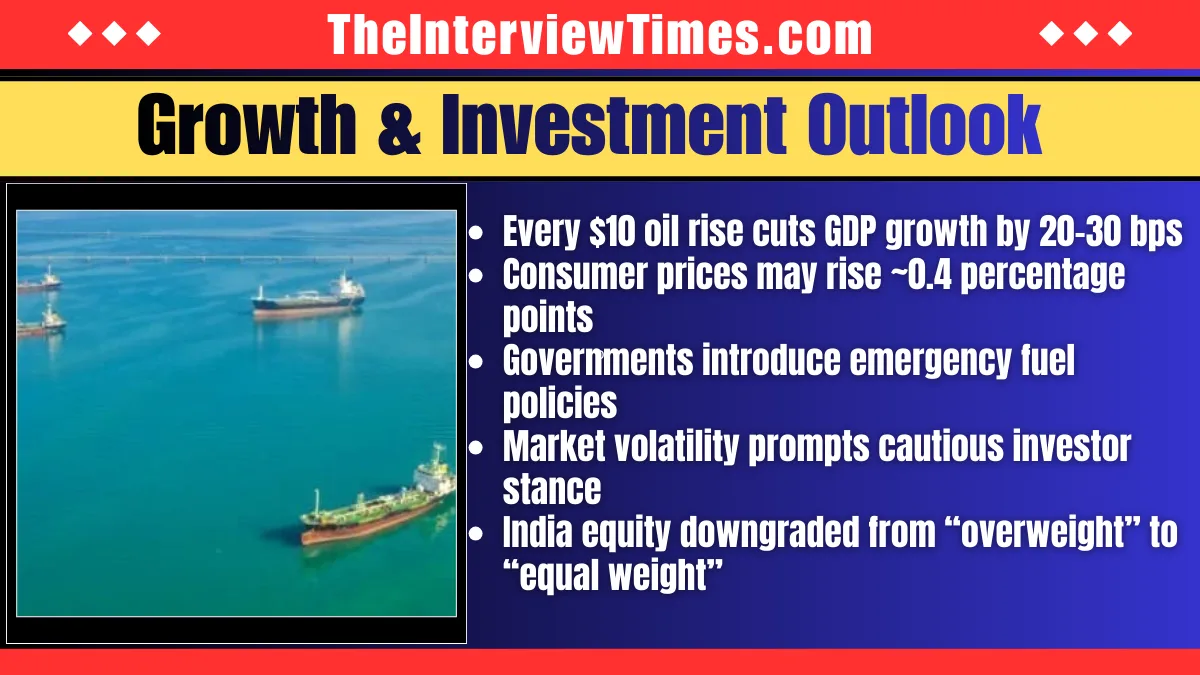
Economic Impact: Growth and Inflation Pressures
Morgan Stanley estimates that every $10 increase in oil prices could reduce Asia’s GDP growth by 20 to 30 basis points.
At the same time, consumer prices across the region could rise by around 0.4 percentage points on a purchasing-power-parity basis.
However, subsidies and government intervention in some countries may partially cushion the inflation impact.
The bank’s main concern is volatility and uncertainty rather than a full-scale economic slowdown.
Still, prolonged energy shocks could force companies to downgrade earnings forecasts, especially in export-dependent industries.
Investors Advised To Take Defensive Position
Reflecting these risks, Morgan Stanley has shifted to a more cautious stance on Asian equity markets.
The bank downgraded India from “overweight” to “equal weight” in its Asia and emerging markets portfolios.
Lead strategists Daniel Blake and Jonathan Garner warned that markets may still be underestimating the potential disruption to global energy flows.
They advised investors to treat short-term stock market rallies as opportunities to reduce exposure.
What to Watch in the Coming Weeks
Analysts say the next few weeks will be critical in determining whether the energy crisis deepens.
If shipping through the Strait of Hormuz normalizes quickly, oil prices could fall back toward $60–$65 per barrel.
However, if tensions continue or tanker traffic remains disrupted, the supply crunch could intensify and spread across industries.
Investors and policymakers are closely monitoring:
- Daily oil export volumes
- Refinery utilization rates
- Manufacturing PMI data
- LNG shipment flows
The Morgan Stanley oil crisis Asia warning highlights a broader lesson for the region. While Asia remains one of the fastest-growing economic zones in the world, the current energy shock underscores the urgent need for diversified energy sources, strategic reserves and stronger supply chain resilience in an increasingly uncertain global environment.
Top News: Strait of Hormuz Explained: Why This Narrow Waterway Controls the World’s Oil Supply
