
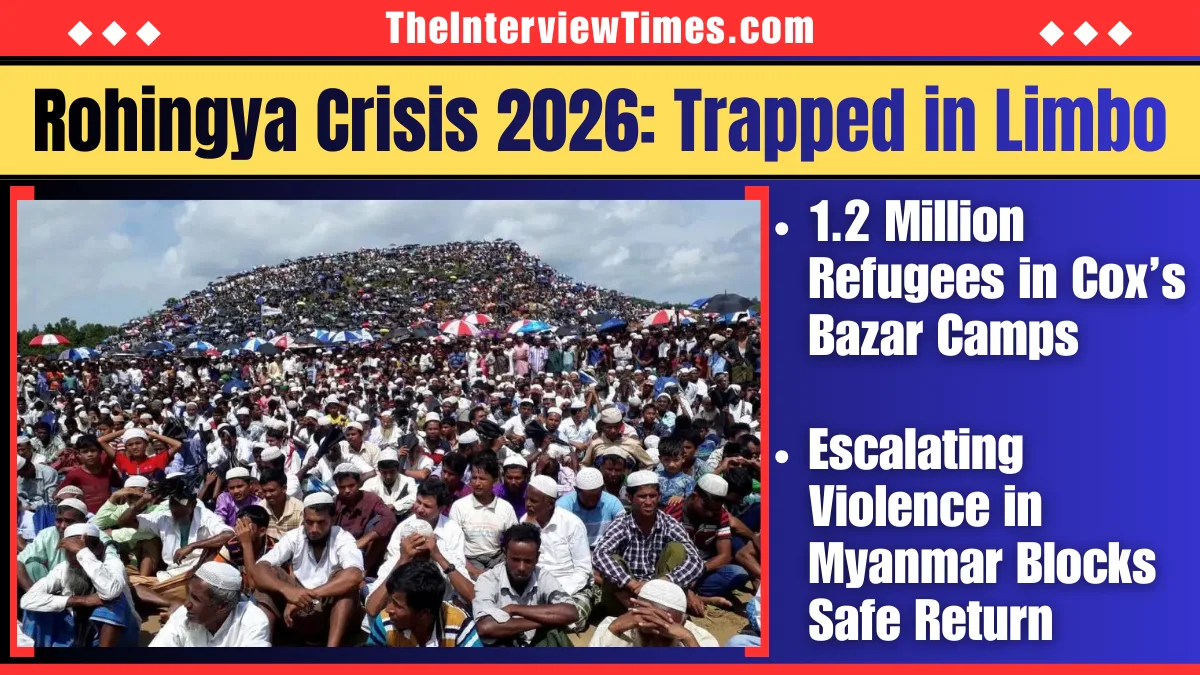
TheInterviewTimes.com | March 18, 2026 | 1:33 PM (IST)
Rohingya crisis 2026 explained. Over 1.2 million refugees in Bangladesh camps face aid cuts, violence in Myanmar, and stalled repatriation efforts.
Rohingya Crisis 2026: A Worsening Humanitarian Emergency
The Rohingya crisis 2026 remains one of the world’s most severe humanitarian disasters. More than 1.2 million stateless Rohingya Muslims are currently living in overcrowded refugee camps in Cox’s Bazar, Bangladesh.
Eight years after the 2017 mass exodus, conditions have not improved. Violence in Myanmar continues, while global funding cuts are worsening life inside refugee camps.
Despite repeated appeals from the United Nations and UNHCR, there is still no clear roadmap for safe and voluntary repatriation.
Historical Timeline Behind the Rohingya Crisis
The roots of the Rohingya crisis go back decades, marked by systematic exclusion and state-led violence.
- 1942: Communal clashes during the Japanese occupation of Burma caused early displacement
- 1978: Military crackdown forced up to 300,000 Rohingya into Bangladesh
- 1982: Citizenship law made Rohingya stateless
- 1991–92: Another military operation displaced over 250,000 people
- 2012: Sectarian violence displaced 140,000 Rohingya
- 2016–2017: Military operations following attacks by Arakan Rohingya Salvation Army forced 750,000 refugees to flee
- 2021: Myanmar military coup 2021 triggered nationwide conflict
- 2023–2025: Arakan Army gained control of large parts of Rakhine
This long history shows a consistent pattern of statelessness and persecution.

Myanmar Violence and Forced Recruitment Concerns
Since the 2021 coup, fighting between the military junta and ethnic armed groups has intensified.
In Rakhine State, the Arakan Army now controls key regions. Reports from Human Rights Watch highlight:
- Forced recruitment of Rohingya men and boys
- Arbitrary detention and forced labor
- Killings and destruction of villages
Both the junta and armed groups deny systematic abuses. However, independent investigations suggest widespread human rights violations.
Fresh violence since 2024 has pushed tens of thousands more refugees into Bangladesh.
Life in Cox’s Bazar Camps: Aid Cuts and Survival Struggles
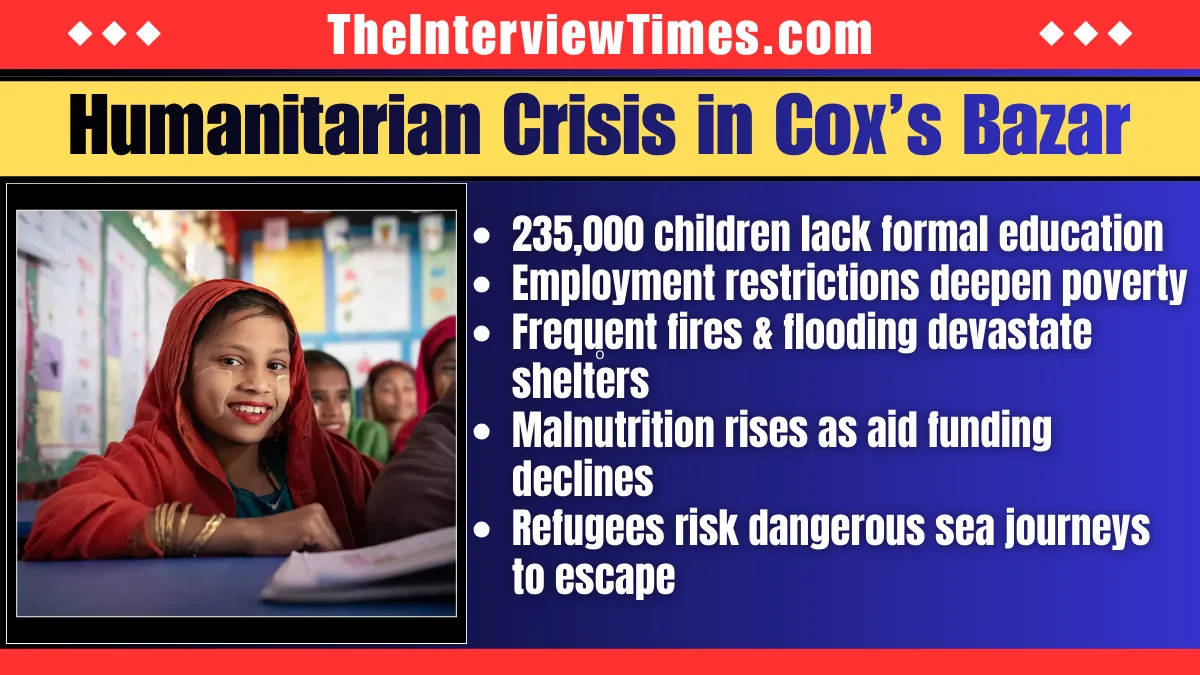
The refugee camps in Cox’s Bazar are among the largest in the world, housing nearly 1.15 million registered refugees.
Daily life is becoming increasingly difficult due to:
- Over 235,000 children out of school
- Severe restrictions on jobs and movement
- Frequent fires and floods
- Declining food rations due to funding shortages
The 2025–26 Joint Response Plan requires $934.5 million, but faces major funding gaps.
A major fire in January 2026 alone displaced over 2,000 refugees, highlighting the fragile living conditions.
Why Rohingya Repatriation Has Failed
Bangladesh continues to push for repatriation, but conditions inside Myanmar remain unsafe.
Efforts through the International Court of Justice and International Criminal Court aim to ensure accountability, but progress has been slow.
Rohingya refugees have clearly stated they will only return if:
- Full citizenship is restored
- Security is guaranteed
- Justice is delivered for past crimes
At present, none of these conditions exist.
Rohingya in India: Deportation and Legal Debate
An estimated 40,000 Rohingya refugees are living in India.
Recent developments include:
- Detention and verification drives
- Deportations to Bangladesh and Myanmar
- Allegations of forced pushbacks
India is not a signatory to the 1951 Refugee Convention, but is bound by the principle of non-refoulement under international law.
Human rights organizations argue that deportations may expose refugees to serious danger.
Global Response and Future Outlook
Organizations like UNICEF and UNHCR continue to provide aid, but funding shortages remain a major concern.
Experts warn that:
- Bangladesh cannot host refugees indefinitely
- Aid cuts could trigger a deeper humanitarian crisis
- Statelessness is creating long-term instability
Without political change in Myanmar, the Rohingya crisis 2026 risks becoming a permanent global emergency.
Top News: Strait of Hormuz Explained: Why This Narrow Waterway Controls the World’s Oil Supply
