
TheInterviewTimes.com | March 26, 2026 | 11:25 AM IST | New Delhi
India e-Arrival Card and eVisa 2026 guide. Learn rules, eligibility, documents, deadlines, and step-by-step process for smooth entry into India.
India continues to modernize its immigration and visa processes in 2026, making entry smoother and more efficient for international visitors. Two key digital tools now dominate the entry process: the e-Arrival Card (a mandatory digital disembarkation form) and the eVisa system. Together, they replace much of the old paperwork, reduce queues at immigration, and align India with global digital border standards.
What is the e-Arrival Card?
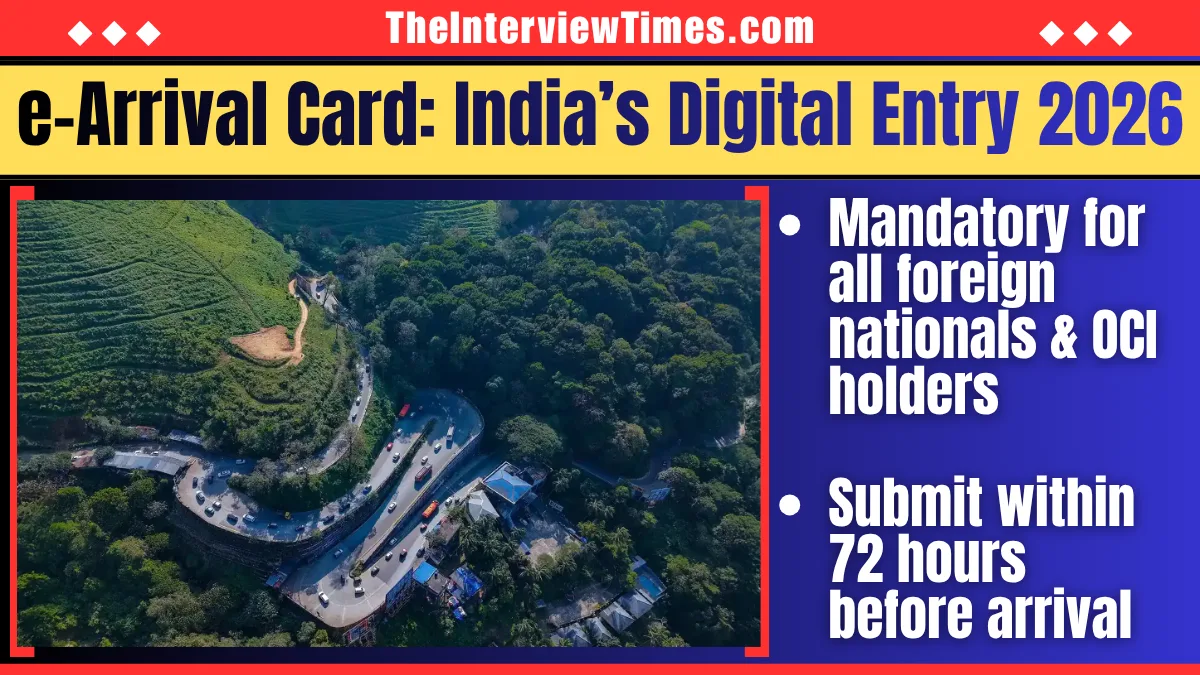
The e-Arrival Card (also called the electronic Disembarkation Card) is not a visa. It is a digital declaration of arrival details that all foreign nationals and Overseas Citizen of India (OCI) cardholders must submit before entering India. It collects personal information, passport details, flight information, address in India, and contact details to speed up immigration processing.
- Mandatory since: October 1, 2025.
- Fully mandatory (no paper option): From April 1, 2026. Physical disembarkation cards will no longer be accepted after March 31, 2026. Airports like Delhi and Bengaluru have already issued advisories confirming this shift.
- Who must submit it? All foreign passport holders (tourists, business travellers, students, medical visitors, etc.) and OCI cardholders. Indian passport holders are exempt.
- When to submit: Up to 72 hours before your scheduled arrival in India. You can complete it anytime within this window.
Important: The e-Arrival Card is separate from your visa application. You need a valid visa (or eVisa) plus a submitted e-Arrival Card to enter smoothly.

How to Fill the e-Arrival Card (Step-by-Step)
- Visit one of these official platforms (use only these to avoid scams):
- Indian Visa Online portal: https://indianvisaonline.gov.in/earrival/
- Bureau of Immigration (BOI): https://boi.gov.in
- Su-Swagatam mobile app (available on iOS and Android).
- Enter basic details: Name, passport number, nationality, date of birth, and purpose of visit.
- Provide arrival information: Flight details, port of entry, countries visited recently (if required).
- Add stay details: Address in India (hotel or host), contact information.
- Review and submit. You will receive a confirmation (digital receipt). Save or print it as a backup, though a digital copy on your phone is usually sufficient.
The form is straightforward and takes only a few minutes. Many airports now direct passengers to complete it digitally for faster immigration lanes.
Tips:
- Fill it 24–48 hours before departure for peace of mind.
- Double-check passport details to match exactly with your travel document.
- Have your hotel booking or host address ready.
India eVisa 2026: Overview and Key Updates
Most foreign travellers enter India on an eVisa, a fully online electronic visa that eliminates the need for embassy visits in many cases. The system supports multiple categories and has seen expansions in 2025–2026.
Eligible Categories (2026)
- e-Tourist Visa — Tourism, sightseeing, visiting friends/relatives, short yoga programmes.
- e-Business Visa — Business meetings, trade.
- e-Medical & e-Medical Attendant Visa — Treatment (including Ayush systems).
- e-Conference Visa, e-Student Visa, e-Transit, e-Mountaineering, e-Film, and others.
India expanded e-Tourist Visa eligibility to 166 countries as of early 2026, with entry allowed at dozens of airports, seaports, and select land borders (around 33 airports, 19 seaports, and additional land ports in recent updates).

Key Requirements for eVisa
- Passport: Valid for at least 6 months from the date of arrival in India, with at least 2 blank pages.
- Photograph: Recent front-facing passport-size photo with white background (strict rules in 2026; no selfies).
- Other: Return/onward ticket (recommended), sufficient funds proof (sometimes requested), and purpose-specific documents (e.g., invitation letter for business/conference).
Application Window: You can now apply up to 120 days (4 months) in advance for many categories, a significant improvement from earlier limits.
Processing Time: Usually 24–72 hours, but apply early. Approval is sent via email; print or save the eVisa PDF.
Validity and Stay (Common Options):
- 30-day e-Tourist: Double entry, stay up to 30 days.
- 1-year e-Tourist: Multiple entry, stays up to 90 or 180 days per visit (varies by nationality; US/Japan often get longer).
- 5-year e-Tourist: Multiple entry for frequent visitors.
- Business: 1 year, multiple entry, up to 180 days per visit in some cases.
Fees vary by nationality, duration, and season (reciprocal pricing applies in some cases). Short-term tourist visas remain relatively affordable (e.g., 30-day options often $10–$25). Always check the official portal for exact fees, as they can include service charges.
Entry Points: eVisa holders must arrive at designated airports/seaports/land ports. Exit is allowed from any authorized immigration checkpost.

Combined Digital Entry Process in 2026
- Apply for eVisa (if required) well in advance via https://indianvisaonline.gov.in/evisa/.
- Book flights and accommodation.
- Submit e-Arrival Card within 72 hours of arrival.
- At the airport: Present passport, printed/digital eVisa, e-Arrival confirmation, and any other required documents (e.g., yellow fever certificate if applicable).
- Proceed to immigration — digital submissions often lead to faster queues.
Note for OCI Holders: You still need to submit the e-Arrival Card, even though you enjoy visa-free entry in many cases.
Practical Tips for Smooth Entry
- Use only official websites and the Su-Swagatam app. Avoid third-party sites that charge extra fees.
- Keep digital copies of all documents on your phone and a printed backup.
- Check for health requirements (yellow fever vaccination for travellers from affected countries).
- Maximum stay limits apply (e.g., 180 days per calendar year on tourist visas for some nationalities).
- Hotel registration in India will still require passport and visa details.
- Children and minors need individual applications.
Latest Travel News: Exploring Vrindavan: Krishna’s Sacred Land of Eternal Devotion – theinterviewtimes.com
Why These Changes Matter
The shift to fully digital e-Arrival and expanded eVisa options reduces paperwork, shortens immigration wait times, and enhances security through better data integration.
As of 2026, India aims to position itself as a more traveller-friendly destination while maintaining robust border controls.
For the latest information, always refer to:
- Official eVisa portal: https://indianvisaonline.gov.in
- Bureau of Immigration: https://boi.gov.in
- Your nearest Indian embassy/consulate for nationality-specific advice.
Safe travels to India in 2026! The country’s digital entry system makes planning easier than ever, letting you focus on experiencing its rich culture, heritage, and hospitality.
Latest Travel News: Top 10 Travel Destinations in India to Explore in 2026 – theinterviewtimes.com
