
TheInterviewTimes.com | September 2, 2026 | New Delhi
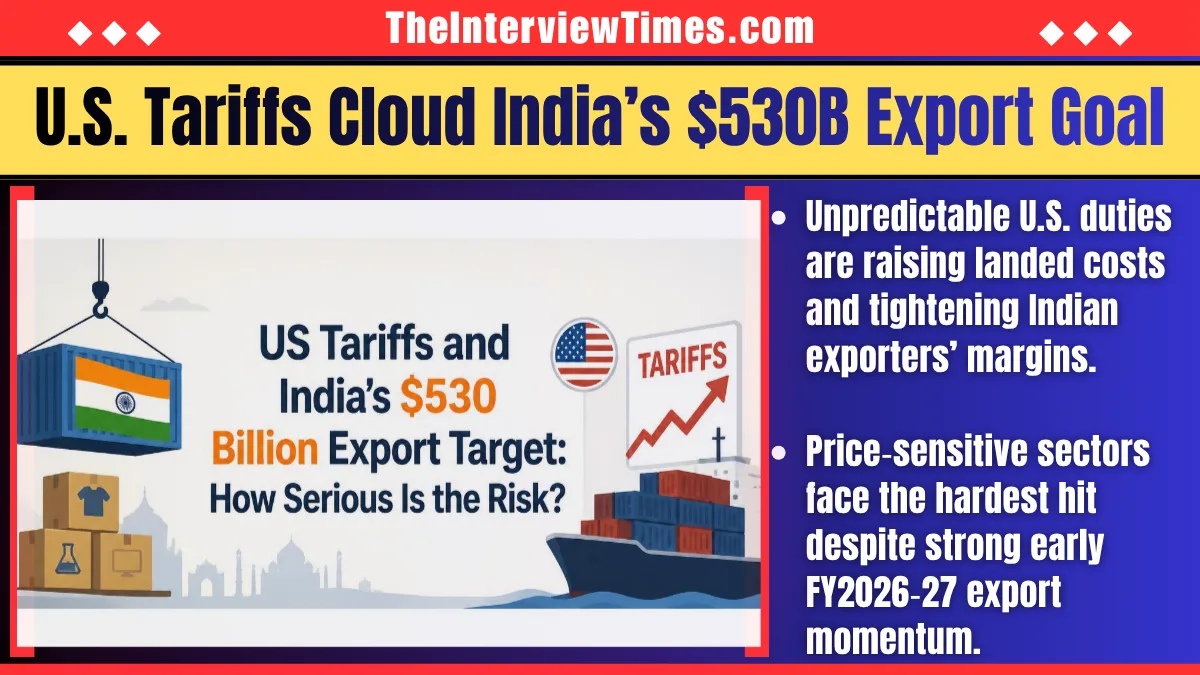
U.S. Tariffs put India’s $530 billion export target under pressure as higher costs, uncertainty and weaker competitiveness challenge Indian exporters.
Article Summary
India has set an ambitious target of taking merchandise exports to around $530 billion in FY2026-27, requiring merchandise export growth of roughly 16–17%. However, changing U.S. tariff policies are creating a new challenge for Indian exporters.
The issue is not simply the level of tariff imposed on Indian goods. Repeated changes in U.S. trade policy can affect the final landed price of Indian products, put pressure on exporters’ margins, influence sourcing decisions by American buyers and make companies more cautious about long-term investments.
The impact is likely to be more significant in labour-intensive and price-sensitive sectors such as textiles, apparel, leather, footwear, gems and jewellery, marine products, engineering goods and auto components.
At the same time, India’s strong export performance in the opening months of FY2026-27 suggests that the $530 billion target is not necessarily out of reach.
The bigger question is whether India can maintain export competitiveness despite continuing uncertainty in global trade.
Key Highlights
- India is targeting around $530 billion in merchandise exports in FY2026-27.
- Merchandise exports during April-July 2026 reached $173.78 billion, registering 17.04% year-on-year growth.
- The February 2026 India-U.S. framework provided for an 18% reciprocal tariff framework for several Indian-origin goods.
- A subsequent U.S. Section 301 action in July 2026 introduced an additional 10% tariff measure affecting India.
- The actual duty on a particular product depends on its existing tariff structure, exemptions and other trade measures.
- Labour-intensive sectors remain particularly vulnerable to tariff-driven price pressures.
- India’s services exports provide an important cushion because traditional customs tariffs apply primarily to physical goods.
Why U.S. Tariffs Matter for India’s Export Target
India’s merchandise export target depends on more than simply producing more goods.
Three conditions must work together:
- Global demand must remain strong.
- Indian products must remain price competitive.
- Exporters must have enough confidence to invest in additional capacity.
U.S. tariffs can affect all three.
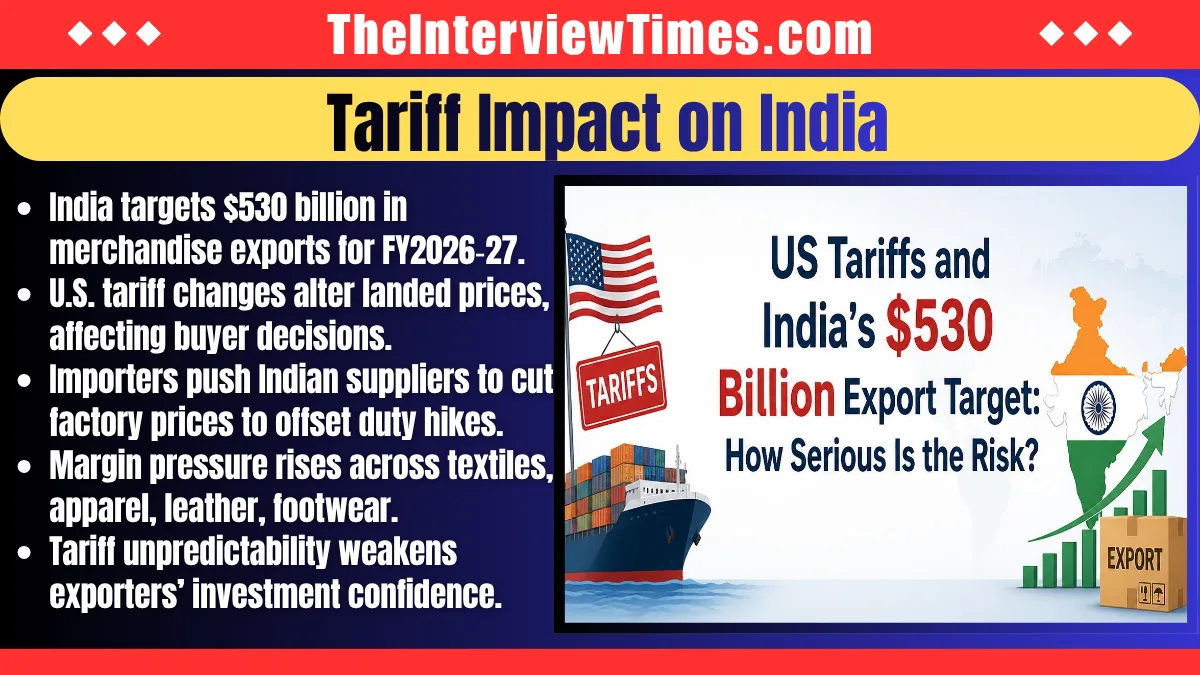
When an American importer faces a higher customs cost, the additional expense does not necessarily remain entirely with the importer. The buyer may negotiate a lower price with the Indian supplier.
That leaves the Indian exporter with two choices:
Absorb part of the tariff through lower prices and margins, or risk losing the order.
If thousands of exporters face the same decision, the cumulative effect can become significant for India’s merchandise export earnings.
The Landed-Cost Problem
Consider a simplified example.
Suppose an Indian apparel company sells a shirt to a U.S. distributor for $20.
If a 10% additional tariff applies, the importer faces a $2 customs cost, taking the cost to $22 before other expenses.
At an 18% tariff, the customs cost would rise to $3.60, taking the figure to $23.60.
At 50%, the customs cost would become $10, taking the figure to $30.
The exporter may then be asked to reduce the factory price to help the U.S. buyer maintain its target retail economics.
If the Indian company cuts its price from $20 to $17, the order may survive, but the exporter earns less revenue and potentially a lower profit margin.
If the exporter refuses, the American buyer may look for an alternative supplier.
This is how a tariff can affect India’s export target even when the customs duty itself is technically paid by the U.S. importer.
Why Tariff Volatility Can Be More Damaging Than a Stable Tariff
For exporters, predictability is almost as important as the tariff rate itself.
A garment manufacturer planning a new factory may need to make decisions months or even years in advance.
The company must determine:
- how much machinery to purchase;
- how many workers to hire;
- where to source raw materials;
- which markets to target;
- what prices to offer;
- and whether to sign long-term contracts.
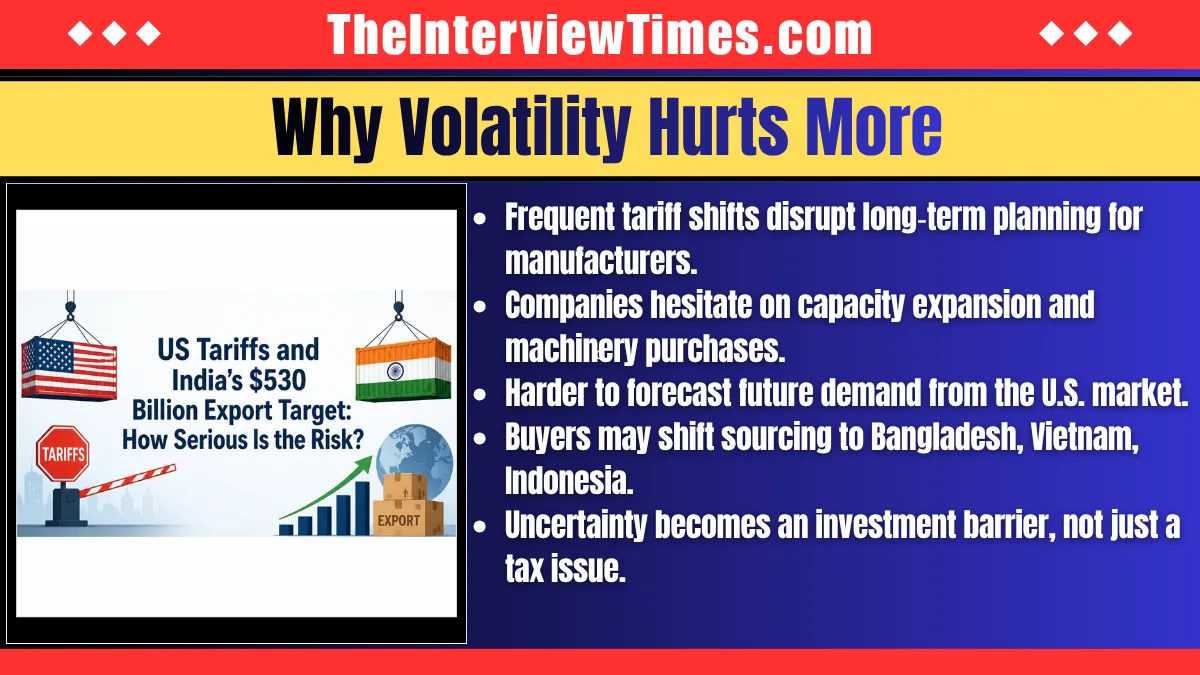
If tariff policy changes repeatedly, these calculations become much harder.
A company may postpone capacity expansion because it cannot confidently estimate future demand from its largest export market.
This is why tariff uncertainty can become an investment problem, not merely a trade-tax problem.
Which Indian Sectors Face the Greatest Pressure?
Textiles and Apparel
Textiles and apparel are among the most price-sensitive export sectors.
Indian manufacturers compete with suppliers from Bangladesh, Vietnam, Indonesia, China and other Asian economies.
Even a relatively modest increase in landed cost can influence sourcing decisions by U.S. buyers.
Leather and Footwear
Leather and footwear are similarly exposed because labour costs and final consumer prices are important determinants of competitiveness.
If Indian products become more expensive relative to competing suppliers, buyers may shift orders elsewhere.
Gems and Jewellery
Gems and jewellery involve high-value transactions, but consumer demand can still be sensitive to final prices.
Tariff costs may therefore create pressure on exporters, importers and retailers to absorb part of the additional expense.
Marine Products
Indian seafood exporters already operate within a complex regulatory environment.
Tariffs, sanitary requirements and other trade measures can collectively affect their competitiveness in the U.S. market.
Engineering Goods and Auto Components
Engineering products and auto components are particularly important because they are often integrated into long-term supply chains.
A tariff change can affect not only the price of the final product but also sourcing arrangements, supplier contracts and production planning.
India’s Export Performance Provides Some Cushion
Despite the U.S. tariff challenge, India’s export performance in the first four months of FY2026-27 has remained strong.
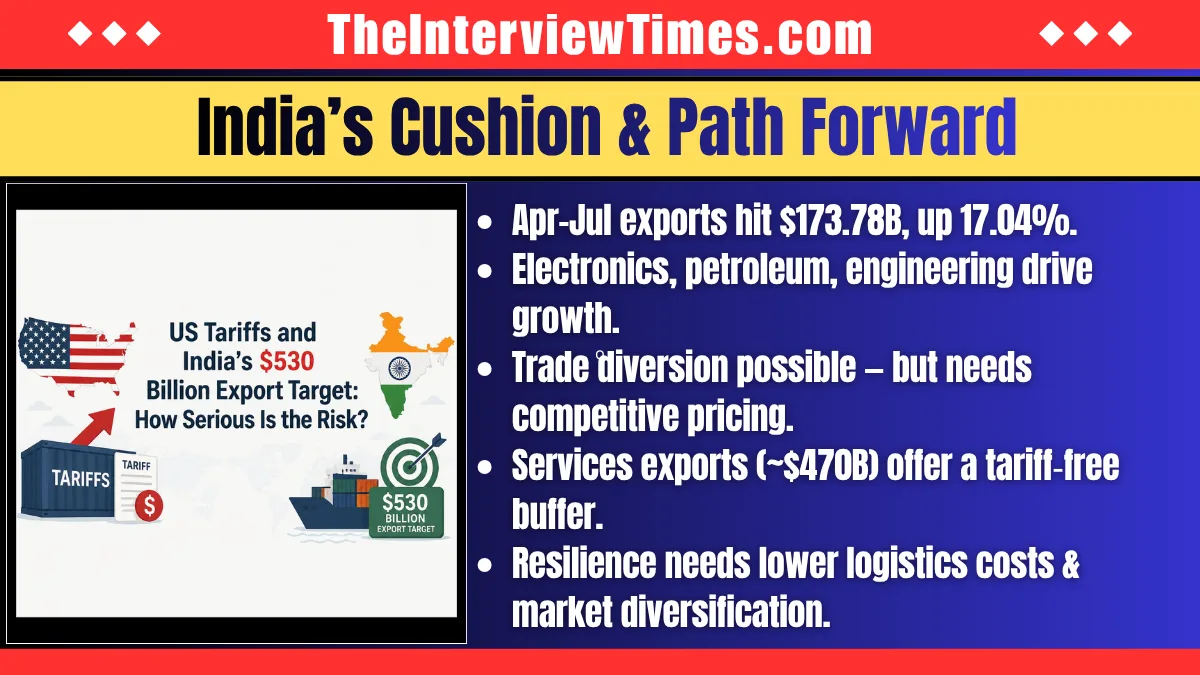
Merchandise exports during April-July 2026 stood at $173.78 billion, compared with $148.48 billion during the corresponding period a year earlier, a growth of 17.04%.
Electronic goods, petroleum products and engineering goods were among the sectors supporting export growth.
This means it would be premature to conclude that U.S. tariffs will automatically cause India to miss its $530 billion merchandise-export target.
The more accurate assessment is that tariffs increase the difficulty of achieving the target.
India will need to sustain strong export growth for the remaining months of the financial year while managing market-access risks in the United States.
Could Trade Diversion Create an Opportunity for India?
There is also a potential upside. If U.S. companies reduce sourcing from countries facing higher tariffs or other trade restrictions, India could gain additional orders. This phenomenon is commonly described as trade diversion.
However, India cannot assume that such business will automatically come its way.
To capture the opportunity, Indian exporters need to offer:
- competitive prices;
- consistent quality;
- reliable delivery;
- adequate production capacity;
- global-standard compliance;
- and efficient logistics.
Tariff differences may create an opening, but long-term supply relationships depend on overall competitiveness.
Why Services Exports Matter
India’s export economy has one major structural advantage: its services sector. Software and IT services are not physical merchandise entering the United States through customs. Therefore, traditional customs tariffs on imported goods do not directly apply to software exports in the same way they apply to garments, machinery or jewellery.
This provides India with an important diversification advantage. The government’s broader FY2026-27 export ambition is around $1 trillion, combining merchandise exports of approximately $530 billion with services exports of around $470 billion.
However, services should not be considered completely immune from international trade barriers. Digital regulations, taxation, data rules, visa policies and other market-access restrictions can affect cross-border services.
What Should India Do?
1. Seek Greater Policy Predictability
For exporters, predictable market access is crucial. A stable trade framework allows companies to negotiate long-term contracts and make capacity investments with greater confidence.
2. Support Vulnerable Export Sectors
Labour-intensive industries may require targeted support through export credit, insurance, technology upgrades and market-development assistance.
A parliamentary committee has also highlighted the need for support to sectors affected by U.S. tariff measures.
3. Diversify Export Markets
India should reduce excessive dependence on any single market. Europe, the Middle East, Africa, Latin America and other Asian markets can provide additional opportunities for Indian exporters.
Market diversification would make India’s export economy more resilient to policy changes in the United States.
4. Reduce Domestic Production Costs
India’s best long-term response to tariff pressure is greater competitiveness. Lower logistics costs, faster ports, reliable infrastructure, efficient customs procedures, competitive input prices and greater technology adoption can help Indian companies absorb external trade shocks.
The Bottom Line
The biggest risk to India’s $530 billion merchandise-export target is not one particular tariff number. It is uncertainty.
Higher U.S. duties can increase the landed cost of Indian products, put pressure on exporters to reduce prices, weaken profit margins and encourage American buyers to explore alternative suppliers.
But India’s strong export growth in the opening months of FY2026-27 shows that the export story remains resilient. The $530 billion target is therefore challenging, but not necessarily unattainable.
For India, the long-term answer lies beyond tariff negotiations. The country needs to build an export ecosystem that remains competitive even when global trade rules change.
That means lower logistics and production costs, better infrastructure, stronger manufacturing capabilities, diversified markets and greater integration into global supply chains.
The real test for India is not whether it can survive one tariff increase. It is whether Indian exporters can remain globally competitive when trade policy itself becomes unpredictable.