
TheInterviewTimes.com | September 3, 2026 | New Delhi
Gravity on quantum atoms has been measured in a new experiment, offering a fresh test of Einstein’s equivalence principle in the quantum world.
Article Summary
Gravity on Quantum Atoms has been measured in a new experiment using a Quantum Galileo Interferometer, giving scientists a new way to test Einstein’s equivalence principle in the quantum world. Researchers observed the gravitational phase accumulated by a freely falling atomic wave packet and found that it matched theoretical predictions. The experiment does not prove the existence of quantum gravity or unify quantum mechanics with general relativity, but it provides important experimental evidence that Einstein’s description of gravity remains consistent with quantum behaviour under the conditions tested.
Key Highlights
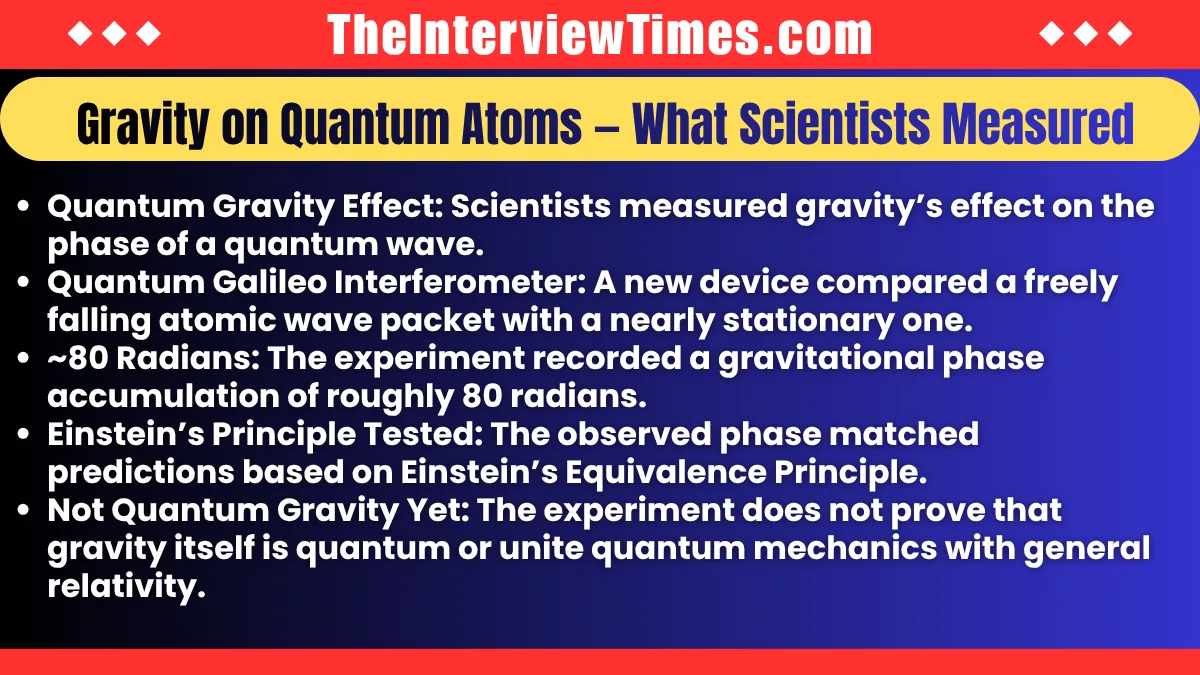
- Gravity on Quantum Atoms: Scientists measured the gravitational phase of a freely falling quantum wave packet.
- Quantum Galileo Interferometer: A new experimental setup was used to compare a freely falling atomic wave packet with a nearly stationary one.
- Einstein’s Equivalence Principle: The observed quantum phase was consistent with predictions based on Einstein’s equivalence principle.
- Around 80 Radians: The experiment measured a gravitational phase accumulation of roughly 80 radians and observed the expected T³ dependence on free-evolution time.
- Not Quantum Gravity: The experiment does not prove that gravity itself is quantum or solve the long-standing conflict between quantum mechanics and general relativity.
- Roger Penrose: The research team includes Nobel Prize-winning physicist Roger Penrose, whose ideas about gravity-induced quantum state collapse could be explored in future experiments.
- Future Research: Researchers hope to extend the technique to heavier quantum systems, potentially including nanodiamonds.
- Why It Matters: The experiment provides a new platform for studying the boundary between quantum mechanics and Einstein’s theory of gravity.
Gravity on Quantum Atoms: Scientists Test Einstein’s Theory in the Quantum World
An international research team has used a new Quantum Galileo Interferometer to measure the gravitational phase of a freely falling quantum wave packet, providing a new experimental test of Einstein’s equivalence principle.
For more than a century, physics has relied on two extraordinarily successful theories. Quantum mechanics explains the behaviour of atoms and other microscopic objects, while Einstein’s general theory of relativity describes gravity, space and time on larger scales.
The problem is that physicists still do not have a complete theory explaining how the quantum world and gravity fit together.
A new experiment has now taken another important step into this difficult territory.
An international team of researchers, including scientists from Ben-Gurion University of the Negev, the University of Oxford and the University of Ulm, has directly measured a predicted gravitational effect on a freely falling quantum wave packet. The research was published in Science Advances on September 2, 2026.
The experiment found that the measured quantum phase behaved as predicted by applying Einstein’s equivalence principle to a quantum matter wave.
The result is significant—but it does not mean scientists have discovered quantum gravity or finally unified quantum mechanics with general relativity.
A Quantum Version of Galileo’s Falling-Object Experiment
The experiment centres on a new device called the Quantum Galileo Interferometer (QGI).
The name refers to Galileo Galilei’s pioneering work on free fall and gravity.
In classical physics, if an object is thrown upwards, gravity slows it down until it stops momentarily and then accelerates it back towards Earth.
Quantum objects behave differently. An atom can exhibit wave-like behaviour, and its quantum wave can be placed into a superposition in which different parts of the wave follow different trajectories.
The researchers used this property to create two different paths for an ultracold atomic wave packet.
One part was held approximately stationary relative to the laboratory by using precisely controlled magnetic fields. The other part was allowed to move freely under gravity.
The two parts were subsequently brought back together.
When quantum waves overlap, they can interfere. The resulting interference pattern contains information about the relative phase accumulated along the two paths.
That phase is the key to the experiment.
How Gravity Leaves a Fingerprint on a Quantum Wave
In quantum mechanics, phase describes part of the evolution of a particle’s wave function.
Two wave packets can travel along different paths and accumulate different phases. When they are recombined, the difference between those phases changes the interference pattern.
In the Quantum Galileo Interferometer, one branch experienced free fall while the other was effectively held against gravity.
The researchers measured the resulting phase difference and found the characteristic behaviour predicted for a freely falling quantum object.
In particular, the gravitational phase showed the expected dependence on the cube of the free-evolution time, T³. The experiment reached a phase accumulation of roughly 80 radians.
This is important because the T³ dependence is not simply a measurement of how fast an atom falls. It is a signature of the quantum phase associated with comparing a freely falling frame with the laboratory frame.
The experiment therefore probes gravity through the quantum wave itself, rather than merely measuring an atom’s acceleration.
What Einstein’s Equivalence Principle Says
The equivalence principle is one of the foundations of Einstein’s theory of general relativity.
In simple terms, it says that locally, the effects of gravity can be indistinguishable from the effects of acceleration.
Imagine being inside a closed elevator.
If the elevator is accelerating upwards in empty space, objects released inside it appear to fall towards the floor. If the elevator is stationary on Earth, objects also fall towards the floor.
Without looking outside, it can be impossible to distinguish the two situations locally.
The same idea works in reverse. An observer freely falling in a gravitational field experiences a locally weightless environment.
Einstein used this principle as a crucial foundation for developing general relativity.
The new experiment asks a deeper question:
Does this principle continue to work when the object experiencing free fall is described by quantum mechanics?
The researchers’ measurement indicates that, under the conditions of the experiment, the answer is yes.
Top News: Decoding the American Education System: A Complete Guide for Global Students – theinterviewtimes.com
Why This Is Different From Earlier Quantum Gravity Experiments
Gravity and quantum systems are not new territory for experimental physicists.
Gravitational effects have previously been observed using quantum systems, including atom interferometers.
What makes this experiment different is the specific quantity being measured.
Rather than simply measuring the gravitational acceleration of atoms, the researchers measured the relative quantum phase between a freely falling wave packet and a stationary reference wave packet.
That distinction matters.
The experiment effectively compares two descriptions of the same quantum system: one associated with the laboratory and another associated with free fall.
The measured phase agrees with the prediction obtained from Einstein’s equivalence principle in the quantum domain.
The Experiment Used Ultracold Rubidium Atoms
The researchers worked with clouds of rubidium atoms cooled to temperatures just above absolute zero.
At such extremely low temperatures, the atoms can be manipulated with exceptional precision and their quantum wave behaviour becomes easier to control.
The experimental setup used an atom chip capable of producing carefully controlled magnetic fields.
Microwave pulses were used to prepare the atoms in the required quantum state. Magnetic fields were then used to control one part of the atomic wave while another part followed a free-falling trajectory.
Eventually, the two wave packets were recombined.
The resulting interference pattern allowed the researchers to determine how their relative quantum phase had evolved during the experiment.
It is this phase measurement that provides the central result.
Does This Mean Scientists Have Discovered Quantum Gravity?
No.
This distinction is essential.
The experiment does not demonstrate that gravity itself is a quantum field or that gravity has been placed into a quantum superposition.
It does not provide a complete theory combining general relativity with quantum mechanics.
It also does not establish that Einstein’s theory will remain correct in every possible quantum-gravitational situation.
Instead, it demonstrates that a specific prediction obtained by extending the equivalence principle into the quantum domain agrees with experimental observation.
That is an important result—but it is not a solution to the quantum-gravity problem.
Top News: Guide for Indian Students: How to Secure Admission to American Universities – theinterviewtimes.com
Why Roger Penrose’s Involvement Matters
The research team includes Sir Roger Penrose, the Nobel Prize-winning mathematical physicist whose work has explored deep questions involving gravity, spacetime and quantum theory.
Penrose has also proposed ideas suggesting that quantum superpositions might eventually break down because of gravitational effects when sufficiently massive systems are involved.
The current experiment does not test that proposal decisively.
The atoms used in the experiment are far too small, and the relevant timescales are not sufficient to establish whether gravity ultimately causes quantum superpositions to collapse.
However, the new interferometer could potentially provide a platform for future experiments involving much heavier quantum systems.
The researchers have pointed towards possibilities including nanodiamonds, which could allow physicists to explore the boundary between quantum mechanics and gravity under very different conditions.
A New Test at the Boundary of Physics
The deeper importance of this experiment lies in the question it addresses.
Quantum mechanics works extraordinarily well for microscopic systems.
General relativity works extraordinarily well for gravity and large-scale structures such as planets, stars and galaxies.
But extreme environments—such as the interior of black holes or the earliest moments of the universe—require physicists to understand both quantum mechanics and gravity simultaneously.
That is where current theories reach their limits.
The Quantum Galileo Interferometer does not solve that problem.
What it does is provide a new experimental way to examine the boundary between the two theories.
By measuring how a quantum wave accumulates gravitational phase during free fall, scientists can test whether fundamental principles developed for classical physics continue to hold when matter behaves according to quantum mechanics.
The Bottom Line
The most accurate way to describe the result is not that scientists have discovered quantum gravity.
They have measured a long-predicted gravitational phase of a freely falling quantum wave packet and found it consistent with the quantum extension of Einstein’s equivalence principle.
That may sound like a subtle distinction, but in fundamental physics, it is crucial.
The experiment strengthens the evidence that Einstein’s description of free fall remains compatible with quantum behaviour in the regime tested.
At the same time, the much bigger question remains unanswered:
How does gravity itself behave at the quantum level?
For now, the bridge between quantum mechanics and general relativity is still under construction.
The Quantum Galileo Interferometer provides another carefully measured piece of that bridge.