
TheInterviewTimes.com | September 3, 2026 | New Delhi
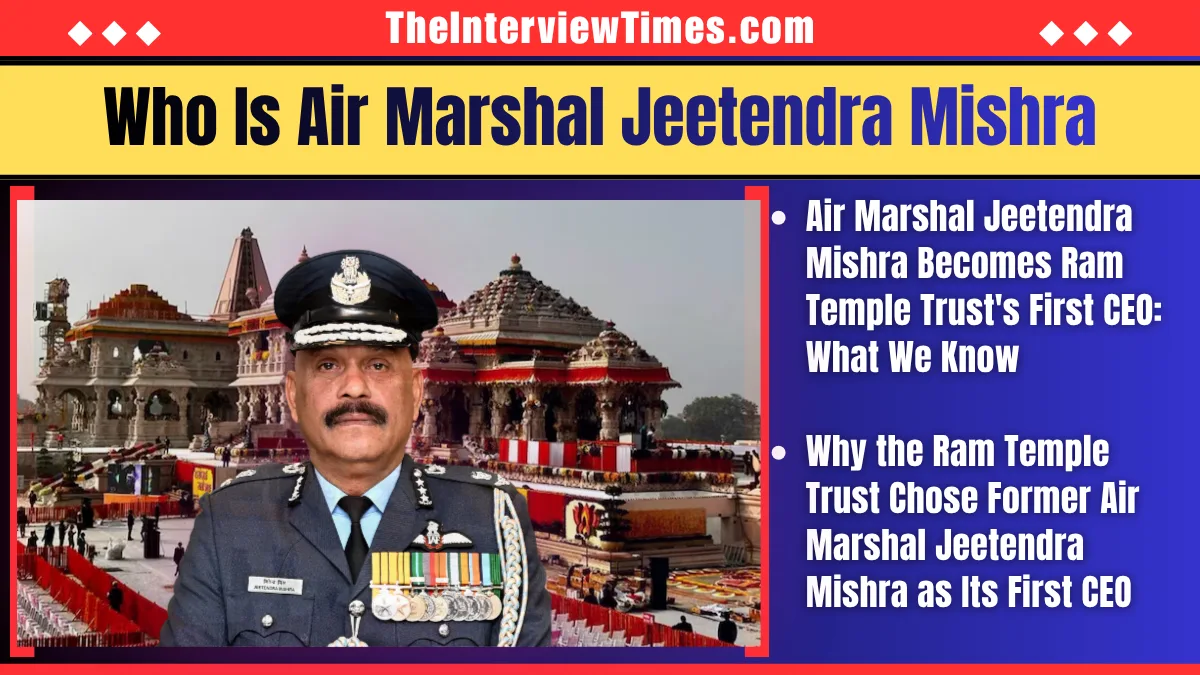
Air Marshal Jeetendra Mishra, former Western Air Command chief during Operation Sindoor, is appointed the first full-time CEO of Ram Temple Trust.
Article Summary
Air Marshal Jeetendra Mishra (Retd.), the former Air Officer Commanding-in-Chief of the Indian Air Force’s Western Air Command, has been appointed the first full-time Chief Executive Officer (CEO) of the Shri Ram Janmbhoomi Teerth Kshetra Trust, which oversees the Ram Temple in Ayodhya.
Mishra headed Western Air Command during Operation Sindoor in May 2025. He had assumed command of the IAF’s Western Air Command on January 1, 2025, and retired from the Indian Air Force in April 2026.
His appointment places a former senior military commander at the centre of the Trust’s executive administration as the Ram Temple moves into a phase requiring sustained management of its operations and facilities.
Key Highlights
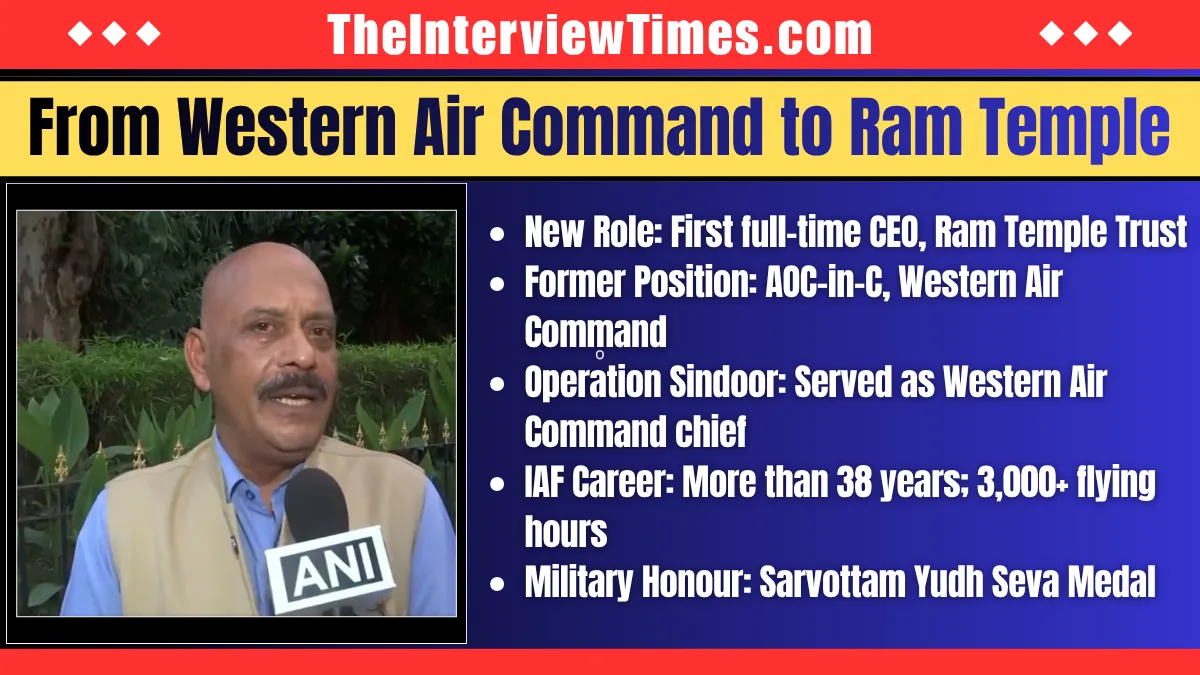
- Air Marshal Jeetendra Mishra has been appointed the first full-time CEO of the Shri Ram Janmbhoomi Teerth Kshetra Trust.
- Mishra served as Air Officer Commanding-in-Chief of Western Air Command during Operation Sindoor.
- He assumed command of Western Air Command on January 1, 2025.
- He joined the Indian Air Force as a fighter pilot on December 6, 1986.
- The Ministry of Defence recorded more than 38 years of service and over 3,000 flying hours when he assumed command of Western Air Command.
- In 2025, Mishra was among the IAF officers awarded the Sarvottam Yudh Seva Medal.
- The Trust’s CEO selection process reportedly considered 5,585 applications before the final selection.
Air Marshal Jeetendra Mishra Gets New Role in Ayodhya
The Shri Ram Janmbhoomi Teerth Kshetra Trust has appointed retired Air Marshal Jeetendra Mishra as its first full-time CEO.
The decision was taken by the Trust in Ayodhya on September 2, 2026, according to reports following the meeting.
The appointment creates a dedicated full-time executive position within the organisation responsible for the Ram Temple and its associated activities.
Mishra’s appointment is notable because of his recent role in the Indian Air Force. Before retiring, he served as the head of the Western Air Command, one of the IAF’s major operational commands.
Reports on the appointment said the Trust had received 5,585 applications for the CEO position. The selection process subsequently narrowed the field before a final panel of candidates was placed before the Trust.
Who Is Air Marshal Jeetendra Mishra?
Mishra was commissioned into the Indian Air Force as a fighter pilot on December 6, 1986.
According to the Ministry of Defence, he is an alumnus of the National Defence Academy in Pune, the Air Force Test Pilots School in Bengaluru, the Air Command and Staff College in the United States and the Royal College of Defence Studies in the United Kingdom.
The Ministry described him as a Fighter Combat Leader and experimental Test Pilot and recorded more than 3,000 hours of flying experience.
During his IAF career, he held several command and staff positions. These included commanding a fighter squadron, serving as Chief Test Pilot at the Aircraft & Systems Testing Establishment, commanding two frontline air bases and holding senior appointments at Air Headquarters.
He also served as Commandant of the Aircraft & Systems Testing Establishment and as Deputy Chief of Integrated Defence Staff. Before taking over Western Air Command, he served as Deputy Chief of Integrated Defence Staff (Operations).
Mishra and Western Air Command
Air Marshal Jeetendra Mishra assumed command of the Indian Air Force’s Western Air Command on January 1, 2025.
The Ministry of Defence’s official release said he succeeded Air Marshal Pankaj Mohan Sinha.
Western Air Command is one of the IAF’s operational commands and has responsibility for India’s western air sector.
Mishra was therefore serving as Air Officer Commanding-in-Chief of Western Air Command when India conducted Operation Sindoor in May 2025.
It is important to distinguish this role from saying that Mishra personally commanded the entire Operation Sindoor. His established position was the commander of the Western Air Command during the operation.
The distinction matters because Operation Sindoor involved India’s wider military response and multiple elements of the armed forces.
Sarvottam Yudh Seva Medal
Mishra’s service during this period was subsequently recognised at the national level.
The Government of India’s 2025 list of gallantry awardees includes Air Marshal Jeetendra Mishra, AVSM, VSM, among the recipients of the Sarvottam Yudh Seva Medal.
The official list identifies him as an Air Force officer in the Flying (Pilot) category.
The Ministry of Defence separately recorded that four IAF personnel received the Sarvottam Yudh Seva Medal in the 2025 awards announced around Independence Day, while 162 IAF personnel received Mention-in-Despatches for Operation Sindoor.
Mishra had already been a recipient of the Ati Vishisht Seva Medal and Vishisht Seva Medal, according to his official IAF biography released by the Ministry of Defence when he assumed Western Air Command.
From Nearly Four Decades in the IAF to Ayodhya
Mishra’s career in the Indian Air Force began in 1986 and extended for more than 38 years by the time he assumed command of Western Air Command.
His professional background covers flying, testing, operational planning, command and senior defence administration.
That experience now moves into a very different institutional setting.
As CEO of the Ram Temple Trust, Mishra will be working within an organisation responsible for the administration and functioning of the Ram Janmbhoomi temple complex.
Reports on the appointment indicate that the Trust is defining the responsibilities of the CEO through an administrative framework and Standard Operating Procedure.
This is important because the exact authority and responsibilities attached to the new position should be understood through the Trust’s formal structure rather than assumed from Mishra’s previous military rank.
Why the CEO Appointment Matters
The creation of a full-time CEO represents an administrative development for the Shri Ram Janmbhoomi Teerth Kshetra Trust.
The Trust’s responsibilities have expanded beyond the construction of the temple itself. The institution now has to manage the functioning of the temple complex and the administrative systems associated with it.
A dedicated executive position provides a formal role for coordinating these functions.
The appointment also comes at a time when the Trust has faced public scrutiny over an alleged temple donation embezzlement case. Reports have said that arrests were made in connection with the case.
However, the appointment of Mishra should not automatically be described as a response to that case unless the Trust itself establishes such a direct connection.
The factual position is that the CEO appointment and the reported administrative changes came during the same period.
A Competitive Selection Process
The selection of Mishra followed an extensive recruitment exercise.
According to reports, the Trust received 5,585 applications for the CEO position.
The search process subsequently narrowed the applicants to a smaller group, with 16 candidates considered during the selection process before a final panel of three candidates was placed before the Trust.
Mishra was ultimately selected.
The process is notable because the Trust used a formal search exercise rather than simply announcing an internal appointment.
For students of public administration and governance, the development provides an example of how a large religious institution can create a dedicated executive-management position as its operational responsibilities expand.
What Lies Ahead for the New CEO?
Mishra’s new assignment is fundamentally different from his military career.
The IAF operates through a clearly defined command structure, while the administration of a religious institution involves trustees, religious authorities, administrators, employees, government agencies, security organisations and millions of devotees.
The CEO’s responsibilities will ultimately be determined by the Trust’s organisational framework and the formal duties assigned to the position.
The immediate significance of the appointment is therefore institutional: the Ram Temple Trust now has its first full-time CEO, and that position will provide a dedicated executive layer for its administration and operations.
The Larger Significance
Air Marshal Jeetendra Mishra’s appointment brings together two very different areas of public life: India’s military leadership and the administration of the Ram Temple in Ayodhya.
His record includes fighter-pilot service, test-pilot experience, senior command assignments and leadership of Western Air Command.
His appointment as the first full-time CEO of the Shri Ram Janmbhoomi Teerth Kshetra Trust marks the beginning of a new professional chapter.
For the Ram Temple Trust, the important question will now be how the newly created executive position functions within the Trust’s existing decision-making structure.
For observers of governance, the development is significant because the management of the Ram Temple increasingly requires permanent administrative systems alongside its religious and cultural responsibilities.
The appointment of Air Marshal Jeetendra Mishra therefore represents not merely a change in personnel, but the establishment of a new full-time executive position within the organisation overseeing one of India’s most significant religious institutions.