
TheInterviewTimes.com | New Delhi | October 31, 2026
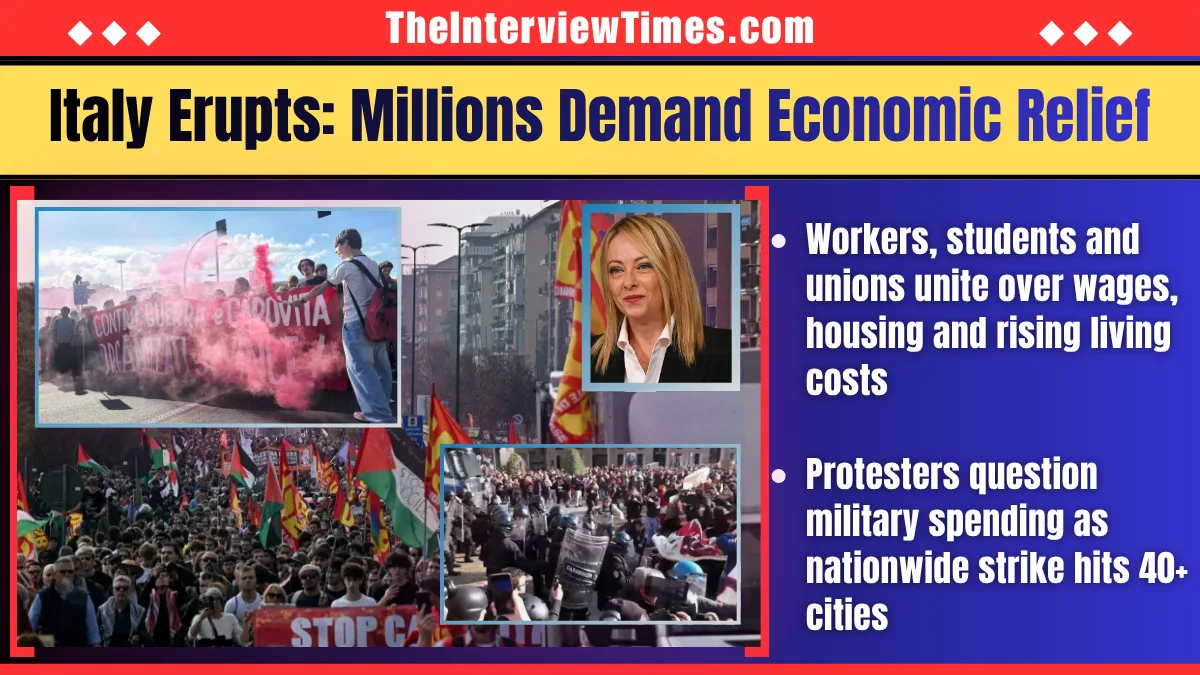
Italy protests explained: Thousands of students and workers strike over wages, rising living costs, housing, education and military spending.
Thousands of students, workers and trade union members took to the streets across Italy on October 30, as a nationwide general strike brought demonstrations to more than 40 cities. Protesters demanded higher wages, affordable housing, better-funded public services and greater investment in education, while opposing increased military spending and the use of commercial ports for arms shipments.
The demonstrations, organised alongside a 24-hour strike called by the grassroots trade union Unione Sindacale di Base (USB), brought together groups with different concerns but a common message: economic insecurity and public spending priorities must be addressed.
Although most demonstrations remained peaceful, tensions emerged in Rome, Turin and other cities, prompting police intervention. The scale of the mobilisation has also raised questions about the challenges facing Prime Minister Giorgia Meloni’s government.
Why Did Thousands Protest Across Italy?
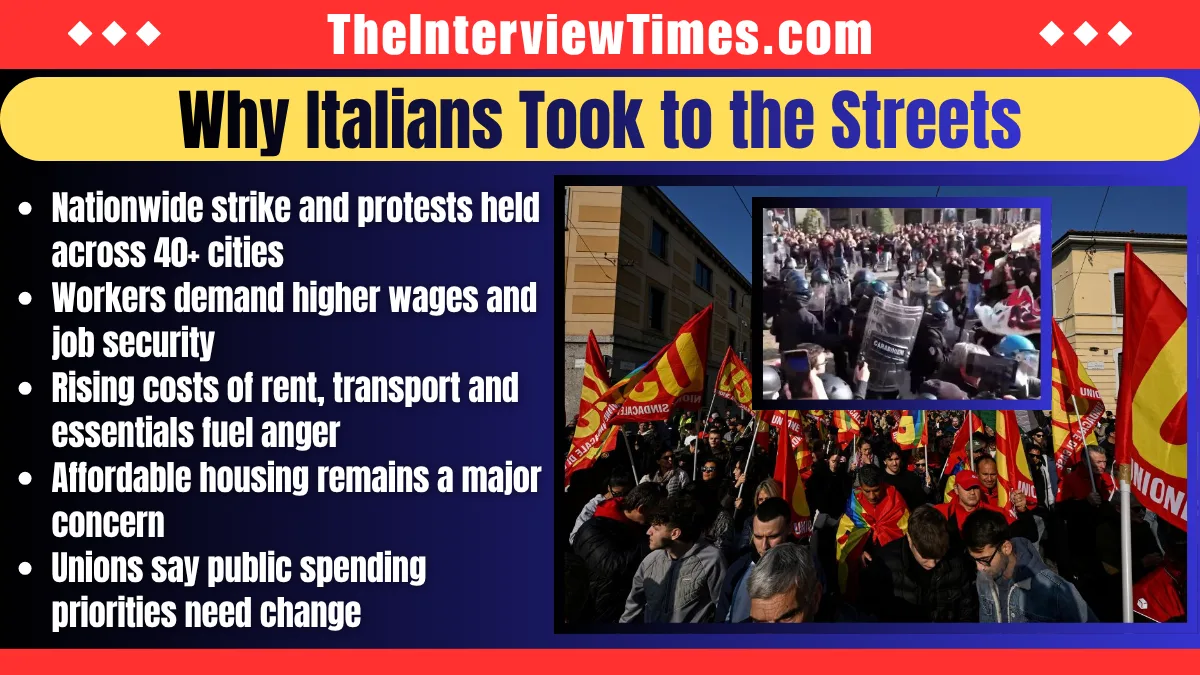
The October 30 demonstrations were organised in more than 40 cities, including Rome, Milan, Naples, Turin, Bologna, Genoa, Venice and Palermo.
Students, teachers, transport workers, public-sector employees, farmers, truck drivers, taxi drivers and port workers participated in the mobilisation.
According to Reuters, tens of thousands of people joined demonstrations nationwide. However, the organisers reported much higher participation figures. USB estimated that between one million and 1.5 million people took part, while a student collective claimed participation of approximately two million.
These figures have not been independently verified, and Italian authorities did not publish an official nationwide attendance total.
The demonstrations reflected several interconnected concerns, particularly rising living costs, low wages, insecure employment, housing affordability and dissatisfaction with government spending priorities.
Rising Living Costs and Low Wages Fuel Public Anger
The cost of living has become one of the central issues behind Italy’s protests.
Higher expenses for rent, electricity, transport and everyday necessities are putting pressure on household budgets. Workers and young people are particularly concerned about whether their incomes can provide financial stability.
For many younger Italians, finding employment does not necessarily mean being able to afford independent living. Temporary contracts, relatively low wages and expensive accommodation can make it difficult to plan for the future.
Housing affordability has therefore become an important part of the protest movement.
Students have also highlighted the high cost of accommodation in university cities. During the demonstrations, concerns about expensive student housing were raised alongside demands for better educational facilities and stronger public investment.
The protesters argue that economic growth must translate into better living conditions, particularly for people entering the workforce.
Why Are Students Joining the Protests?
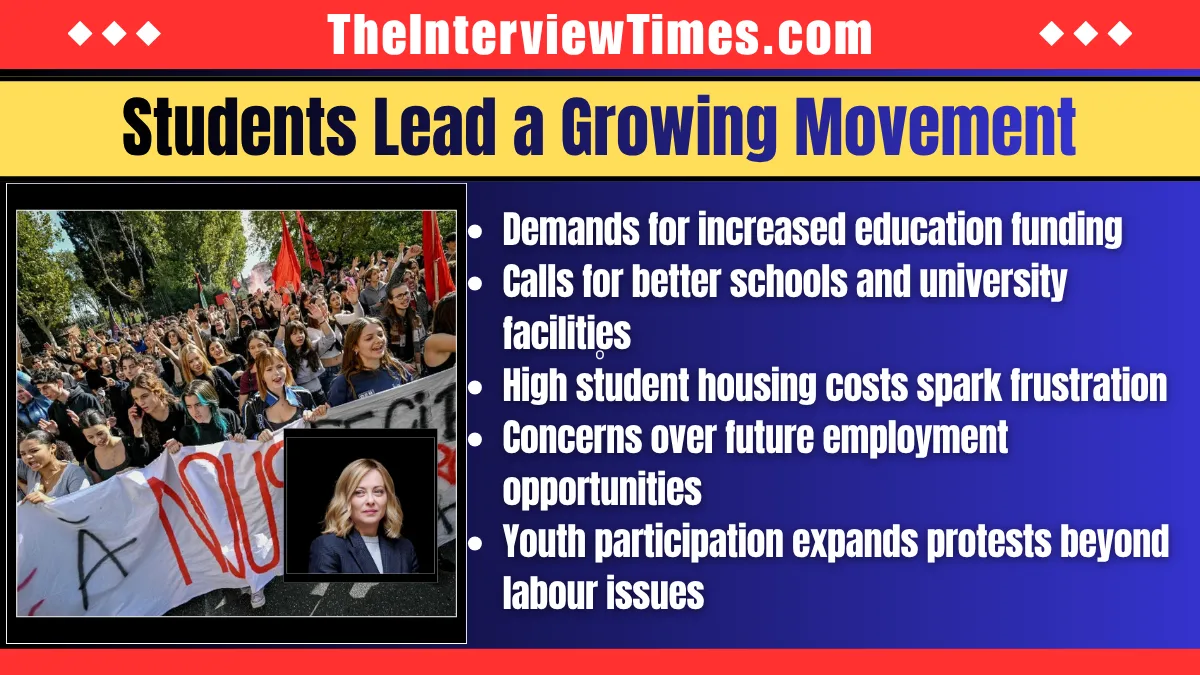
Students have become one of the most visible groups in Italy’s recent demonstrations.
Their demands include improved school infrastructure, better university facilities, increased education funding and affordable accommodation.
Some student groups have raised concerns about poorly maintained school buildings and inadequate facilities. In recent weeks, student organisations have also organised school walkouts, occupations and protest camps to draw attention to these problems.
For younger demonstrators, the issue extends beyond education. They are concerned about employment opportunities, financial independence and the ability to build a secure future.
Their participation has helped turn what might otherwise have been a conventional labour dispute into a broader social movement.
Opposition to Military Spending and Rearmament
Another major issue is opposition to increased military expenditure.
Protesters argue that public money should prioritise healthcare, education, housing and social protection rather than increased defence spending.
The debate comes at a time when European governments are reconsidering their military capabilities and defence commitments amid the war in Ukraine and wider geopolitical tensions.
Italy, as a NATO member, is part of this broader European security debate.
However, demonstrators question whether increased military investment should take priority over domestic economic and social needs.
This disagreement highlights a wider political challenge for European governments: balancing defence commitments with the expectations of citizens who want better public services and improved living standards.
Why Are Italian Port Workers Opposing Arms Shipments?
One of the most significant international dimensions of the protests involved Italy’s port workers.
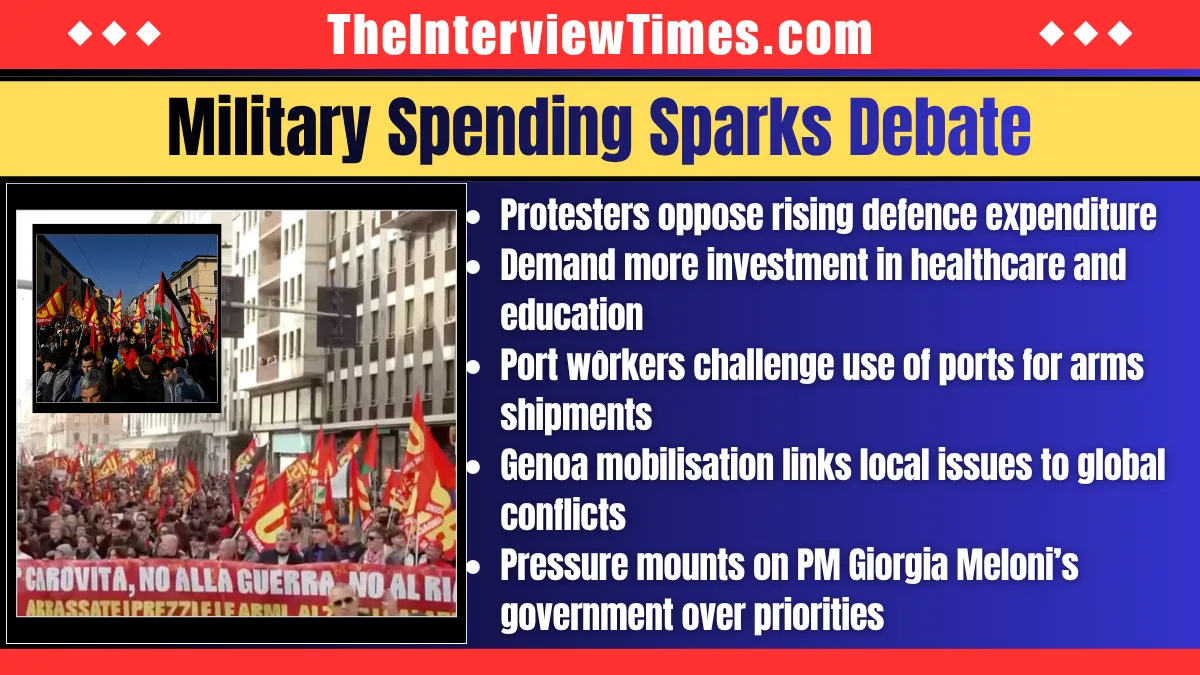
Dockworkers joined a coordinated international mobilisation opposing the use of commercial ports to transport weapons and military equipment to conflict zones.
The campaign involved trade unions across several countries, with demonstrations and industrial action reported at ports in Europe and beyond.
According to Reuters, approximately 15,000 port workers, students and other demonstrators participated in the mobilisation around Genoa’s port.
The protesters argued that civilian port infrastructure should not facilitate military operations and arms shipments connected to ongoing conflicts. They also highlighted the safety of maritime workers operating in conflict-affected regions.
The campaign connected Italy’s domestic demonstrations with a wider international debate about the arms trade, maritime transport and the role of civilian infrastructure during wars.
What Happened in Rome, Milan and Turin?
Despite the largely peaceful nature of the nationwide demonstrations, some cities witnessed confrontations.
In Rome, a large procession passed near the Colosseum. Some protesters set rubbish bins on fire, while police later used water cannons to disperse a group attempting to approach parliament. ANSA reported that eight people were detained after attempts to breach police barricades.
In Turin, police used water cannons to push back students and left-wing activists who approached security cordons protecting the prefecture building.
In Milan, demonstrators marched onto the city’s ring road before concluding their procession near Politecnico di Milano. Flares and incidents involving burning objects were also reported.
Genoa witnessed a major mobilisation around its port, where demonstrators focused on arms shipments and the role of commercial shipping infrastructure in international conflicts.
Reuters and other news agencies reported that most demonstrations remained peaceful despite isolated incidents.
Must Read: Best AI Tools for Small Business in 2026: 10 Tools Worth Paying For – theinterviewtimes.com
How Is Giorgia Meloni’s Government Being Challenged?
The demonstrations have put additional pressure on Meloni’s government over economic conditions, public services and defence policy.
The protests do not necessarily indicate an immediate political crisis, but they demonstrate the government’s challenge in responding to different groups with overlapping concerns.
The government has announced financial support for sectors affected by rising fuel prices, including truck drivers, farmers and fishermen. AFP reported an assistance package worth €175.2 million.
A proposed annual bonus of €2,500 for workers under the age of 30 has also been included in the draft 2027 budget.
However, these measures do not address every demand raised by the protesters, particularly those concerning education, housing, public infrastructure and military spending.
The central question is whether the government’s economic and social policies can ease public dissatisfaction.
Must Read: China Visa Guide 2025: Complete Application Process for Global Travellers – theinterviewtimes.com
What Happens Next?
Italy’s October 30 demonstrations have highlighted a combination of economic, social and political concerns that are unlikely to disappear quickly.
Workers want better wages and greater financial security. Students are demanding affordable education and housing, while port employees are challenging the involvement of commercial infrastructure in arms shipments.
For Meloni’s government, the challenge is to balance domestic expectations with Italy’s economic and international commitments.
The protests also form part of a wider pattern of social mobilisation across Europe, where living costs, housing affordability, employment conditions and public spending have become increasingly important political issues.
Italy’s nationwide strike was therefore about much more than one day of industrial action. It brought together different sections of society around questions concerning economic security, public investment and the country’s role in an increasingly uncertain international environment.
Whether the mobilisation produces lasting policy changes remains to be seen. But the demonstrations have made clear that these issues are now a significant part of Italy’s political debate.
Reporting Sources: Reuters, AFP, ANSA, Associated Press,