
TheInterviewTimes.com | October 5, 2026 | New Delhi
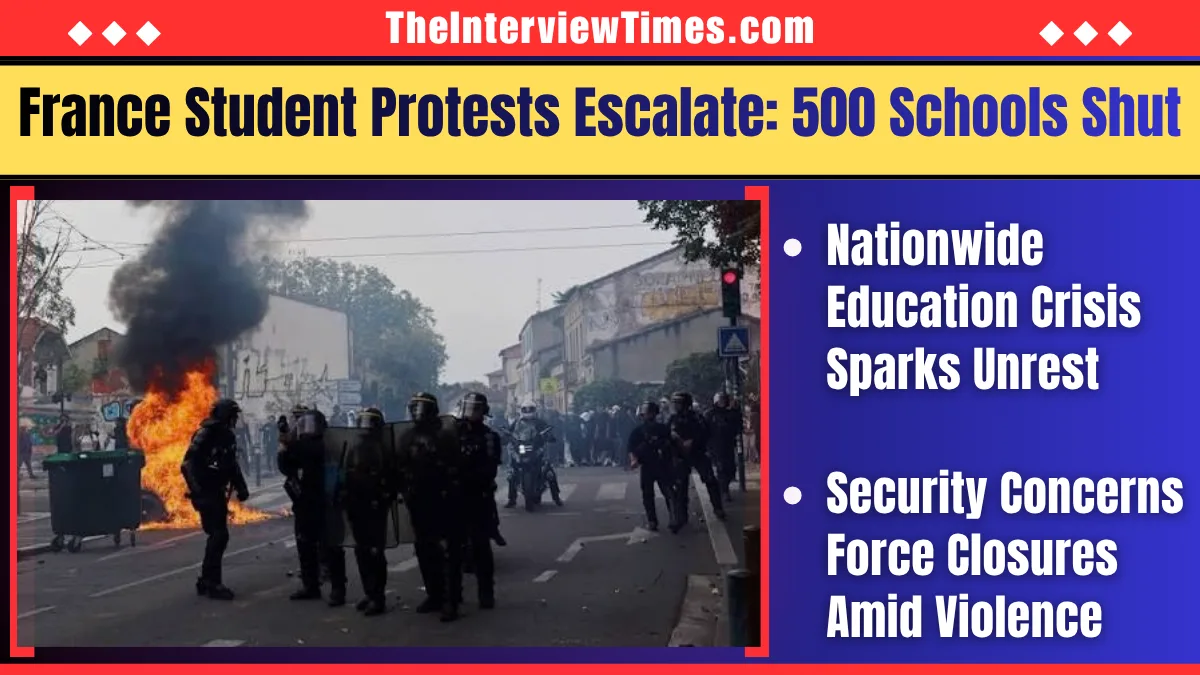
France’s student protests have spread nationwide, with up to 500 high schools closing amid teacher shortages, poor facilities and clashes.
France is facing a growing wave of high school student protests over teacher shortages, overcrowded classrooms, deteriorating school facilities and demanding school schedules. The unrest has spread from the Paris region to cities across the country, with some demonstrations escalating into clashes, vandalism and attacks.
On Monday, October 5, between 400 and 500 high schools are expected to remain fully or partially closed, according to French Education Minister Édouard Geffray. The closures are primarily being justified on security grounds following several days of protests and damage around schools.
The developments mark one of the most significant waves of high school mobilisation France has seen in years.
Why Are French Students Protesting?
The movement began in the Paris region in mid-September and was initially linked to complaints about staffing and resources at high schools. It subsequently spread nationwide.
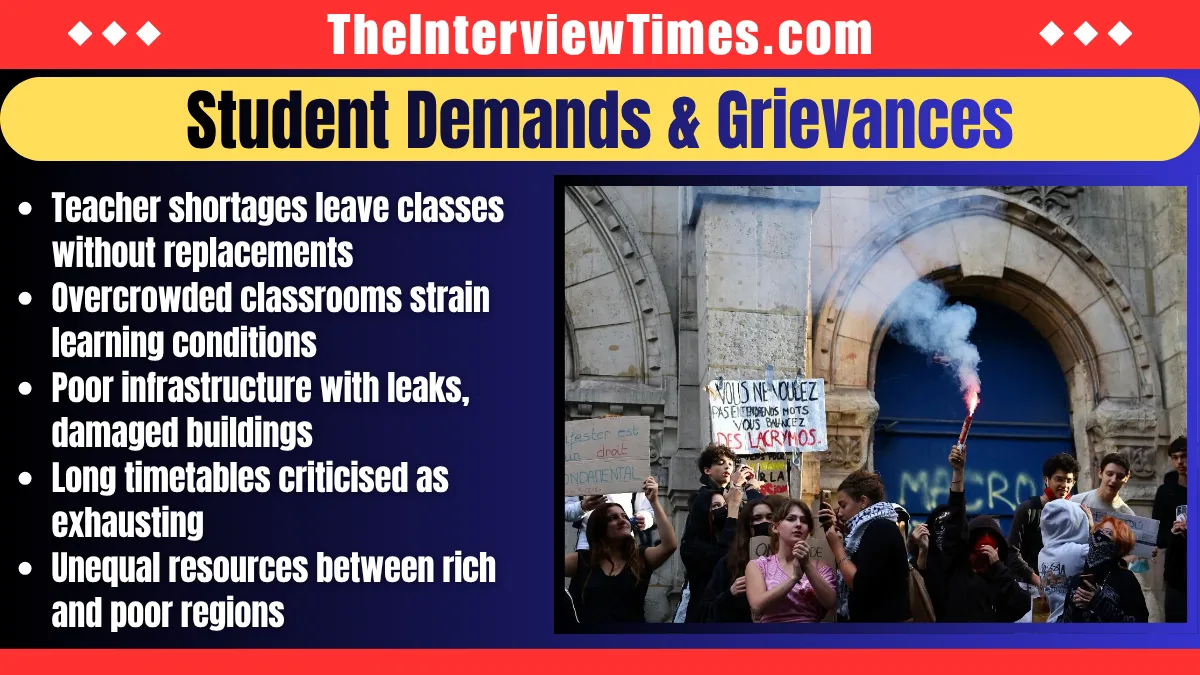
Students have raised several interconnected concerns, including:
- Teacher shortages and classes without replacement teachers when staff are absent
- Overcrowded classrooms
- Poorly maintained or inadequate school buildings
- Long school days and demanding timetables
- Concerns about unequal educational resources between different parts of France
- Pressure surrounding the country’s university admissions system
Reuters reported that protests had affected more than 1,200 high schools during the previous week, while the Education Ministry reported more than 1,000 schools affected by strikes or protests on October 1. The figures refer to schools affected by mobilisation, not schools that were necessarily closed.
The distinction is important because the much smaller figure of 400–500 schools refers specifically to establishments where classes were expected to be suspended on Monday.
How Did the Protests Begin?
The current movement emerged around September 18 at Lycée Saint-Exupéry in Créteil, southeast of Paris, amid complaints over a lack of teachers and resources.
From there, protests spread to other schools in the Paris suburbs before reaching cities across France. Demonstrations and blockades were reported in places including Paris, Marseille, Strasbourg, Lille, Tours and other urban areas.
By October 1, the Education Ministry said more than 1,020 high schools had been affected by strikes or protests, including 222 blockades. That represented roughly one in four high schools, according to Le Monde’s reporting of ministry figures.
The movement has therefore grown considerably beyond the local disputes that triggered it.
Why Are Hundreds of Schools Closing?
The French government says the immediate reason for the Monday closures is security.
Education Minister Édouard Geffray said on October 4 that lessons would be totally or partially suspended in 400 to 500 high schools where security conditions were not considered adequate.
The minister said 24 schools had been “burned or ransacked” since the beginning of the movement. He also reported that 78 education staff members had been injured.
The closures therefore should not be interpreted as 500 schools voluntarily joining a strike. The government’s announcement concerns schools where authorities believe normal classes cannot safely take place.
Some schools have instead shifted lessons online or planned a gradual return to classroom teaching when conditions permit.
More Than 5,000 Arrests Reported
The protests have also produced a major security response.
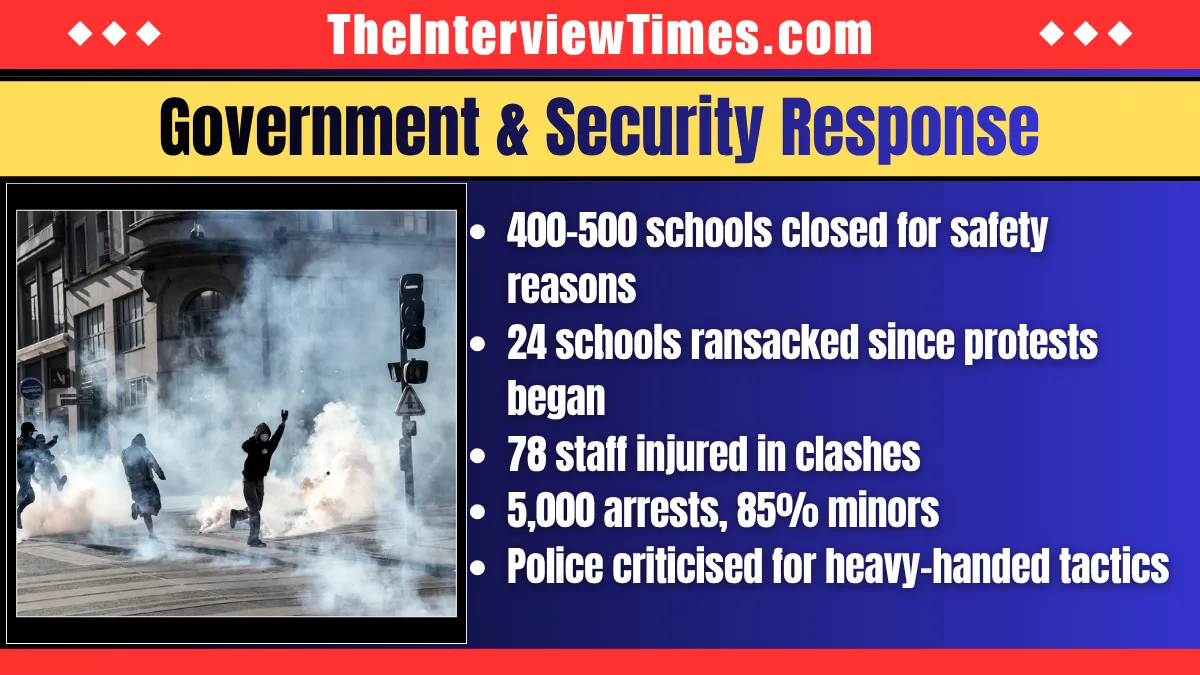
France’s Interior Ministry has reported approximately 5,000 arrests since the beginning of the previous week, with about 85% of those arrested being minors, according to Associated Press. Reuters has similarly reported more than 5,000 arrests.
Authorities have reported violence including:
- Projectiles thrown at police
- Fires involving rubbish bins and other objects
- Damage to public property
- Attempts to enter or blockade schools
- Attacks involving school staff
- Clashes between demonstrators and police
Police have used measures including tear gas, batons and non-lethal projectiles in some confrontations. Rights groups and some political figures have criticised the police response, while Interior Minister Laurent Nuñez has defended the actions of security forces and rejected accusations that police intervention has been disproportionate.
These competing claims should be distinguished from the underlying, documented fact that the protests have involved both injuries to demonstrators and attacks on police and education staff.
The Education Funding Dispute
The protests are unfolding at the same time as France debates its 2027 national budget, adding another layer to the dispute.
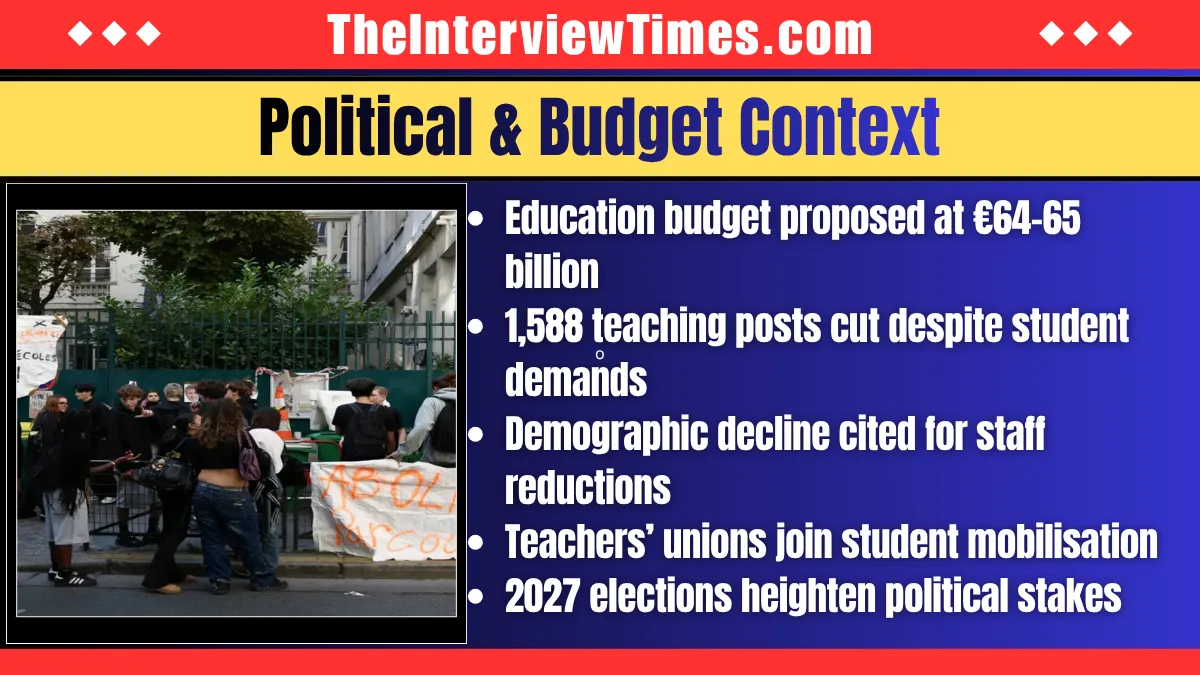
The French government has proposed increasing the Education Ministry’s budget to around €64 billion, excluding pensions, according to the Education Ministry’s budget documents. The ministry describes education as the state’s largest public-service budget and says the additional resources are intended partly to reduce class sizes and improve educational provision.
However, the proposed budget also includes reductions in some permanent teaching positions.
According to the Education Ministry’s presentation of the 2027 budget, the government plans 1,588 fewer permanent teaching positions, including 1,250 in public education. The government links the reductions to demographic change and expects around 180,000 fewer students in the school system in September 2027.
The government argues that demographic decline allows resources to be reorganised while maintaining or improving student-to-teacher ratios in some areas.
Teachers’ unions, however, have criticised the planned reductions and argued that schools need additional staff rather than fewer permanent teaching positions.
This difference in interpretation is central to the current dispute.
France’s Demographic Decline Adds Complexity
France is simultaneously dealing with a long-term decline in the number of school-age children.
The Education Ministry said the 2026 school year began with 11.6 million students and around 1.2 million education personnel across more than 55,000 locations.
The ministry expects the number of students to decline by around 1.7 million between 2025 and 2035.
This demographic trend is one reason the government says some teaching positions can be reduced without necessarily reducing the overall quality of education.
But the protests highlight a different problem: where teachers are needed and where students are concentrated may not always match national demographic trends.
Reuters reported particularly strong concerns in Seine-Saint-Denis, a relatively disadvantaged department north and northeast of Paris, where students and teachers have complained about staffing shortages, overcrowding and poor facilities.
Top News: The Arteries of the World: Maritime Chokepoints That Control Global Trade – theinterviewtimes.com
What Do Students Want?
Although the movement is not represented by a single unified political organisation, several recurring demands have emerged.
Students have called for:
More teachers:
Students complain that teacher absences are not always covered, leaving classes without instruction.
Better school infrastructure:
Some protesters have highlighted leaks, damaged buildings, inadequate furniture and uncomfortable classroom conditions.
Smaller classes:
Overcrowding is a repeated complaint, particularly in schools serving disadvantaged communities.
More manageable timetables:
Students have criticised schedules that can keep them at school from early morning until the evening.
Greater equality between schools:
Students from poorer areas argue that their schools do not always receive the same level of resources and support as schools in wealthier areas.
Changes to the wider education system:
Some protesters have also criticised the pressure surrounding university admissions and the Parcoursup system.
Government Response: Security and Dialogue
The government has attempted to combine two approaches: restoring order around schools while maintaining discussions with student and education representatives.
Education Minister Édouard Geffray has said that students’ original concerns were legitimate but that violence and attacks cannot be accepted.
The government has also ordered schools to use remote learning when damage or blockades make normal classes unsafe.
Prime Minister Sébastien Lecornu convened a crisis meeting as the protests expanded, while Interior Minister Laurent Nuñez has defended the police response.
The government has also indicated that it wants to accelerate consideration of a proposed “casseur-payeur” approach, under which those responsible for damage could face greater responsibility for repair costs.
Why the Protests Matter Beyond Education
The demonstrations are taking place at a politically sensitive moment for France.
The country is preparing for the 2027 presidential election, while the government is simultaneously trying to address its fiscal deficit and implement a cost-cutting budget.
That has turned education spending into a wider political issue.
Reuters reported that the government’s proposed 2027 education budget would rise by around 1.7% to €65.53 billion, excluding teacher pensions, while the Education Ministry’s own presentation uses a different accounting format and gives a figure of around €64 billion. The difference reflects different budget presentation methods, so the figures should not be treated as contradictory without considering the accounting basis.
For the government, the challenge is therefore twofold: responding to demands for better public services while attempting to control public spending.
Teachers Join the Movement
The student mobilisation has also attracted support from teachers’ unions.
France’s teachers’ unions have announced support for the students’ demonstrations and planned participation in Tuesday’s mobilisation. They argue that many student complaints overlap with longstanding concerns among education workers about staffing and resources.
This is potentially significant because a movement that began largely as a student protest could develop into a broader education-sector mobilisation.
A major demonstration is expected on Tuesday, October 6, with the CGT union urging workers to participate.
A Movement at a Turning Point
France’s school protests now sit at the intersection of several issues: education quality, regional inequality, public spending, policing and youth participation in politics.
The government’s immediate priority is to keep schools safe and restore classroom teaching. Students and their supporters, meanwhile, want concrete changes to staffing, facilities and the organisation of education.
The key question this week is whether the movement remains primarily focused on education or develops into a broader confrontation over government spending and public services.
For now, one fact is clear: France’s education dispute has moved far beyond a handful of school blockades.
With up to 500 high schools expected to be fully or partially closed on Monday, more than 5,000 arrests reported, dozens of injured education workers and another nationwide mobilisation planned for Tuesday, the protests have become a major national issue.
The scale of the response and the government’s ability to address the underlying educational complaints without allowing further violence will determine what happens next.