
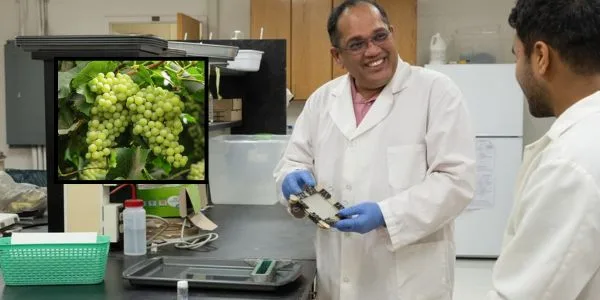
Discover how South Dakota State University scientists have created Biodegradable Packaging from Grapevine Canes, a transparent, eco-friendly plastic alternative that decomposes in 17 days, offering a sustainable solution to the global plastic crisis.
Biodegradable Packaging from Grapevine Canes – A Breakthrough in Sustainable Packaging
In a groundbreaking development, researchers at South Dakota State University (SDSU) have transformed agricultural waste into a revolutionary eco-friendly packaging solution. The innovation—Biodegradable Packaging from Grapevine Canes—offers a powerful alternative to traditional plastics. This new material is strong, transparent, and fully decomposes in soil within just 17 days, significantly reducing environmental damage.
The project, led by Associate Professor Srinivas Janaswamy from SDSU’s Department of Dairy and Food Science and Distinguished Professor Anne Fennell from the Department of Agronomy, Horticulture and Plant Science, taps into the potential of grapevine canes—an agricultural byproduct normally discarded, burned, or composted. Packed with nearly 35% cellulose, these canes serve as the primary raw material for producing Biodegradable Packaging from Grapevine Canes.
From Vineyard Waste to Sustainable Solution
To create Biodegradable Packaging from Grapevine Canes, the research team extracted cellulose through alkaline and bleaching treatments. This cellulose was then dissolved in zinc chloride, crosslinked with calcium ions, and plasticized using glycerol. The result? Transparent films that boast a tensile strength of 15.42 to 18.20 MPa, comparable to or exceeding that of commercial low-density polyethylene plastic bags.
With a transparency level of around 84%, Biodegradable Packaging from Grapevine Canes ensures that food products remain visually appealing on store shelves, making it ideal for the retail and food packaging industries.
“This high level of transparency allows consumers to inspect products easily without unsealing the package, while also making them more attractive to buyers,” explained Janaswamy.
A Step Toward Tackling the Plastic Pollution Crisis
Globally, only 9% of plastic waste is recycled, while microplastics have infiltrated oceans, soil, air—and even human bodies. An estimated 13 million metric tons of plastic enter natural environments every year. Biodegradable Packaging from Grapevine Canes directly addresses this crisis by providing a scalable, fully compostable alternative that leaves no harmful residue.
The project also makes economic sense. Farmers currently spend an average of $26 per ton to dispose of grapevine waste. Repurposing this into Biodegradable Packaging from Grapevine Canes could turn waste disposal costs into a profitable revenue stream.
Rising Demand for Biodegradable Packaging from Grapevine Canes
The global biodegradable packaging industry is set to hit $1.4 billion by 2026, fueled by growing environmental awareness and stricter regulations. Corporations such as Nestle and Mars Wrigley have already begun making changes, with Nestlé’s Smarties brand switching to recyclable paper packaging—cutting plastic use by 250 million packs annually.
Supported by the U.S. Department of Agriculture’s National Institute of Food and Agriculture and the National Science Foundation, Janaswamy’s work with Biodegradable Packaging from Grapevine Canes is just one part of his ongoing research. His team has also developed biodegradable films from avocado peels, coffee grounds, and banana peels—further proving the potential of agricultural waste in creating plastic alternatives.
Must Read: Earth’s Freshwater Crisis: A Dire Threat to Billions in 2025
The Future of Sustainable Packaging
Biodegradable Packaging from Grapevine Canes represents an important milestone for sustainable manufacturing. If adopted widely, this technology could drastically cut down the use of petroleum-based plastics, help fight climate change, and reduce pollution in oceans and landfills.
By turning vineyard waste into a product that benefits both the environment and the economy, South Dakota State University has created a model for future innovations in eco-friendly materials.
For more inspiring stories on sustainability breakthroughs follow TheInterviewTimes.com — your trusted source for environmental news and green innovation.