

If the U.S. stops outsourcing to India, millions of jobs and billions in revenue could be lost. But America too risks higher costs and weaker competitiveness. A detailed analysis.
The debate over outsourcing has once again resurfaced in Washington’s policy circles, with growing concerns that the United States may take steps to reduce or even halt its dependence on India’s service sector. Such a move, if implemented, would have seismic consequences on both economies—though the pain would be distributed very differently.
India’s Heavy Dependence on U.S. Outsourcing
India’s Information Technology and Business Process Management (IT-BPM) industry has long been described as the “back office of the world.” Valued at nearly $283 billion, it employs more than 5.7 million professionals and contributes close to 7–8% of India’s GDP.
The U.S. is the single largest client, accounting for 50–60% of total sector revenues. This means that if American companies suddenly shut the outsourcing tap, India could lose well over $100 billion annually in direct revenue.
The job impact would be equally staggering. From Bengaluru to Gurugram, millions of employees—particularly in call centers, software services, and customer support—are directly tied to U.S. contracts. Analysts estimate that 2–3 million jobs could be at immediate risk, with a ripple effect on urban consumption, housing, retail, and even banking. The IT corridors of Bengaluru, Hyderabad, and Pune would likely face the sharpest shocks.
Must Read: Meta Hires Contractors to Build Hindi AI Chatbots at $55 an Hour
America’s Dilemma: Jobs vs. Costs
At first glance, ending outsourcing might look like a win for U.S. workers. Some service-sector jobs would indeed be “reshored.” Historically, offshoring to India has displaced 150,000–300,000 American jobs annually, particularly in IT services and customer support.
But the benefits may be short-lived. Outsourcing has allowed U.S. corporations to cut costs by up to 40–60%, freeing resources for research, product development, and global expansion. Without this cost advantage, companies could face rising operational expenses. For consumers, this might translate into higher prices for software, digital services, and even banking and telecom operations that rely heavily on Indian back-end support.
Moreover, the U.S. labor market is not perfectly equipped to absorb all these roles. Many of the jobs outsourced to India are high-volume, repetitive processes that American workers are less inclined to take up unless wages rise dramatically. That, in turn, could erode corporate margins.
Must Read: Mental Health at Work: How Stress Affects Productivity and How to Manage It
Structural Shifts: AI and the Future of Outsourcing
Even without U.S. intervention, India’s outsourcing sector is already under stress. Artificial Intelligence (AI) and automation are transforming the global services industry. Tech giants like TCS and Infosys have started reducing headcounts as routine call-center and coding tasks are increasingly automated. Reuters recently reported that TCS alone cut 12,000 jobs, citing AI-driven restructuring—an early sign of the storm ahead.
In this context, a U.S. withdrawal would accelerate an already painful transition for India. The country would be forced to move up the value chain, focusing on cloud computing, cybersecurity, advanced analytics, and AI-driven solutions rather than low-end BPO services.
The Broader Economic Fallout
For India:
- Loss of foreign exchange earnings on a scale comparable to a major export ban.
- Urban unemployment crisis, particularly among graduates trained for IT and BPO jobs.
- Potential slowdown in GDP growth, as IT-BPM is one of India’s strongest export pillars.
- Regional disparities, with southern states like Karnataka, Telangana, and Tamil Nadu hit the hardest.
For the U.S.:
- Short-term job gains in customer service and IT support, but limited in scale.
- Higher corporate costs, weakening competitiveness against European and Asian rivals.
- Reduced agility for tech giants that have long depended on India’s flexible, 24/7 service model.
- Consumer price hikes, especially in industries where margins are thin and back-end outsourcing plays a vital role.
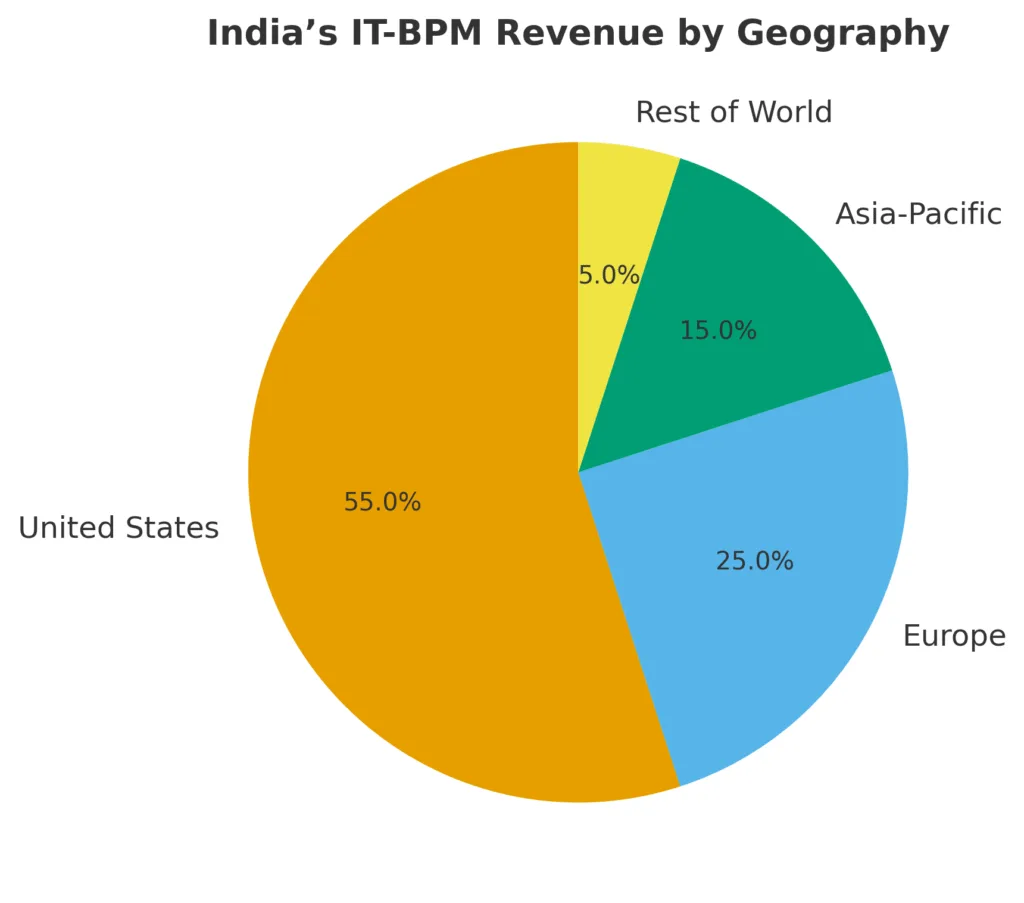
India’s IT-BPM Revenue by Geography shows how over half of India’s IT revenue depends on the U.S.
Source: NASSCOM Industry Reports, 2024; FT & Reuters estimates
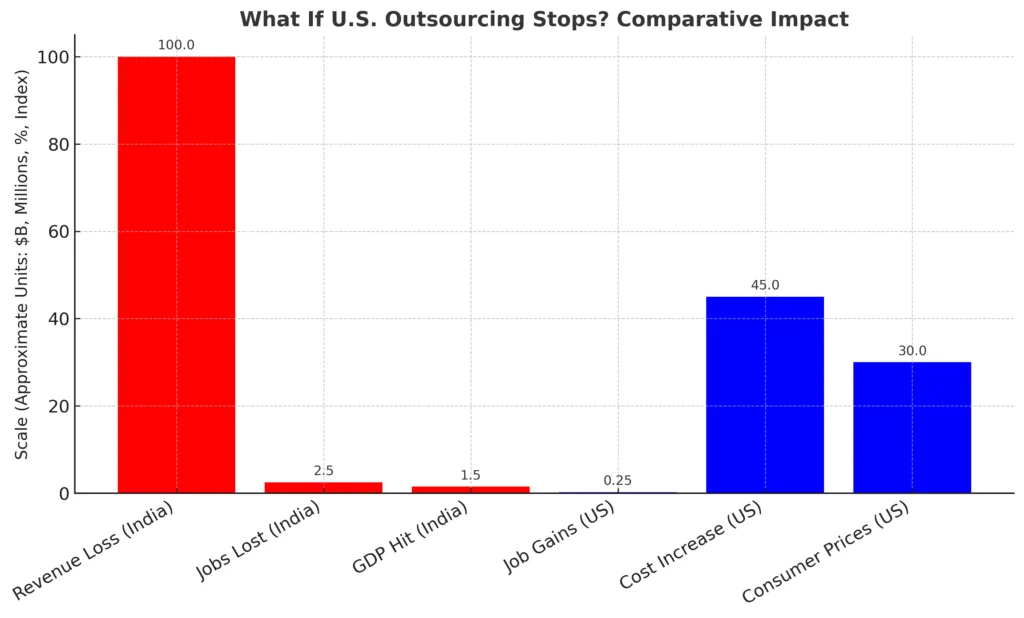
Comparative Impact if U.S. Outsourcing Stops: Clearly highlights that India faces massive losses (revenue, jobs, GDP), while the U.S. only sees modest job gains but higher costs.
Source: Industry estimates based on NASSCOM, Reuters, Washington Post, WSJ, FT (2024–2025)
A Relationship of Mutual Dependence
Ultimately, outsourcing has been less a one-way street and more a mutual dependence. For over three decades, U.S. companies have relied on India’s vast talent pool to remain globally competitive, while India has relied on U.S. contracts to fuel its service-led growth story.
If America truly halts outsourcing, India will bear the brunt in the short term, with millions of jobs and billions in revenue at stake. But the U.S. too risks paying a hidden price: higher costs, slower innovation, and reduced competitiveness.
The bigger question may not be whether outsourcing ends, but how both nations adapt to the twin pressures of protectionism and automation. In that battle, flexibility—not withdrawal—may decide who comes out stronger.