
President Trump ends a 33-year moratorium on nuclear weapons testing, alarming global powers and raising fears of a renewed arms race.
TheInterviewTimes.com | New Delhi | October 30, 2025 — In a move that has stunned the international community, U.S. President Donald Trump has ordered the United States to resume nuclear weapons testing, officially ending a 33-year moratorium that began in 1992.
The decision has triggered widespread condemnation from global leaders, arms control experts, and nuclear watchdogs who warn that it could reignite a dangerous global arms race.
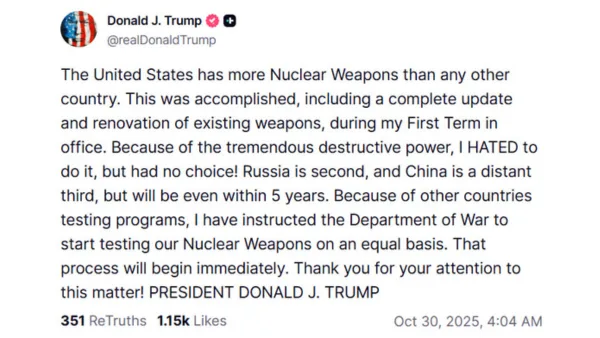
The announcement came through Trump’s Truth Social post, where he declared,
“Because of other countries’ testing programs, I have instructed the Department of War to start testing our Nuclear Weapons on an equal basis. That process will begin immediately.”
The post appeared just hours before Trump’s high-profile meeting with Chinese President Xi Jinping in South Korea, adding new geopolitical friction to already tense diplomatic and trade negotiations.
Global Shock Over U.S. Nuclear Weapons Testing Decision
The decision marks a significant reversal of long-standing U.S. nuclear policy. Since the end of the Cold War, nuclear weapons testing has been largely halted worldwide under the spirit of the Comprehensive Nuclear-Test-Ban Treaty (CTBT), though the treaty has yet to be ratified by several major powers including the United States and China.
No major nuclear power, aside from North Korea, has conducted an explosive nuclear test in more than three decades. The last U.S. test occurred in 1992, Russia’s in 1990, and China’s in 1996. Trump cited recent Russian tests of delivery systems — including the Poseidon nuclear-powered underwater drone and Burevestnik cruise missile — as justification.
However, experts emphasize these are weapons delivery tests, not nuclear detonations, and do not breach current international moratoria.
Must Read: Trump Xi Deal: Tactical Trade Breakthrough Sparks Cautious Optimism in Global Markets
Russia and China Respond Strongly
Kremlin spokesperson Dmitry Peskov reacted sharply, warning that Moscow would “act accordingly” if Washington proceeds with nuclear weapons testing. “If someone departs from the moratorium, Russia will respond accordingly,” Peskov stated, stressing that Moscow’s recent tests involve conventional, not nuclear, technologies.
Meanwhile, China’s Foreign Ministry urged the United States to “abide by its obligations under the Comprehensive Nuclear-Test-Ban Treaty” and maintain “global strategic stability.” Beijing warned that the U.S. move risks dismantling decades of progress toward non-proliferation.
Experts Warn of Dangerous Precedent
Arms control specialists have condemned the move as reckless and shortsighted. Daryl Kimball, executive director of the Arms Control Association, said that reviving nuclear weapons testing could trigger “a dangerous domino effect,” prompting other nuclear states to follow suit.
“This could undo 30 years of restraint and lead to new waves of nuclear escalation,” Kimball warned, adding that the Nevada test site — where the last U.S. underground test was conducted — would require years of reactivation before any detonation could occur safely.
The decision also coincides with the upcoming expiration of the New START Treaty in February 2026, the last major arms control agreement between the United States and Russia.
Analysts fear the timing could further erode global nuclear security frameworks at a particularly fragile moment for international diplomacy.
Confusion Over Implementation and Policy Goals
When questioned about logistical details, Trump offered few specifics, seemingly confusing missile system testing with nuclear weapons testing. He stated that “testing sites will be determined later,” providing no clear roadmap or timeline for the first detonation. The ambiguity has added to the growing anxiety within the scientific and diplomatic communities.
Critics argue that Trump’s order represents not only a policy shift but a symbolic rejection of decades of bipartisan commitment to nuclear restraint. It also risks legitimizing future tests by states like North Korea and undermining diplomatic pressure on Iran’s nuclear ambitions.
Global Implications and Future Outlook
The resumption of nuclear weapons testing would mark the first such U.S. detonation since 1992, carrying enormous implications for global security. It could undermine international trust, destabilize arms control mechanisms, and open a new chapter of nuclear brinkmanship among major powers.
With the nuclear weapons testing order coming amid rising global tensions and waning arms control agreements, experts warn the world is entering an uncertain era. The coming months will determine whether diplomatic pressure or international consensus can prevent a return to the volatile nuclear competition of the past.