
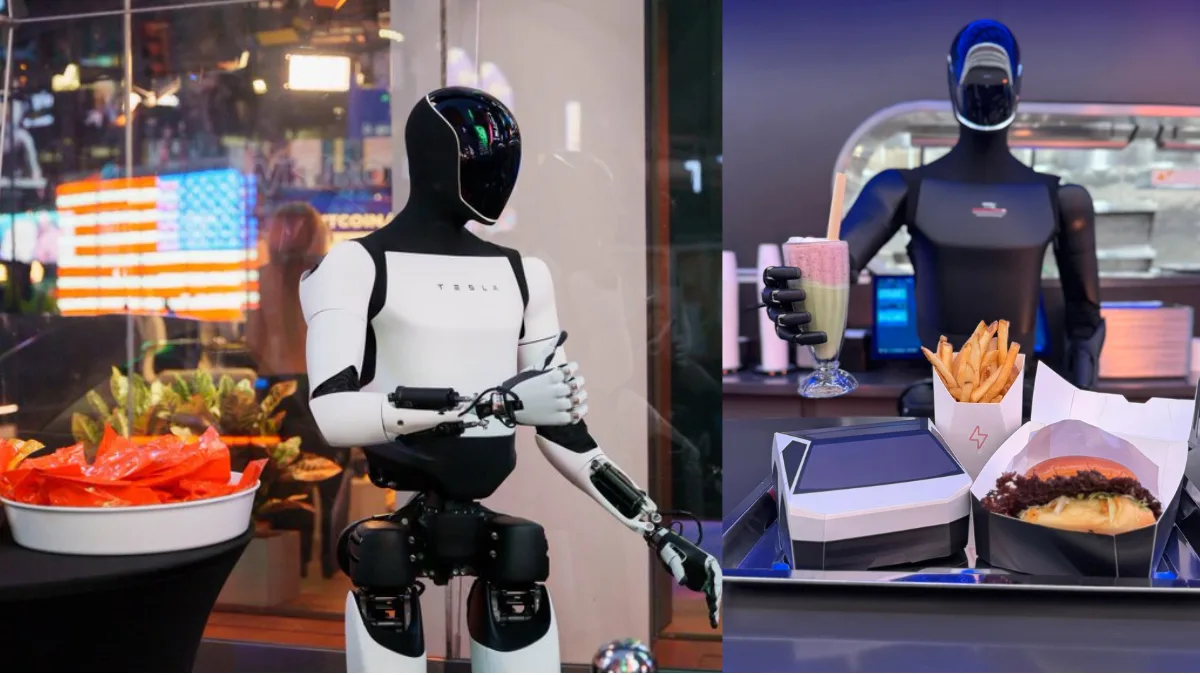
Humanoid Robot Optimus is Elon Musk’s most ambitious technological project, promising to eliminate poverty, automate global labor, and enable mind-machine integration while reshaping medicine, manufacturing, and the future of humanity.
Introduction: Why Humanoid Robot Optimus Matters Now
TheInterviewTimes.com | November 17, 2025: Elon Musk’s Humanoid Robot Optimus has rapidly evolved from a sci-fi dream to a real-world technological force shaping the next era of artificial intelligence, robotics, and human labour.
At a recent Tesla shareholder meeting, Musk made sweeping predictions—claiming Optimus would “eliminate poverty,” create “universal high income,” and even support digital immortality through mind uploads.
These bold claims have sparked global debate. This in-depth explainer examines the origins, capabilities, breakthroughs, risks, economics, and future of the Humanoid Robot Optimus.
Poptimus pic.twitter.com/pu8MxEoDJz
— Tesla Optimus (@Tesla_Optimus) September 6, 2025
The Origin Story: From Tesla Bot Sketch to Global Industrial Vision
The journey of Humanoid Robot Optimus began in August 2021 during Tesla’s first AI Day. Musk introduced the concept as a simple outline—then known as “Tesla Bot.” Its mission: handle “unsafe, repetitive, or boring” tasks that dominate factories and routine environments.
Momentum accelerated after 2022. Early prototypes demonstrated basic walking and hand movement. By 2023, Optimus Gen 2 arrived with smooth mobility, advanced grip, and improved balance, including tasks such as sorting objects and pouring drinks.
In 2024, Optimus crossed a historic milestone—autonomous deployment in Tesla factories, performing battery handling and assembly tasks without human teleoperation.
By late 2025, production was underway, with Gen 3 preparing for mass manufacturing in 2026. Musk’s ambition: one million robots per year, making Optimus Tesla’s largest revenue engine.
Optimus will eliminate poverty and provide universal high income for all https://t.co/ZfKSOuQvrq
— Elon Musk (@elonmusk) November 16, 2025
Design and Engineering: Built to Navigate Human Spaces
The Humanoid Robot Optimus design philosophy is simple—mirror human form so it works anywhere humans do.
Key Physical Specs
- Height: 5’8″ (173 cm)
- Weight: 125 lbs (57 kg)
- Payload: 45 lbs (20 kg)
- Speed: 5 mph walking
- Degrees of Freedom: 28
- Sensors: Eight cameras + force sensors
- Power: AI5 inference chip (approx. 250W)
- Battery: Full day of mixed-use tasks
Tesla’s V3 hands—featuring 25 actuators per arm—deliver fine-motor control for precision tasks, from folding clothes to threading a needle.
Optimus relies on Tesla’s vision-based FSD technology, giving it real-time awareness, gait control, and environmental prediction without Lidar.
Must Read: AI in Healthcare 2025: How Artificial Intelligence Is Redefining Diagnosis and Treatment
Capabilities and Real-World Demonstrations
By mid-2025, Optimus was no longer just walking; it was performing human-grade tasks with grace.
Notable Demonstrations
- Autonomously folding laundry
- Performing Kung Fu movements
- Dancing and gesture-based interaction
- Pouring liquids without spillage
- Engaging socially at public events
- Working in Tesla factories across multiple stations
Tesla’s vehicle fleet provides a data moat unmatched globally—500 years of training video per day fuels Optimus’ decision-making models. Alongside this, Tesla uses Gaussian Splatting and a neural simulator to rapidly generate synthetic training environments.
Hand production costs are dropping sharply—from $80k to under $10k, enabling mass-market affordability.
True @Tesla_Optimus https://t.co/iNpZKIJa39
— Elon Musk (@elonmusk) May 19, 2025
The Neural Brain: Tesla’s End-to-End AI Advantage
At the heart of Humanoid Robot Optimus is Tesla’s unified end-to-end neural network, shared across FSD, Robotaxi, and robotics.
Key AI Characteristics
- Predictive video-based learning
- Real-time multi-modal processing
- Zero-rigid programming architecture
- Natural language interaction
- Automated path planning and error correction
Tesla’s AI roadmap includes upcoming AI6, AI7, and AI8 chips, with AI8 teased as “mind-blowing.”
Future clusters like Cortex 2 will train Optimus for surgeon-level precision and massive task generalization.
Elon Musk’s Vision: A Future Liberated by Robots
Musk’s views on Humanoid Robot Optimus are sweeping in scale.
Economic Impact
- Full global automation could end material scarcity.
- Working could become optional.
- Countries with aging populations (Japan, South Korea, Europe) gain massive labor support.
Medical Revolution
Optimus could act as:
- a surgical partner
- a home-care nurse
- a remote precision operator
Social Governance
Musk has even suggested non-lethal “robot companions” for criminal rehabilitation rather than prisons.
Transhumanism
Perhaps Musk’s most controversial prediction:
human consciousness uploaded into Optimus bodies, enabling digital immortality.
Must Read: Project Suncatcher: Google’s Bold Step Toward In-Space AI Computing
Production, Costs, and Global Rollout Timeline
Tesla’s pilot line in Fremont is producing early units for internal use. Commercial sales are targeted for 2026, priced around $20,000–$30,000, cheaper than a car.
Projected volumes:
- 2026: Tens of thousands
- 2027: Hundreds of thousands
- 2028+: One million+ units annually
Revenue potential exceeds $20–30 billion in the early rollout phase, with long-term potential far higher.
Challenges, Risks, and Ethical Dilemmas
Despite enormous potential, Humanoid Robot Optimus faces major hurdles.
1. Competition from China
Chinese firms like Unitree and Fourier Intelligence are flooding markets with low-cost humanoids.
China added 295,000 robots in factories last year versus just 34,000 in the U.S.
2. Security Threats
A 2025 global assessment found that humanoids could be exploited for:
- surveillance
- cyber-physical attacks
- infrastructure manipulation
3. Economic Displacement
While Musk promises universal high income, critics worry about:
- job loss
- widening inequality
- delayed policy responses
4. Musk’s Reputation for Optimistic Timelines
From Full Self-Driving to Mars missions, Musk’s schedules often slip. Some expect Optimus to face similar delays.
5. Control of Robot Armies
Musk himself flagged the biggest concern:
Who controls the robots—and how securely?
Optimus pilot production line is currently running in our Fremont Factory
— Tesla (@Tesla) November 6, 2025
Significantly larger Gen 3 production line coming in 2026
We're also testing in our factories & office spaces for real-time use case
Our goal is $20k COGS per robot at scale pic.twitter.com/WAfdcdt0Ue
The Future: Humanoid Robot Optimus as Humanity’s Companion
Whether viewed as a technological miracle or a societal disruptor, the Humanoid Robot Optimus represents a paradigm shift.
If Musk’s vision holds, Optimus will:
- free humanity from labor
- revolutionize healthcare
- reshape economies
- extend human consciousness beyond the biological body
The debate now is not if humanoid robots will change humanity, but how fast—and who shapes the rules.
Key Takeaways
- Humanoid Robot Optimus is Tesla’s flagship robotics project, aimed at mass automation.
- It could transform labor, medicine, manufacturing, and the global economy.
- Tesla’s AI-first approach gives Optimus an advantage over traditional industrial robots.
- Ethical, economic, and security challenges must be addressed before full adoption.
- Optimus may redefine life itself—from work to longevity to human identity.