
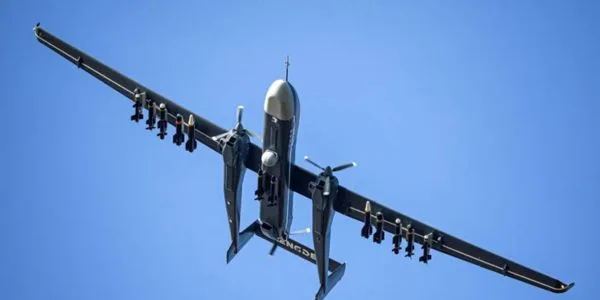
China is developing a futuristic hypersonic drone carrier using a revolutionary scissor-wing design, capable of Mach 5 speeds and swarm drone deployment. The breakthrough could transform global defense strategies and reshape air warfare.
China Unveils Futuristic Hypersonic Drone Carrier
In a striking revival of a decades-old aerospace experiment, Chinese defense engineers are working on a groundbreaking hypersonic drone carrier based on NASA’s forgotten “scissor wing” concept from the 1970s. If successful, the futuristic aircraft could travel at speeds exceeding Mach 5 while deploying swarms of drones deep into contested enemy airspace — a capability that could dramatically transform the dynamics of modern aerial warfare.
A Forgotten Design, Reinvented
The breakthrough lies in the carrier’s oblique or scissor wing mechanism. Unlike conventional aircraft, which are forced to compromise between low-speed stability and high-speed efficiency, this design employs a single wing mounted at the center of the fuselage. The wing can rotate up to 90 degrees, allowing the aircraft to reconfigure itself mid-flight.
- At takeoff and low speeds, the wing remains perpendicular to the fuselage, maximizing lift for stability.
- Around Mach 1, the wing swings to 45 degrees, redistributing airflow to reduce drag and turbulence.
- At Mach 5 and beyond, the wing aligns nearly parallel to the fuselage. In this orientation, the craft transforms into a “waverider”, harnessing shockwaves beneath its body to generate lift more efficiently while conserving fuel.
This aerodynamic flexibility could overcome many of the historic challenges that have plagued hypersonic aircraft, such as maintaining stability, controlling drag, and managing fuel efficiency.
Must Read: Uranus Hidden Heat: Scientists Uncover the Ice Giant’s Secret Warmth
Military Edge of the Hypersonic Drone Carrier
Where this technology stands out is not just in speed, but in its payload potential. According to reports, China’s hypersonic carrier is designed to launch multiple autonomous drones during flight. These drones could be deployed for long-range reconnaissance, electronic warfare, or even precision strikes — roles that become far more threatening when launched from a platform moving at hypersonic velocity.
Such a concept aligns with China’s expanding focus on “swarm warfare”, in which large numbers of drones overwhelm and confuse enemy defense systems. Traditional missile defense radars and interceptors, already struggling against hypersonic threats, would face an exponentially more difficult task if swarms of drones are released close to their airspace.
Overcoming Technical Challenges
For decades, hypersonic flight has remained an elusive goal due to overwhelming thermal and structural stresses. Traveling at Mach 5 or more generates extreme temperatures that can melt metals and fatigue traditional aerospace materials. Chinese engineers are reported to be experimenting with advanced ceramic composites, heat-resistant alloys, and cutting-edge fuel systems to ensure survivability at such breakneck speeds.
Propulsion is another key hurdle. To transition from takeoff to hypersonic cruising, engineers are believed to be testing hybrid concepts involving turbojet, ramjet, and scramjet technologies. The challenges are monumental — but the payoff could be an aircraft capable of crossing global distances in under two hours while carrying a suite of autonomous strike assets.
Must Read: Alibaba Accio Agent: World’s First AI-Powered Tool to Transform Global Trade
Global Implications of the Hypersonic Drone Carrier
The development comes at a time when nations across the world are investing heavily in hypersonic platforms. The United States, for example, is advancing its reusable Talon-A series, while Russia has showcased its Avangard hypersonic glide vehicle and Kinzhal missile system. Yet China’s proposed design stands out because of its dual capability: speed and drone deployment.
Defense analysts warn that this combination could create a new strategic deterrent. Conventional fighters or even next-generation stealth bombers might find themselves vulnerable to swarms of fast-moving drones appearing suddenly within their airspace, launched from a mothership that itself is nearly impossible to intercept.
For global security, this signals a new phase in the arms race. Countries may need to accelerate development of AI-driven air defense systems, hypersonic interceptors, and directed-energy weapons to keep pace with these aerial innovations.
The Future Battlefield and Hypersonic Drone Carriers
While the timeline for operational deployment remains uncertain — with experts noting that full-scale production could take years — the very fact that China has revived and advanced a 40-year-old American experiment underlines the geopolitical intensity of current aerospace competition.
If realized, the hypersonic drone carrier could be more than just an engineering marvel. It could reshape the rules of the battlefield, offering nations not only speed and stealth, but the ability to project power through autonomous swarms across continents.
As the race for hypersonic supremacy accelerates, one thing is clear: the skies of future warfare will be dominated not just by who flies faster, but by who can deploy smarter — and in greater numbers.