
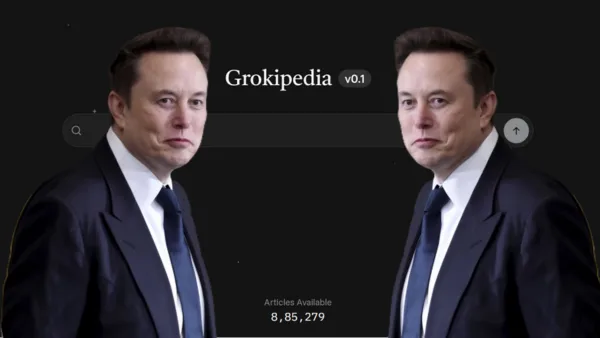
Elon Musk’s xAI launches Grokipedia, an AI-powered encyclopedia challenging Wikipedia with real-time updates and a bold “truth-seeking” mission.
Elon Musk Grokipedia Launch Sparks Global Debate
New Delhi | October 24, 2025 | The Interview Times— In a move shaking up the digital knowledge landscape, Elon Musk’s xAI has unveiled Grokipedia, an AI-powered encyclopedia positioned as a “truth-seeking” alternative to Wikipedia. The platform went live on October 27, 2025, under the domain grokipedia.com, marking Musk’s most ambitious foray yet into information technology and artificial intelligence.
A New Vision for Online Knowledge
The Elon Musk Grokipedia project represents xAI’s attempt to create a self-learning, bias-free information hub that updates in real-time. Described as “Wikipedia without human filters,” it uses xAI’s Grok chatbot to generate, edit, and fact-check entries based on live internet data streams, including verified posts from X (formerly Twitter).
Musk, who previously criticized Wikipedia for its “left-wing bias” and reliance on “legacy media propaganda,” said Grokipedia aims to restore “balance and factual integrity” to the web. In September 2025, he called on users to “defund Wikipedia” until it “stops censoring truth.”
Nice work by the @xAI team on https://t.co/op5s4ZiSwh!
— Elon Musk (@elonmusk) October 28, 2025
The goal here is to create an open source, comprehensive collection of all knowledge.
Then place copies of that etched in a stable oxide in orbit, the Moon and Mars to preserve it for the future.
Foundation.
Must Read: Japanese PM Nominates Trump for Nobel Peace Prize 2026: ‘A Golden Age’ of Partnership
Grokipedia vs Wikipedia: AI Versus Human Collaboration
At launch, Elon Musk Grokipedia contained 885,000 AI-generated articles—far fewer than Wikipedia’s 7.1 million English entries—but Musk claims the database will expand rapidly through automation. The site’s tagline, “Maximum Truth-Seeking,” underlines its core philosophy: delivering “what’s really happening” without editorial bottlenecks.
Early adopters on X praised Grokipedia’s balanced take on controversial topics, such as the George Floyd entry, which some users called “more objective” than Wikipedia’s.
However, the Elon Musk Grokipedia debut was not without issues. The website briefly crashed due to heavy traffic, and analysts found several entries mirroring Wikipedia’s text, sparking debates about originality and data sourcing. Musk responded by promising to “scrub Wikipedia traces” from Grok’s training data by year’s end.
Must Read: OpenAI Offers Free ChatGPT Go Subscription in India for One Year Starting November 4, 2025
Criticism from Wikimedia and Media Outlets
The Wikimedia Foundation, which runs Wikipedia, quickly pushed back. In a statement, it said, “Wikipedia’s knowledge is human. AI projects like Grokipedia rely on this human-created base to function.”
Forbes and other outlets pointed out the irony: while Elon Musk Grokipedia seeks independence from human bias, it might amplify the very biases embedded in AI datasets. Critics also noted factual inaccuracies, including false references involving Vivek Ramaswamy.
Must Read: SBI Recruitment 2025: State Bank of India to Hire 18,000 Employees by March 2026
Musk’s Ideological Battle for Truth
The Elon Musk Grokipedia project is also part of a larger ideological battle over control of information. Musk has long feuded with Larry Sanger, Wikipedia’s co-founder, who shares similar concerns about bias in digital encyclopedias.
Reactions on X were polarized—some users hailed Grokipedia as “the future of factual knowledge,” while others dismissed it as a “truth silo for Musk loyalists.”
AI researcher Ryan McGrady from the University of Massachusetts Amherst contextualized the launch: “The impulse to control knowledge is as old as civilization itself. Musk’s Grokipedia is the latest chapter in that struggle.”
AI-Driven Knowledge: Future or Fiction?
Whether Elon Musk Grokipedia becomes a credible information resource or a cautionary tale remains to be seen. Experts warn that while AI-driven content can accelerate access to knowledge, it risks recycling existing biases from its data sources.
With Grokipedia pulling live data from X, questions persist about reliability, editorial transparency, and accountability—core values long upheld by Wikipedia’s volunteer-driven model.
Musk’s Vision: A Declaration of “Truth”
Elon Musk remains defiant in his pursuit of what he calls the “whole truth.” In a recent post, he wrote:
“The goal of Grok and Grokipedia is the truth, the whole truth, and nothing but the truth. We will never be perfect, but we will strive toward that goal.”
As Elon Musk Grokipedia evolves, it could redefine how humanity interacts with knowledge—fusing AI speed with ideological intent. Whether it dethrones Wikipedia or becomes another experiment in digital truth, Musk has once again ensured that the conversation revolves around him.
Must Read: India e-Arrival Card 2025 for Foreigners: Step-by-Step Process, Rules, and Key Benefits