

New Delhi, January 19, 2026, 10 a.m. IST
The European Union prepares a 93 billion euro retaliation package after Donald Trump threatens tariffs on allies over Greenland, freezing a key US-EU trade deal.
The European Union is bracing for a potential trade war after US President Donald Trump threatened sweeping tariffs on key European allies unless they support his push to purchase Greenland from Denmark. The escalation has prompted Brussels to consider retaliation worth up to 93 billion euros, putting a fragile US-EU trade agreement at serious risk just days before global leaders gather in Davos.
What began as a geopolitical dispute has rapidly turned into an economic showdown, raising fears of a deep transatlantic rift at a time when unity is already strained by global security and trade pressures.
Trump Tariff Threats Spark Transatlantic Crisis
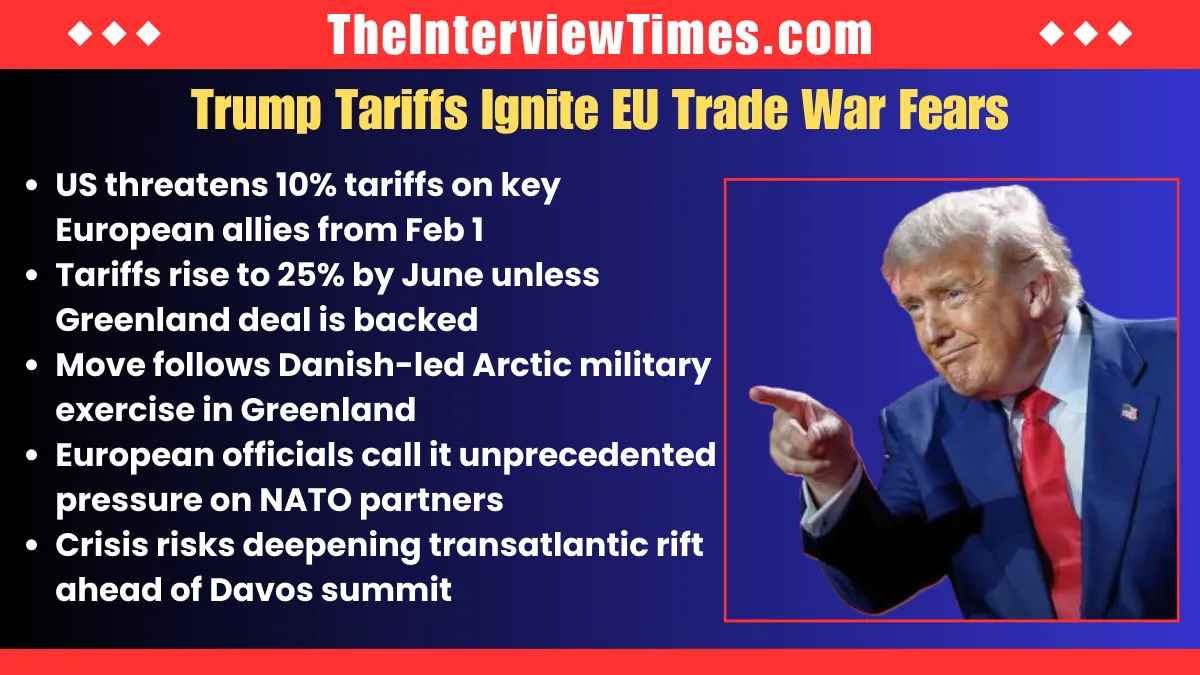
Trump announced the tariff measures on Saturday, January 17, 2026, in a post on Truth Social. He said the United States would impose a 10 percent tariff on all goods imported from Denmark, Norway, Sweden, France, Germany, the United Kingdom, the Netherlands, and Finland starting February 1.
The tariff rate would rise to 25 percent on June 1 unless those countries help secure what Trump described as the complete and total purchase of Greenland. All eight nations are NATO members and among America’s closest trading partners.
The announcement followed a Danish-led Arctic military exercise in Greenland involving several European allies. Trump framed the tariffs as retaliation for opposition to his long-standing interest in the territory, which he considers strategically vital amid growing Russian and Chinese presence in the Arctic.
European officials described the move as unprecedented pressure on allied nations and a direct challenge to established trade and security norms.
I spoke to @SecGenNATO, @EmmanuelMacron, @Keir_Starmer, @bundeskanzler and @GiorgiaMeloni.
— Ursula von der Leyen (@vonderleyen) January 18, 2026
Together we stand firm in our commitment to uphold the sovereignty of Greenland and the Kingdom of Denmark.
We will always protect our strategic economic and security interests.
We…
EU Prepares 93 Billion Euro Countermeasures
In response, ambassadors from all 27 EU member states held an emergency meeting in Brussels on Sunday. According to officials familiar with the talks, the bloc is preparing a retaliation package valued at up to 93 billion euros, or about 108 billion dollars.
The proposed measures include tariffs on US goods, restrictions on American companies’ access to the European single market, and possible limits on services trade and investments. EU institutions are also reviewing legal pathways to move quickly if Washington enacts the tariffs.
French President Emmanuel Macron has urged the bloc to consider activating the Anti Coercion Instrument, a powerful trade defense tool adopted in 2023. Often described as the EU’s strongest response mechanism, it allows Brussels to block foreign firms from public contracts, restrict services, curb investments, and impose additional trade barriers. Despite its scope, the instrument has never been used.

US-EU Trade Deal Approval Frozen
The crisis threatens a US-EU trade agreement reached in summer 2025 between European Commission President Ursula von der Leyen and Trump during talks in Scotland. The deal established a 15 percent baseline tariff on most EU exports while removing duties on many US industrial products.
At the time, European lawmakers suspended earlier retaliation plans to secure the agreement. That consensus has now collapsed.
Leaders from major European Parliament groups, including the European People’s Party, Socialists and Democrats, and Renew Europe, have said ratification is no longer viable. EPP leader Manfred Weber said Trump’s tariff threats make approval impossible and called for suspending zero tariffs on US products.
Top News: Trump’s Tariff Ultimatum to NATO Allies Escalates Greenland Dispute
European Leaders Close Ranks
The eight countries targeted by the tariffs issued a joint statement warning that such threats undermine transatlantic relations and risk triggering a dangerous downward spiral. British Prime Minister Keir Starmer spoke directly with Trump and said penalizing NATO allies in this manner was wrong.
Macron stated publicly that Europe would not be influenced by intimidation or threats, whether related to Ukraine, Greenland, or any other issue. German industry groups, including VDMA and VDA, warned that the tariffs would cause serious economic harm during an already difficult period for manufacturers.
Business leaders across Europe cautioned that higher duties would raise costs for consumers and disrupt supply chains on both sides of the Atlantic.
Davos Talks Loom as Uncertainty Grows
With the World Economic Forum set to begin in Davos this week, EU officials view the 93 billion euro retaliation plan as leverage to force negotiations. However, diplomats privately acknowledge that the standoff carries major risks.
A prolonged dispute could weaken Western unity, raise prices, and slow economic growth. China and Russia are seen as potential beneficiaries of any sustained transatlantic division.
The confrontation also revives memories of past trade disputes but adds a new geopolitical layer tied to Greenland’s future. As one senior EU diplomat noted, the crisis will test whether economic pressure can override alliance bonds built over decades.
Top World News: NATO Chief Rutte’s Delicate Balancing Act: Trump Tariffs Escalate Greenland Tensions
