
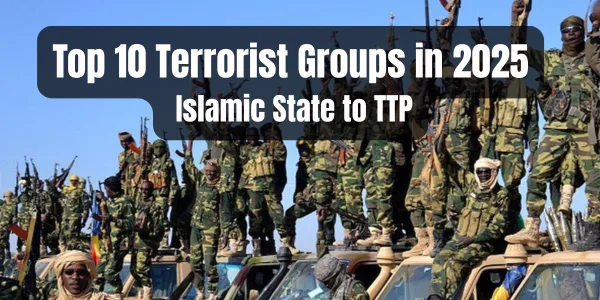
The Global Terrorism 2025 report reveals the ten most dangerous terrorist organizations shaping global security, from ISIS and Al-Qaeda to the TTP and Boko Haram.
Global Terrorism 2025: A Shifting Landscape of Violence
As of 2025, terrorism remains heavily concentrated across Africa, the Middle East, and South Asia, where extremist networks continue to exploit regional instability. According to the Global Terrorism Index 2025, and corroborated by intelligence assessments from the U.S., UN, and allied agencies, the world’s most dangerous terrorist organizations have evolved—adapting their tactics, expanding geographically, and embracing technology-driven warfare.
Below is a detailed look at the ten most dangerous terrorist organizations in 2025, responsible for the vast majority of global terror-related deaths.
1. Islamic State (IS)
The Islamic State (IS) remains the deadliest terrorist organization in 2025, causing over 1,800 deaths across 22 countries. Although its caliphate in Iraq and Syria has long collapsed, IS maintains a powerful global presence through regional offshoots such as ISIS-K (Khorasan Province), ISWAP (West Africa Province), and ISCAP (Central Africa Province).
Its operational focus has shifted toward Africa and Asia, particularly Syria and the Democratic Republic of Congo, where it continues to execute mass-casualty bombings and guerrilla attacks.
2. ISIS-K (Islamic State – Khorasan Province)
Based in Afghanistan and Pakistan, ISIS-K has become the most internationally active branch of the Islamic State. With an estimated 4,000–6,000 fighters, the group has executed attacks in Russia, Iran, and plotted operations across Europe and the United States.
Known for extreme brutality, ISIS-K recruits heavily from Central Asian states, posing a growing global threat amid Afghanistan’s deteriorating security environment.
3. Al-Qaeda
Even after the deaths of key leaders, Al-Qaeda remains a resilient transnational network. Its affiliates in Africa, the Middle East, and South Asia continue to plan and execute large-scale attacks.
Groups like Al-Qaeda in the Arabian Peninsula (AQAP) and Al-Qaeda in the Indian Subcontinent (AQIS) remain operational hubs for its ideology and training infrastructure. Al-Qaeda’s strategy increasingly relies on local insurgencies to preserve global reach.
4. Al-Shabaab
Operating from Somalia, Al-Shabaab is Al-Qaeda’s most active and powerful affiliate. It routinely targets Somali and Kenyan cities with bombings, assassinations, and assaults on military bases.
The group generates millions annually through illegal taxation, extortion, and smuggling, financing both its local operations and Al-Qaeda’s broader global network.
5. Boko Haram / Islamic State West Africa Province (ISWAP)
In Nigeria, Niger, Chad, and Cameroon, the insurgency led by Boko Haram and its splinter group ISWAP continues to devastate local populations.
ISWAP, now the stronger faction with around 2,000–3,000 fighters, conducts advanced operations, including assaults on military installations and aid convoys. Both factions are notorious for targeting civilians, schools, and humanitarian workers.
6. Tehrik-i-Taliban Pakistan (TTP)
The TTP has recorded a 90% increase in deaths from its attacks in 2025, making it the fastest-growing terrorist organization this year. Its resurgence coincides with the Taliban’s rule in Afghanistan, providing strategic depth and safe havens for TTP fighters.
The group primarily targets Pakistani military and government installations, aiming to overthrow the state and impose a hardline Islamic rule. Its growing cross-border operations threaten both Pakistan and Afghanistan.
7. Hay’at Tahrir al-Sham (HTS)
Formerly known as the Al-Nusra Front, HTS dominates northwestern Syria, especially in Idlib province. Though it publicly distances itself from Al-Qaeda, its Salafi-jihadist ideology and quasi-state governance make it a potent regional actor.
HTS maintains sophisticated command structures, taxation systems, and courts—making it one of the best-organized militant entities in the Middle East.
8. Jama’at Nasr al-Islam wal Muslimin (JNIM)
JNIM, Al-Qaeda’s branch in the Sahel region, operates across Mali, Niger, and Burkina Faso. It is responsible for attacks on UN peacekeepers, local militaries, and civilians, contributing significantly to the Sahel’s instability.
Its financing stems from kidnapping, smuggling, and illicit trade, which sustains its insurgency and regional influence.
9. Hamas
While often viewed as both a political and militant movement, Hamas remains designated as a terrorist organization by the U.S. and several other countries.
Following the 2024–2025 escalation with Israel, Hamas conducted rocket attacks and armed incursions that led to widespread casualties. Its governance in Gaza continues to intertwine politics and armed militancy, posing complex challenges for regional peace.
10. Hizbullah (Hezbollah)
Operating mainly in Lebanon, Hezbollah is a hybrid entity—a political party and militant group supported by Iran. Its involvement extends to Syria and Yemen, while its international network conducts intelligence and operational planning abroad.
Hezbollah’s advanced military infrastructure, global logistics, and ideological commitment to Iran’s strategic goals ensure its ranking among the world’s most dangerous non-state actors.
Must Read: Saudi Arabia US Defense Pact: MBS to Visit White House Amid Gulf Security Surge
Global Outlook: The New Epicenters of Terrorism
The Sahel region—spanning Mali, Burkina Faso, and Niger—has overtaken the Middle East as terrorism’s new epicenter, now accounting for over half of all global terrorism deaths in 2025.
Meanwhile, Western nations are witnessing a rise in lone-wolf attacks inspired by extremist propaganda, reflecting the digitization of radicalization through online networks.
Despite coordinated international surveillance, these organizations continue to adapt through cyber recruitment, drone warfare, and regional expansion—making Global Terrorism 2025 a defining security challenge of the modern era.