
Prime Minister Modi launched the Gyan Bharatam Portal to digitize 10 million ancient Indian manuscripts, preserving cultural heritage for future generations. Learn how this portal boosts research and fights intellectual piracy.
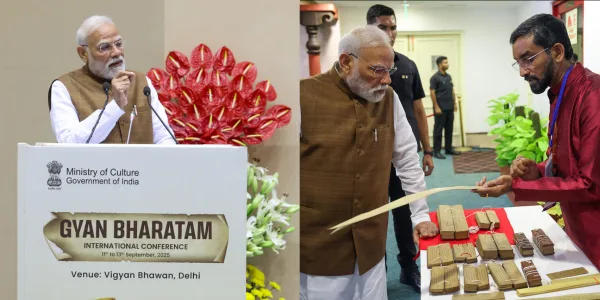
New Delhi, Prime Minister Narendra Modi launched the Gyan Bharatam Portal on September 12, 2025, a major step to save and share India’s ancient knowledge. This new digital platform aims to digitize nearly 10 million ancient manuscripts, making India’s rich cultural heritage available to everyone. The launch happened at the International Conference on Gyan Bharatam in New Delhi, where scholars, students, and experts gathered to celebrate India’s manuscript legacy.
हमारे पूर्वजों ने शब्दों को ईश्वर मानकर जिस प्रकार प्राचीन पांडुलिपियों को सहेजा, उससे पता चलता है कि हमारी संस्कृति के संरक्षण को लेकर उनकी चिंता कितनी गहरी थी। pic.twitter.com/KuAnPSkV2w
— Narendra Modi (@narendramodi) September 12, 2025
What is the Gyan Bharatam Portal
The Gyan Bharatam Portal is a digital library that will store and protect around one crore ancient manuscripts. These manuscripts, written in languages like Sanskrit, Tamil, Bengali, and more, cover topics like science, medicine, philosophy, and art. The portal makes it easy for people worldwide to access these texts, ensuring they are preserved for future generations. Already, over 10 lakh manuscripts have been digitized with help from places like the Asiatic Society of Kolkata and the Saraswati Mahal Library in Thanjavur.
Modi called the Gyan Bharatam Portal a “gift to the world,” saying it will help researchers, students, and anyone curious about India’s ancient wisdom. The portal uses modern technology like Artificial Intelligence (AI) to organize and translate these texts, making them easier to understand.

MUST READ: The Science of Happiness: What Research Really Says
Why the Gyan Bharatam Portal Matters
The Gyan Bharatam Portal is more than just a digital library—it’s a way to protect India’s heritage from being lost or stolen. Modi highlighted how some countries have copied India’s traditional knowledge, like Ayurvedic medicine, and claimed it as their own. “By digitizing our manuscripts, the Gyan Bharatam Portal will stop this intellectual piracy,” he said. It ensures the world knows these ideas come from India.
The portal also opens doors for new research. With millions of manuscripts available online, students and scholars can explore topics like ancient math, astronomy, and even the invention of zero, found in the Bakhshali manuscript. Modi noted that this knowledge could inspire new ideas in fields like technology and medicine, boosting India’s role in the global cultural economy, worth $2.5 trillion.
A Step Toward Cultural Pride
At the conference, Modi shared stories of India’s manuscripts, like the Charaka Samhita on Ayurveda and the Natya Shastra on dance and drama. He said these texts show India’s deep connection to knowledge, even after many manuscripts were destroyed in the past. “The Gyan Bharatam Portal is our way of bringing this knowledge back to life,” he added.
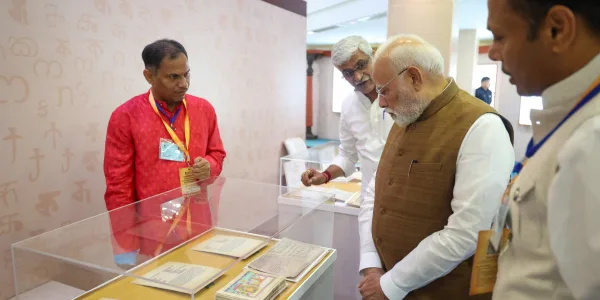
The event also showcased rare manuscripts and included discussions on how to preserve them using AI and other tools. Modi praised the young participants, saying, “70% of you here are young—this shows the Gyan Bharatam Portal will inspire the next generation.”
Global Impact of the Gyan Bharatam Portal
India is also working with other countries to protect its manuscripts. Agreements with Thailand and Vietnam will train scholars to read ancient languages like Pali and Cham. Modi mentioned Indian manuscripts preserved in Japan’s Horyu-ji Monastery, showing Asia’s shared cultural roots. “India is a trusted guardian of global heritage,” he said, pointing to the return of ancient idols from abroad as proof.
The Portal is part of a bigger mission to make India self-reliant (Aatmanirbhar Bharat) in preserving its culture. Scholars at the conference called it a “game-changer” for making ancient knowledge accessible to everyone, not just experts.

MUST READ: पितृ पक्ष में खरीदारी का महत्व: पूर्वजों की प्रसन्नता, पुण्य और स्वर्ग की प्राप्ति
Looking Ahead
The Gyan Bharatam Portal is a proud moment for India, ensuring that ancient manuscripts are not forgotten. Modi urged young people and universities to join the mission, saying, “This is about sharing India’s wisdom with the world.” The portal is now live, and people can explore it through the Ministry of Culture’s website.
As the conference continues until September 14, the Gyan Bharatam Portal stands as a symbol of India’s commitment to its past and future. It’s a simple yet powerful tool to keep India’s knowledge alive for generations to come.