
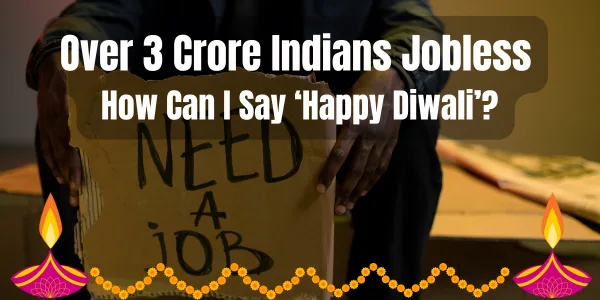
India’s jobless rate rose to 5.2% in September 2025 — over 3 crore Indians are unemployed this festive season. For many, “Happy Diwali” feels hollow this year.
As festive lights shimmer across India, millions of homes remain cloaked in economic darkness. Streets may glow with diyas and LED decorations, but behind those celebrations lie the quiet anxieties of over 3.16 crore Indians who remain unemployed this Diwali season.
According to the latest Periodic Labour Force Survey (PLFS) released by the Ministry of Statistics and Programme Implementation (MoSPI), India’s unemployment rate rose to 5.2% in September 2025, up from 5.1% in August 2025. Translating percentages into people, that means nearly 31.6 million citizens are without work — a sobering reminder that growth numbers can’t always light up every home.
Must Read: Indians Barred from US Green Card Lottery Until 2028: Key Reasons and Alternatives
Festivals Amid Joblessness
The rise in unemployment may look minor on paper, but it reflects a deeper crisis in India’s job landscape. Rural joblessness increased from 4.3% to 4.6%, while urban unemployment climbed to 6.8%, marking a tough festive season for daily wage earners and young job seekers alike.
Among all demographics, urban women remain the most vulnerable, facing 9.3% unemployment, the highest across categories. Despite small gains in rural self-help employment and MSME-driven schemes, the overall recovery remains uneven and fragile.
This Diwali, while the affluent light diyas of prosperity, millions of families are still struggling to afford basic groceries, rent, or electricity bills. For them, “Happy Diwali” sounds more like wishful thinking than reality.
The Shadow Behind the Celebration
Economists point out that India’s Labour Force Participation Rate (LFPR) climbed to 55.3%, its highest level in six months. But that doesn’t necessarily signal progress — it means more people are searching for jobs, not finding them.
With an estimated labour force of 60.7 crore, the fact that over 3 crore remain unemployed reveals how fragile India’s employment recovery truly is. The Worker Population Ratio (WPR) stands at 52.4%, suggesting stability on paper but concealing the widening chasm between aspirations and available opportunities.
For many, festive bonuses and shopping offers provide only a temporary respite. Beyond the glimmer of new lights and gold sales, Diwali 2025 exposes the deeper economic reality — a festival of lights shadowed by livelihood struggles.
Government Response and Policy Efforts
The government continues to highlight initiatives such as the PM Vishwakarma Yojana, PMEGP, and Atmanirbhar Bharat Rozgar Yojana, aimed at expanding employment in rural and informal sectors.
These programs have generated jobs, particularly in small-scale manufacturing and self-employment, but the gains have yet to match the massive workforce re-entering the market after the pandemic.
According to MoSPI’s PLFS insights:
- The urban employment rate remained stable due to growth in construction, manufacturing, and services.
- Female participation in the workforce continues to rise modestly, reflecting rural job formalisation under self-help group and MSME support programs.
- The average unemployment rate from 2018–2025 stands at 8.23%, with the highest peak of 20.8% in June 2020 (pandemic lockdowns) and the lowest of 5.1% in April 2025.
While India’s macroeconomic indicators show resilience, the uneven recovery across states and sectors means that millions still wait for meaningful opportunities to return.
The Human Cost of an Unequal Recovery
Every percentage point in unemployment represents millions of untold stories — shop assistants laid off before the festive rush, rural labourers waiting for MGNREGA payments, and graduates sending yet another unanswered job application.
As urban India celebrates with record Diwali sales, the working class faces stagnating wages, and informal sector workers struggle to secure steady incomes. The lights may shine brighter than ever, but economic inequality ensures that their glow doesn’t reach every doorstep.
For 3 crore unemployed Indians, this Diwali feels less like a celebration of triumph and more like a reminder of uncertainty. Their question echoes through the festive noise: How can I say “Happy Diwali” when I have no job?
Must Read: From CA to Shark Tank Star: How Mohit Yadav Built the Minimalist Empire
The Numbers Behind the Darkness
| Indicator (September 2025) | Value | Change vs August |
| National Unemployment Rate | 5.2% | ↑ from 5.1% |
| Rural Unemployment | 4.6% | ↑ from 4.3% |
| Urban Unemployment | 6.8% | ↑ from 6.7% |
| Urban Female Unemployment | 9.3% | ↑ from 8.9% |
| Rural Female Unemployment | 5.5% | ↑ from 5.2% |
| Urban Male Unemployment | 6.0% | ↑ from 5.9% |
| Rural Male Unemployment | 4.7% | ↑ from 4.5% |
| Labour Force Participation Rate (LFPR) | 55.3% | Highest since April 2025 |
| Worker Population Ratio (WPR) | 52.4% | Stable |
Final Word
As India celebrates Diwali 2025, the festival’s light also exposes its harsh contrasts — economic growth without inclusive prosperity. The challenge for policymakers is clear: celebrations mean little if livelihoods remain uncertain.
Until the glow of opportunity reaches every home, “Happy Diwali” will remain a phrase of hope — not reality — for over 3 crore unemployed Indians.
Mahendra Singh is a seasoned journalist and editor at TheInterviewTimes.com with over 28 years of experience. An alumnus of IIMC, he writes on international affairs, politics, education, environment, and key social issues.