
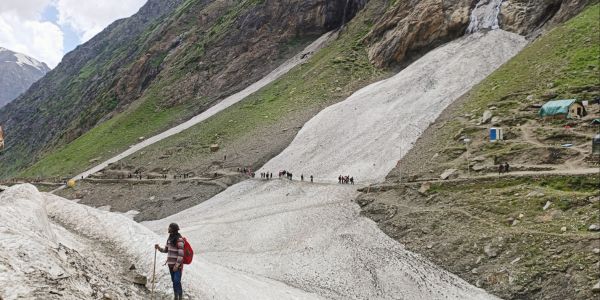
The Himalayan glaciers, often called the “Third Pole” for their vast ice reserves, are melting at an alarming rate, threatening water security, ecosystems, and livelihoods for nearly 2 billion people. United Nations Secretary-General António Guterres recently sounded the alarm, describing the region as “on thin ice” due to accelerating climate change. This warning, echoed in reports from May 2025, underscores a crisis with global implications, as the Himalayas feed some of the world’s most critical river systems.
A Rapidly Worsening Crisis
The Himalayas span five countries—India, Nepal, Bhutan, China, and Pakistan—and house over 50,000 glaciers, storing more freshwater than any region outside the polar ice caps. These glaciers feed major rivers, including the Ganges, Indus, Brahmaputra, and Mekong, which sustain agriculture, hydropower, and drinking water for 1.8 billion people across South Asia and beyond.
However, rising global temperatures are driving unprecedented glacial retreat. According to Guterres, Himalayan glaciers have lost nearly one-third of their ice volume over the past 30 years, with melting rates 65% faster in the last decade than in the previous one, as reported by BizzBuzz News on May 20, 2025. A 2021 study by the Wadia Institute of Himalayan Geology found that the Pensilungpa glacier in Ladakh’s Zanskar Valley shrank by 36% between 1962 and 2012, a trend consistent across the region. Similarly, a 2019 report by the International Centre for Integrated Mountain Development (ICIMOD) warned that even if global warming is limited to 1.5°C, one-third of Himalayan glaciers could vanish by 2100. In higher-emission scenarios, up to two-thirds could be lost.

Causes of the Melt
The primary driver of Himalayan glacier melt is global warming caused by greenhouse gas emissions. Average temperatures in the Himalayas have risen by 1.3°C since the 1950s, according to ICIMOD, outpacing the global average. Black carbon (soot) from industrial pollution, wildfires, and biomass burning exacerbates the problem by settling on glaciers, reducing their reflectivity and accelerating melting. A 2019 study published in Nature estimated that black carbon contributes to 20-50% of glacial melt in parts of the Himalayas.
Local factors, such as deforestation and unplanned infrastructure development, also play a role. Hydropower projects and road construction in fragile Himalayan ecosystems disrupt natural water flows and increase landslide risks, further stressing glaciers.
Devastating Impacts
The consequences of Himalayan glacier melt are profound and far-reaching:
- Water Security: Himalayan rivers provide water to 20% of the world’s population. As glaciers shrink, seasonal water shortages are becoming more common. In Ladakh, reduced snowfall has forced farmers to abandon agriculture, with many turning to tourism, as noted in a Times of India report from 2024. By 2050, ICIMOD projects that river flows could decline significantly, threatening irrigation and drinking water supplies.
- Natural Disasters: Melting glaciers are increasing the risk of glacial lake outburst floods (GLOFs). A 2023 study by the University of Potsdam identified over 1,000 potentially unstable glacial lakes in the Himalayas, posing risks to downstream communities. The 2021 Chamoli disaster in Uttarakhand, which killed over 200 people, was linked to glacial melt and rockslides.
- Biodiversity Loss: Glacial streams feed critical ecosystems, including wetlands and alpine meadows. Their decline threatens species like the snow leopard and disrupts migratory bird habitats. A 2022 WWF report highlighted a 30% decline in wetland coverage in parts of the Himalayas due to reduced glacial runoff.
- Economic and Social Impacts: Agriculture, which employs 70% of the region’s population, faces severe risks from water scarcity. In Pakistan, the Indus River, reliant on glacial melt for 40% of its flow, supports the world’s largest contiguous irrigation system. Declining flows could devastate crops like wheat and rice, exacerbating food insecurity.
- Global Ripple Effects: Guterres warned that Himalayan melt, combined with saltwater intrusion, could lead to the collapse of river deltas like the Ganges-Brahmaputra, potentially displacing millions. Similar patterns of accelerated melting in Antarctica and Greenland amplify the global threat of sea-level rise.
Calls for Action
During a 2023 visit to Nepal’s Everest region, Guterres urged the world to “stop the madness” of fossil fuel reliance, a message he reiterated in his May 2025 statement. He called for urgent global action to cut emissions, transition to renewable energy, and fund climate adaptation in vulnerable regions. The UN’s 2023 Global Stocktake report emphasized that current climate pledges fall short of the 1.5°C target, projecting a 2.5-2.9°C rise by 2100 without stronger action.
Locally, innovative solutions are emerging. In Ladakh, the Leh Nutritional Project has built artificial glaciers to store winter water for irrigation, a model pioneered by engineer Sonam Wangchuk. In Bhutan, early warning systems for GLOFs are being implemented. However, experts stress that these are stopgap measures. A 2024 Nature Climate Change study underscored that only deep, systemic reductions in global emissions can slow glacial melt.
The Path Forward
The Himalayan crisis demands a multi-pronged approach:
- Global Emission Cuts: Wealthy nations, responsible for the bulk of historical emissions, must lead in phasing out fossil fuels and scaling up renewables. The G20, accounting for 80% of global emissions, is a critical player.
- Regional Cooperation: Himalayan nations must collaborate on monitoring glaciers, sharing data, and managing shared river basins. Initiatives like the Hindu Kush Himalayan Monitoring and Assessment Programme (HIMAP) are steps in this direction.
- Local Adaptation: Investments in water storage, sustainable agriculture, and disaster preparedness can help communities cope. Funding for such measures, however, remains inadequate, with only 5% of global climate finance reaching South Asia, per a 2023 OECD report.
- Public Awareness: Grassroots movements and media coverage, amplified by platforms like X, are raising awareness.
A Race Against Time
The rapid melting of Himalayan glaciers is a stark reminder of the climate crisis’s urgency. As Guterres warned, the region is “on thin ice,” with consequences that could reshape South Asia and beyond. Without immediate, coordinated action to curb emissions and support vulnerable communities, the loss of these icy reservoirs could trigger a cascade of environmental, economic, and humanitarian crises.
The world has the tools to act—renewable energy, innovative water management, and international frameworks like the Paris Agreement. The question is whether it has the will. As the Himalayas melt, the clock is ticking.
Must Read: The United Nations: Your Guide to Its Global Role