
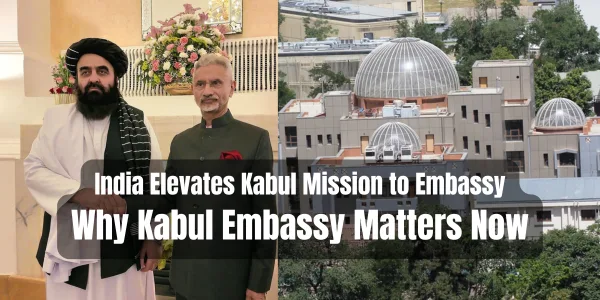
India upgrades its mission to a full Indian Embassy in Kabul, restoring diplomatic presence and signaling a strategic shift in India-Afghanistan relations.
In a landmark move, India has upgraded its Technical Mission to a full-fledged Indian Embassy in Kabul, restoring full diplomatic presence in Afghanistan for the first time since the Taliban’s takeover in August 2021. The decision follows the historic visit of Taliban Foreign Minister Amir Khan Muttaqi to New Delhi, marking the first senior-level Taliban delegation interaction with India since their return to power.
Must Read: Global Terrorism 2025: The World’s 10 Most Dangerous Terrorist Organizations
Indian Embassy in Kabul Restores Full Diplomatic Presence
The Ministry of External Affairs (MEA) announced that the Technical Mission, initially established in June 2022 to manage humanitarian and development projects, will now operate as the Indian Embassy in Kabul, headed by a Charge d’Affaires.
External Affairs Minister S. Jaishankar, speaking during his meetings with Muttaqi, said,
“To enhance our engagement, I am pleased to announce today the upgrading of India’s Technical Mission in Kabul to the status of the Indian Embassy in Kabul.”
The reopening of the Indian Embassy in Kabul marks a significant milestone in India-Afghanistan relations, signaling a pragmatic approach to diplomacy under complex regional circumstances.
Indian Embassy to Strengthen Counterterrorism and Regional Security
During the talks, Jaishankar and Muttaqi focused on security and counterterrorism cooperation. Afghanistan assured India that its territory would not be used for terrorist attacks against India.
Muttaqi described India as a “close friend” and indicated plans to send Afghan diplomats to work with the Indian Embassy in Kabul, reflecting a willingness to engage pragmatically on multiple fronts.
Humanitarian and Development Projects Through the Indian Embassy
The upgraded Indian Embassy will continue overseeing humanitarian programs initiated under the Technical Mission. These include food aid, medical assistance, and education projects.
India also announced six new development initiatives, including a 30-bed hospital in Bagrami district, aimed at strengthening Afghanistan’s healthcare infrastructure.
Through the Indian Embassy in Kabul, India will continue its people-centric development programs, including vocational training, infrastructure development, and scholarships for Afghan students.
Balancing Principle with Pragmatism
While India has not formally recognized the Taliban regime, reopening the Indian Embassy in Kabul reflects a pragmatic foreign policy that balances India’s principles with ground realities.
This strategic move allows India to safeguard its geopolitical interests, counter growing influence from China and Pakistan, and maintain a constructive presence in Afghanistan.
Must Read: Power of America 2025: How the United States Still Dominates the World
Regional Significance
The embassy’s reopening comes amid increased international engagement with the Taliban government. Countries such as China, Russia, Iran, and Qatar already maintain active embassies in Kabul.
With the Indian Embassy in Kabul, New Delhi strengthens its role in regional stability, counterterrorism, and development, ensuring India remains an influential voice in Afghanistan’s political and economic future.
Looking Ahead: The Indian Embassy and Reconstruction
Experts highlight that the Indian Embassy provides a platform for expanding cooperation in health, education, infrastructure, and cultural initiatives. The embassy also ensures India’s long-term involvement in Afghanistan’s reconstruction and peacebuilding efforts.
Conclusion: Indian Embassy in Kabul Marks Strategic Re-engagement
The reopening of the Indian Embassy in Kabul is both symbolic and strategic. It demonstrates India’s long-term commitment to Afghanistan’s stability, sovereignty, and development.
By combining humanitarian assistance with diplomatic realism, the Indian Embassy represents India’s evolving foreign policy—balancing principle, pragmatism, and regional security imperatives.