
TheInterviewTimes.com, New Delhi | January 22, 2026, 09:41 p.m. (IST)
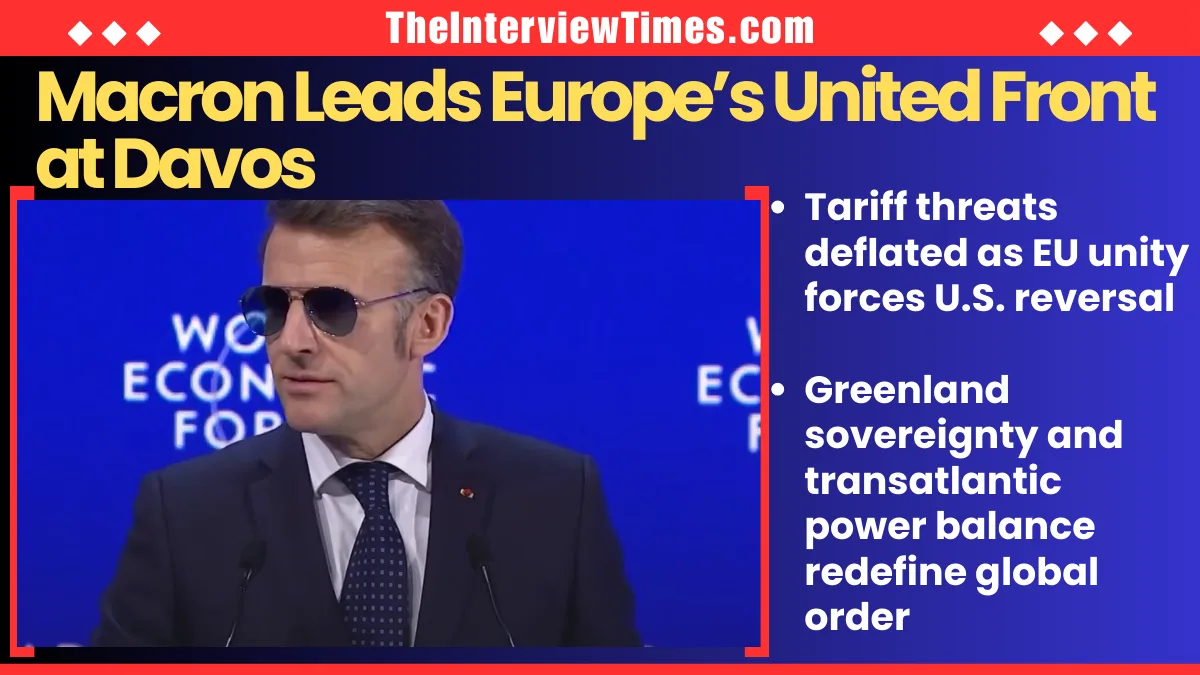
At Davos 2026, Emmanuel Macron led a united Europe that pushed back against Donald Trump’s tariff threats, forcing a U.S. reversal and reshaping transatlantic power dynamics.
Key Highlights
- Emmanuel Macron publicly rejected Donald Trump’s tariff threats at the World Economic Forum in Davos.
- Europe signaled readiness to use EU anti-coercion tools against U.S. economic pressure.
- Trump announced no new tariffs on eight European nations within hours.
- Greenland sovereignty emerged as a key flashpoint during the confrontation.
- Analysts say Europe showed unprecedented unity and strategic confidence.
French President Emmanuel Macron delivered one of the strongest European rebukes yet to U.S. President Donald Trump at the World Economic Forum in Davos, marking a turning point in transatlantic relations. Backed by a unified European leadership, Macron’s firm stance against tariff threats and territorial pressure forced Washington into a rapid retreat and highlighted Europe’s growing geopolitical confidence.
The confrontation unfolded against the backdrop of escalating tensions over trade, sovereignty, and global power balance. Trump had warned of new tariffs on several European nations and revived controversial remarks regarding Greenland. Europe responded not with caution, but with coordinated resistance.
We prefer science to conspiracy theories, rule of law to rule of force, dialogue to threats.
— Emmanuel Macron (@EmmanuelMacron) January 20, 2026
Nous préférons la science au complotisme, l’État de droit à la loi du plus fort, le dialogue aux menaces. pic.twitter.com/e4qK6mdFsa
Macron’s Davos Speech Sets the Tone
Speaking on January 21, Macron condemned the use of tariffs as a political weapon. He described the repeated imposition of trade barriers as fundamentally unacceptable and warned that Europe would not tolerate economic coercion tied to sovereignty issues.
Macron made clear that Europe was prepared to activate its anti-coercion instruments if necessary. His remarks were widely interpreted as a direct response to U.S. pressure tactics involving Greenland and trade relations with EU member states.
Within hours of the speech, President Trump announced that the United States would impose no new tariffs on eight European countries. He also ruled out any military action related to Greenland, signaling a clear reversal from earlier positions.
Momentum Builds From Global Order Warnings
The European response did not emerge in isolation. Earlier at Davos, Canadian Prime Minister Mark Carney warned of a rupture in the global order. He argued that middle powers must resist domination by major states or risk being marginalized.
Carney’s statement that nations not present at the negotiating table would become targets resonated across the forum. His remarks helped frame Macron’s confrontation as part of a broader effort to defend multilateral norms and international balance.
The combination of Canadian and European messaging created a strong diplomatic front that shifted the tone of discussions throughout Davos.
As great powers abandon rules and values for their own interests, middle powers like Canada have a choice: compete with each other for favour or act together with impact. pic.twitter.com/HCfzSS3DRs
— Mark Carney (@MarkJCarney) January 21, 2026
Europe Acts in Unison
European leaders quickly reinforced Macron’s position. European Commission President Ursula von der Leyen stated that the European Union was fully prepared to act with unity, urgency, and determination. She emphasized that Europe would defend its economic and political interests collectively.
Polish Prime Minister Donald Tusk rejected any suggestion of appeasement, stating that weakness only invites further pressure. Sweden’s Prime Minister Ulf Kristersson and German representatives publicly criticized the use of economic blackmail in international relations.
European Central Bank President Christine Lagarde made a symbolic protest by walking out of a U.S.-led dinner, a gesture that underscored the seriousness of Europe’s objections. An emergency EU summit was convened in Brussels shortly afterward to coordinate the next steps.
Top News: Explained: Why the United States Wants Greenland
Greenland Becomes a Defining Red Line
Greenland emerged as a central issue during the standoff. Danish Prime Minister Mette Frederiksen issued one of the clearest statements of the week, declaring that the United States would not own Greenland under any circumstances.
Her remarks drew widespread support from EU leaders and reinforced the principle that European territorial integrity was non-negotiable. The firm response closed the door on any ambiguity surrounding the issue.
Analysts See a Strategic Shift
Diplomats and analysts described the outcome as a rare moment where Europe successfully deflated Trump’s aggressive posture. One senior EU diplomat warned that similar challenges could reappear, but acknowledged that Europe had crossed an important threshold.
Ian Lesser of the German Marshall Fund called the episode a moment of significance for transatlantic relations. He noted that Europe demonstrated its ability to act decisively when confronted with unilateral pressure.
The Davos showdown suggested that Europe is no longer willing to rely solely on quiet diplomacy. Instead, it is prepared to use collective economic and political tools to defend its interests.
A New Era of European Assertiveness
The events in Davos underscored a broader shift in Europe’s global role. Under Macron’s leadership, the European Union presented itself as a confident and coordinated actor capable of reshaping international outcomes.
By forcing a U.S. reversal on tariffs and reaffirming sovereignty over Greenland, Europe sent a clear message that unity remains its strongest asset. The Davos moment may well be remembered as a signal that Europe is ready to stand its ground in an increasingly contested global order.
Top News: Trump Greenland Push Triggers Market Chaos Before Davos De-Escalation Deal
