
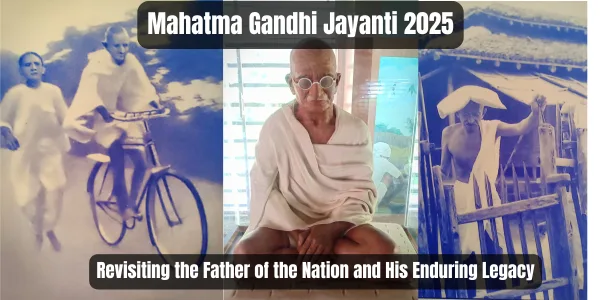
Celebrate Mahatma Gandhi Jayanti 2025: Explore Mahatma Gandhi’s life, writings, Satyagraha, Ahimsa, and enduring global influence.
New Delhi, October 2, 2025 –On this day, October 2, India bows its head in reverence to Mohandas Karamchand Gandhi – the Father of the Nation. The world too, through the observance of the United Nations International Day of Non-Violence, commemorates his life and message.
Gandhi Jayanti is not merely a date on the calendar; it is a reminder of the principles of truth (Satya), non-violence (Ahimsa), and self-rule (Swaraj) which shaped not only India’s freedom movement but also influenced global struggles for justice and human dignity.
This year, as Gandhi Jayanti 2025 is observed, it becomes essential to revisit his journey — from his early life in Gujarat to becoming the moral voice of the 20th century – and to reflect on why his words and actions remain profoundly relevant in today’s fractured world.
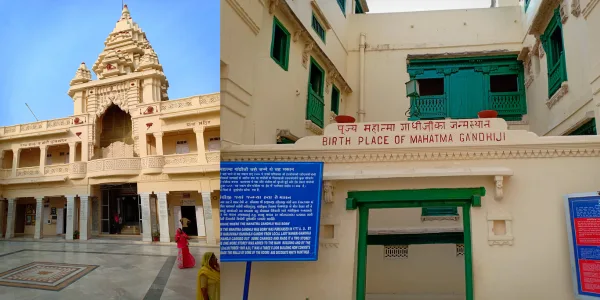
Early Life: The Making of a Mahatma
Gandhi was born on October 2, 1869 in Porbandar, a coastal town in present-day Gujarat. His father, Karamchand Gandhi, was the Diwan (chief minister) of Porbandar, and his mother, Putlibai, was deeply religious, instilling in young Mohandas values of simplicity, compassion, and spiritual discipline.
In 1888, Mahatma Gandhi sailed to London to study law at Inner Temple. His formative years in Britain exposed him to Western thought, literature, and reformist ideals. Yet, it was not until his time in South Africa (1893–1914) that Gandhi discovered his mission.
There, facing racial discrimination firsthand, he developed his twin weapons of Satyagraha (truth-force) and Ahimsa (non-violence), which later became the bedrock of his political philosophy.
Must Read: Zoho: The Homegrown Challenger Ashwini Vaishnaw Prefers Over Microsoft and Google
Writings that Defined a Philosophy
Unlike many political leaders who relied on speeches alone, Gandhi systematically articulated his philosophy through writings that remain timeless.
1. Hind Swaraj (1909)
Written on his return voyage from London to South Africa, Hind Swaraj was Gandhi’s critique of modern civilization and blueprint for Indian self-rule.
- He rejected blind imitation of the West, calling modernity “a disease.”
- He redefined Swaraj:
“Real Swaraj will come not by the acquisition of authority by a few but by the acquisition of the capacity by all to resist authority when it is abused.”
2. An Autobiography: The Story of My Experiments with Truth (1927–29)
This two-volume work was a candid account of Gandhi’s personal experiments in search of truth. It offered rare honesty, as Gandhi openly admitted mistakes.
His famous declaration: “Truth is God.”
He emphasized self-discipline, celibacy (Brahmacharya), vegetarianism, and spiritual growth as essential experiments in his quest.
3. Young India and Harijan
Through these weekly journals, Gandhi addressed the burning issues of his time.
- In Young India, he articulated political strategies, calling Satyagraha “a weapon of the strong, never of the weak.”
- In Harijan, launched in 1933, he waged a moral crusade against untouchability: “Untouchability is a sin. It is the greatest blot on Hinduism.”
Together, these writings formed a moral manifesto, addressing politics, education, rural development, and social reform.
Must Read: Dr. B.R. Ambedkar: The Architect of Modern India’s Constitution and Champion of Equality
Political Movements: Non-Violence in Action
Gandhi’s uniqueness lay not just in his philosophy but in its practical application.
- Champaran Satyagraha (1917) – His first major movement in India, where he fought for indigo farmers against exploitative British planters.
- Non-Cooperation Movement (1920–22) – Urged Indians to boycott British institutions, schools, and goods, shaking the colonial administration.
- Salt March (1930) – A 240-mile march to Dandi against the salt tax became a symbol of peaceful defiance, galvanizing masses.
- Quit India Movement (1942) – “Do or Die” became the rallying cry, marking the final mass upsurge against British rule.
At every stage, Gandhi insisted on non-violence, proving that moral force could challenge the might of an empire.
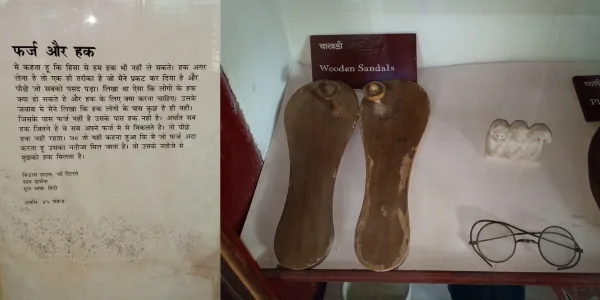
Mahatma Gandhi’s Social Vision: Beyond Politics
Gandhi was not merely a political leader; he was a social reformer and visionary.
- Village Republics: He believed “India lives in her villages,” envisioning decentralized self-sufficient communities.
- Khadi and Swadeshi: Promoting khadi was not only about self-reliance but also dignity of labour.
- Education: Gandhi stressed “Nai Talim” — education integrating craft, literacy, and character-building.
- Women’s Empowerment: Gandhi called women the embodiment of strength, encouraging their active participation in freedom struggles.
- Abolition of Untouchability: He coined the term “Harijan” (children of God) for Dalits, advocating equality and temple entry.
Mahatma Gandhi and the World
Gandhi’s methods transcended national boundaries. His philosophy of non-violence inspired:
- Martin Luther King Jr. in the American Civil Rights Movement.
- Nelson Mandela acknowledged Gandhi as the moral force behind South Africa’s anti-apartheid struggle.
- Lech Walesa in Poland’s Solidarity movement.
The global impact of Gandhi was acknowledged when the United Nations declared his birthday as the International Day of Non-Violence in 2007.
Criticism and Challenges
While revered as the Mahatma, Gandhi was not without critics. Some saw his approach as impractical or too idealistic in a violent world. Subhas Chandra Bose and Bhagat Singh represented alternative paths of armed resistance. Ambedkar criticized Gandhi’s stance on caste, arguing it did not go far enough in dismantling structural inequities.
Yet, Mahatma Gandhi’s greatness lay in his openness to dialogue and his willingness to evolve.
Relevance of Mahatma Gandhi in the 21st Century
As India and the world grapple with complex crises, Gandhi’s ideas remain strikingly relevant.
- Politics of Honesty – In an era of corruption and fake news, his insistence on truth is a moral necessity.
- Peace in Conflict Zones – With wars raging in different parts of the globe, Ahimsa offers a non-violent path to reconciliation.
- Climate Change and Sustainability – Gandhi’s principle of simple living and local economies resonates with calls for ecological balance.
- Social Harmony – His fight against caste and communalism serves as a guide for an inclusive society.
Global Recognition and Legacy
Statues of Mahatma Gandhi stand tall across continents – from London’s Parliament Square to Washington D.C.’s National Mall. Schools, universities, and streets bear his name. His message, though born in colonial India, belongs to humanity.

Conclusion
Mahatma Gandhi’s life was a relentless pursuit of truth, an experiment in moral courage, and a vision for a just society.
His writings – Hind Swaraj, Autobiography, Young India, Harijan – are not relics of history but living texts that speak to our present crises.
As we celebrate Gandhi Jayanti 2025, the truest homage we can pay is not in ritualistic remembrance but in practicing his ideals of truth, non-violence, and self-reliance in everyday life.
“My life is my message.” – Mahatma Gandhi
Mahendra Singh is a seasoned journalist and editor at TheInterviewTimes.com with over 28 years of experience. An alumnus of IIMC, he writes on international affairs, politics, education, environment, and key social issues.