

Muscat/New Delhi, January 6, 2026, 11:22 a.m. IST
Oman has introduced new citizenship fees under its updated nationality law, reducing residency requirements and clarifying eligibility for expats. For over 700,000 Indian residents, the changes bring transparency but require surrendering Indian citizenship, making naturalization a selective privilege under Royal Decree.
In a move aimed at bringing greater transparency to immigration processes, the Sultanate of Oman has rolled out a new fee structure for citizenship and nationality-related applications, effective from January 4, 2026. This comes less than a year after the implementation of the updated Omani Nationality Law in February 2025, which eased some residency requirements for naturalization.
According to details published in Oman’s Official Gazette, applicants seeking Omani citizenship through naturalization will now pay OMR 600 (approximately ₹1.3 lakh). The same fee applies to foreign spouses (primarily women married to Omani men), widows or divorced foreign women previously married to Omanis, and minor children of Omani women applying under family provisions.
Additionally, a new charge of OMR 200 has been introduced for those wishing to voluntarily relinquish Omani nationality, a service that previously had no standardized fee.

Omani authorities have clarified that these changes are purely administrative and do not alter the core eligibility criteria under Royal Decree No. 17/2025, which replaced the 2014 law. The goal, officials say, is to standardize costs and streamline procedures across the country.
The timing of the fee update is significant for Oman’s large expatriate community, including over 700,000 Indians who form one of the biggest foreign workforce groups in the Gulf nation. Many Indians have lived and worked in Oman for decades, contributing to sectors like construction, healthcare, and oil and gas.
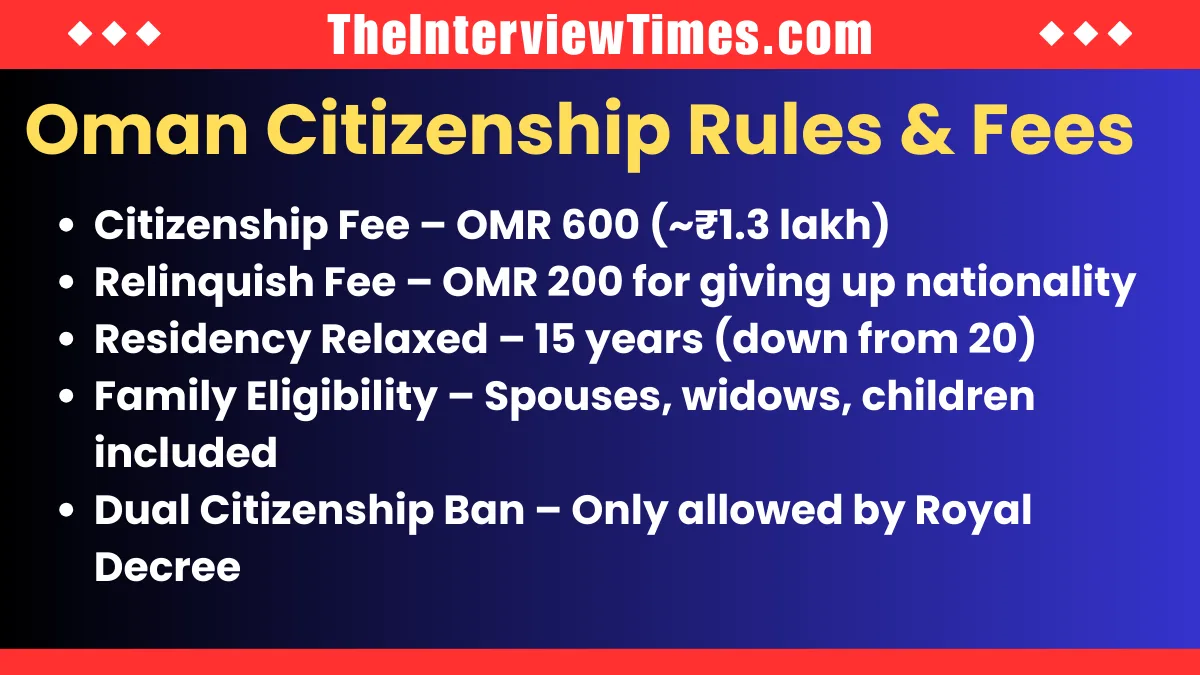
Under the 2025 Nationality Law, key relaxations include:
- Reducing the continuous residency period for general naturalization from 20 years to 15 years.
- Allowing up to 90 days of absence per year without breaking residency continuity (up from 60 days).
- For foreign wives of Omani men: Eligibility after 8 years of marriage and residency (with a child, proficiency in spoken Arabic, and other conditions).
- For foreign husbands of Omani women: After 10 years of marriage, residency, and having a child (requiring reading/writing Arabic proficiency).
Applicants must also demonstrate good conduct, health clearance, a legitimate income, and crucially a written commitment to renounce their original nationality. Dual citizenship remains prohibited except in rare cases approved by a special Royal Decree from His Majesty Sultan Haitham bin Tarik.
For Indian expatriates, this means surrendering Indian citizenship if granted Omani nationality, as India also does not permit dual citizenship. This is a major consideration for many, who value ties to family and property back home.
Legal experts note that while the relaxed rules open a clearer path for long-term residents, approvals remain highly selective and granted only via Royal Decree. “Citizenship is not a right but a privilege in Oman,” said a Muscat-based immigration consultant. “The new fees add predictability, but the process is still rigorous.”
Since the 2025 law took effect, Oman has granted citizenship to select individuals, including professionals with exceptional contributions. However, mass naturalizations are unlikely, aligning with the country’s focus on preserving national identity.
Indian embassy officials in Muscat advise expats to consult official channels for personalized guidance. With Oman’s economy diversifying under Vision 2040, long-term residents especially skilled Indians may find these updates encouraging, though the decision to apply involves careful weighing of benefits like enhanced rights and security against the permanence of renouncing Indian citizenship.
As Gulf nations balance expatriate contributions with localization goals, Oman’s measured reforms signal a welcoming yet controlled approach to integration.
For the latest updates on Gulf immigration affecting Indians, stay tuned to TheInterviewTimes.com.
