
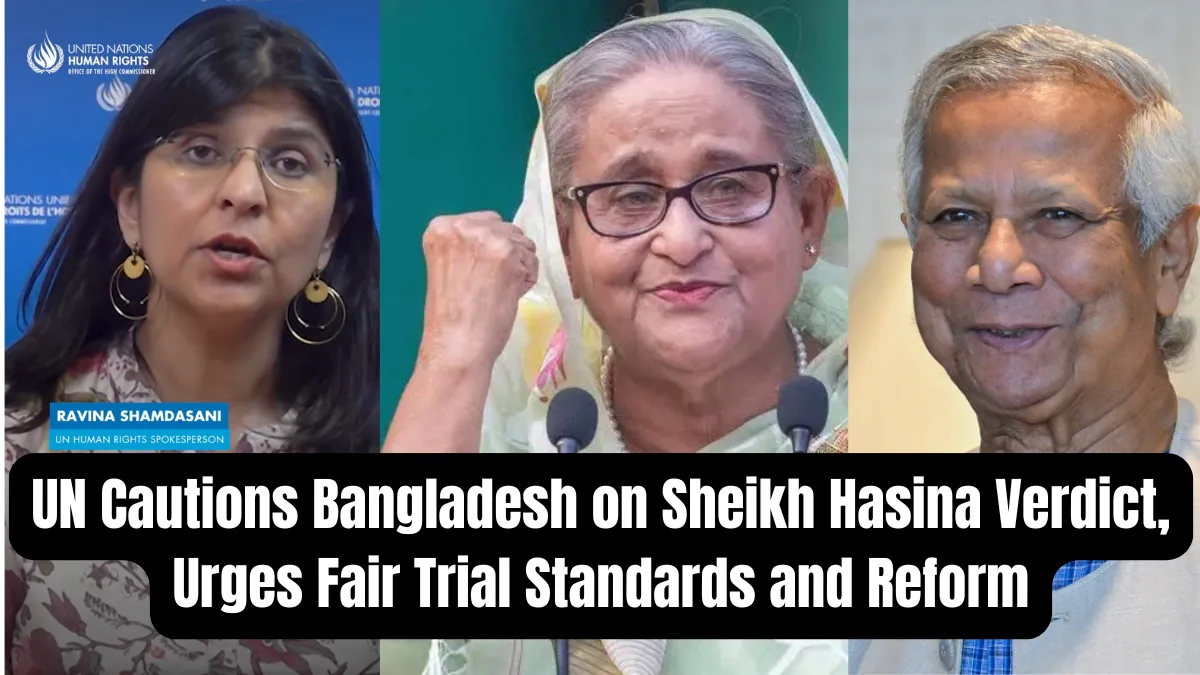
The UN Human Rights Office issues a cautious welcome to Bangladesh’s tribunal verdict against Sheikh Hasina, stressing fairness, due process and opposition to the death penalty. OHCHR calls for truth-telling, justice reform and reconciliation as Bangladesh enters a volatile political phase ahead of 2026 elections.
UN Issues Measured Response to Sheikh Hasina Verdict
TheInterviewTimes.com | 18 November 2025: The United Nations has welcomed aspects of Bangladesh’s International Crimes Tribunal (ICT) ruling against former Prime Minister Sheikh Hasina, but simultaneously expressed deep concerns over due process, trials in absentia and the imposition of the death penalty.
The verdict, delivered on November 17, sentenced Sheikh Hasina and former Home Minister Asaduzzaman Khan Kamal to death in absentia for their alleged roles in the violent 2024 crackdown, where more than 1,400 people were killed during mass student-led protests.
Volker Turk, the UN High Commissioner for Human Rights, responded through OHCHR spokesperson Ravina Shamdasani, calling it “an important moment for victims,” while warning that accountability must align with international human rights standards.
UN Highlights Concerns Over Fair Trial Standards
The UN stressed that the trial of Sheikh Hasina raises serious concerns about procedural fairness because both accused were tried while exiled in India. OHCHR reminded Dhaka that trials in absentia must strictly comply with due process guarantees under international law.
Shamdasani said the UN has “consistently advocated for all accountability proceedings to unquestionably meet international standards of due process and fair trial,” particularly in cases involving international crimes and capital punishment.
This echoes the UN’s February 2025 fact-finding report documenting extrajudicial killings, arbitrary detentions and enforced disappearances during unrest linked to Hasina’s government. The report had urged accountability for commanders and political leaders responsible for ordering violence.
Must Read: Sanctions on Russian Gas Reshape Global Markets as US LNG Dominance Surges
UN Reiterates Opposition to Death Penalty for Sheikh Hasina
A major element of the UN response centred on its global opposition to the death penalty. Turk stated that the UN “regrets the imposition of the death penalty, which we oppose in all circumstances.”
UN Secretary-General Antonio Guterres reinforced this stance on November 18, saying he “fully agrees” with Turk’s position. The unified message aligns with longstanding UN policy, including the 2007 moratorium resolution.
OHCHR’s reaction to the sentence against Sheikh Hasina mirrors similar UN responses in Myanmar, Saudi Arabia and other countries where capital punishment follows trials that fall short of global judicial norms.
Call for Reconciliation, Security Sector Reform and Calm
Beyond the verdict, Türk urged Bangladesh to adopt a holistic strategy for national healing. He called for truth-telling, victim reparations, justice reforms and security sector transformation.
He emphasized that Bangladesh must build safeguards to prevent human rights violations from repeating. OHCHR also offered technical assistance to Dhaka to bring its judicial and policing frameworks closer to international standards.
The UN’s call for “calm and restraint” comes as streets in Dhaka witness escalating protests, arson and political polarization. The interim government led by Muhammad Yunus hailed the verdict as “historic,” while Sheikh Hasina labelled it “rigged” from abroad.
With Bangladesh’s elections scheduled for February 2026, political analysts warn the UN’s feedback could influence how the government manages domestic pressures and international scrutiny.
Social Media Amplifies UN Concerns
A video statement posted by @UNHumanRights on X highlighted the verdict against Sheikh Hasina as “an important moment for victims,” while reiterating regret over the death sentence. The post had over 30,000 views by midday November 18, reflecting heightened global attention.
#Bangladesh: The guilty verdict against ex-Prime Minister Sheikh Hasina is an important moment for victims of the grave violations committed during the suppression of protests last year.
— UN Human Rights (@UNHumanRights) November 17, 2025
We regret that this trial conducted in absentia led to a capital punishment sentence, which… pic.twitter.com/iKzHnhROM6
The online reaction adds momentum to the UN’s push for transparency and reform as Bangladesh navigates its most fragile political period in a decade.
Key Takeaways
- The UN cautiously welcomed accountability in the tribunal verdict against Sheikh Hasina, but raised concerns over due process.
- OHCHR reaffirmed its opposition to the death penalty, noting the trial was held in absentia.
- The UN called for truth-telling, reparations and security sector reform in Bangladesh.
- Heightened political tensions ahead of the 2026 elections place global focus on Bangladesh’s next steps.
- OHCHR stands ready to assist Bangladesh in building a rights-respecting justice system.