
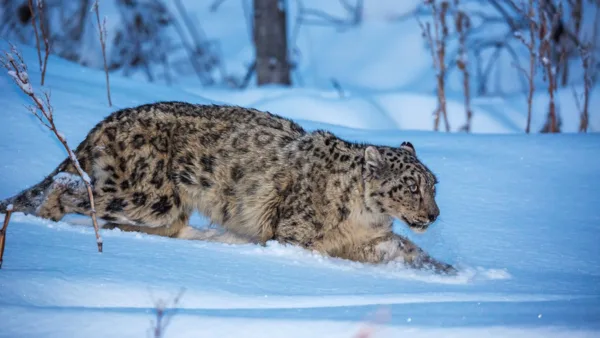
Climate change is driving snow leopards toward extinction in Central Asia. Learn how habitat loss, warming, and poaching threaten these rare big cats.
The Ghost of the Mountains Faces Extinction
In the rugged highlands of Central Asia, the elusive snow leopards—revered as the “ghosts of the mountains”—are silently disappearing. A new report by the United Nations Environment Programme (UNEP) and GRID-Arendal, under the Vanishing Treasures initiative, warns that climate change and human activities are pushing these majestic predators to the edge of extinction.
The report, Getting Climate-Smart with the Snow Leopard in Central Asia, focuses on Kyrgyzstan and Tajikistan, where warming temperatures, habitat fragmentation, and poaching are rapidly diminishing the survival prospects of snow leopards.
Must Read: Green Sea Turtle Recovery: From Endangered to Least Concern, a Global Conservation Triumph
Declining Populations of Snow Leopards in Central Asia
Globally, only 3,500 to 7,500 snow leopards (Panthera uncia) remain in the wild. In Central Asia, their population is estimated at just 470 to 1,000 individuals, including 250–280 in Kyrgyzstan and around 150 in Tajikistan.
As apex predators, snow leopards maintain the delicate ecological balance of their mountain habitats by controlling populations of wild sheep and goats. However, their numbers are declining fast due to habitat loss, poaching, and increased human-wildlife conflict.
विश्व में हिम तेंदुए की संख्या तेज़ी से कम हो रही है. उनका अस्तित्व अवैध शिकार, मानव गतिविधियों और जलवायु संकट के कारण खतरे में है.
— UNHindi (@UNinHindi) October 23, 2025
हिम तेंदुआ दिवस पर अनेक खतरों का सामना करती इस प्रजाति के संरक्षण और उसके बारे में जागरूकता बढ़ाने में हमारा साथ दें. https://t.co/OM2czBsUo1 pic.twitter.com/RTxQZP8YPP
How Climate Change Is Reshaping Snow Leopard Habitats
The UNEP report highlights alarming temperature rises in the region—0.4 to 0.5°C per decade since 1950, exceeding global averages. These shifts have triggered glacier melt, changed vegetation cycles, and pushed the treeline higher, all of which are fragmenting habitats and reducing prey availability for snow leopards.
As glaciers retreat and rivers dry, livestock grazing expands into higher altitudes, competing directly with the snow leopard’s natural prey. The report personifies this crisis through the fictional snow leopard “Svet,” lamenting, “Warmer temperatures mean livestock is coming up higher to graze, encroaching on my favourite wild prey’s space.”
Must Read: Cassowary Bird: Facts, Habitat, and Why It’s Called the World’s Most Dangerous Bird
Human Pressures Intensify the Snow Leopards’ Struggle
In Kyrgyzstan and Tajikistan, livestock farming remains vital, contributing nearly 35.6% of Kyrgyzstan’s GDP. Yet this dependence on highland grazing has devastating consequences for snow leopards.
Between 2012 and 2020, snow leopards were blamed for 60 livestock attacks in Tajikistan, resulting in the loss of nearly 950 animals. Retaliatory killings are common, with 5–7 snow leopards poached each year in Kyrgyzstan and 20–25 in Tajikistan.
Illegal trophy hunting—sometimes showcased on social media—continues despite international bans, undermining conservation progress.

Future Projections: More Fragmentation, Less Water
Climate models predict that suitable snow leopard habitats might increase by 9% in Kyrgyzstan and 5% in Tajikistan by 2080. However, this apparent expansion masks a severe issue—habitat fragmentation could rise by 36%, driving snow leopards into closer proximity with humans and heightening conflict risks.
Meanwhile, glacier shrinkage threatens up to 80% of summer runoff in Kyrgyzstan, endangering both human and animal survival. As mountain streams vanish, the ecosystem and rural livelihoods alike face existential threats.
Local Voices Call for Climate-Smart Conservation
Local conservationists and herders are already witnessing these changes. Kenje Sultanbaeva from the Ilbirs Foundation stresses that, “Nature-based tourism and low-impact agribusiness such as sustainable beekeeping and herbal harvesting can secure both livelihoods and wildlife.”
Herder Aida Ibraeva echoes this sentiment: “Summers are getting longer, and herders move higher into wildlife zones. We’re competing for the same spaces as the snow leopards.”
Such testimonies underline the urgency for climate-resilient conservation strategies that balance ecological protection with economic needs.
Must Read: Every Year, 10M Hectares of Forests Vanish-Halting Deforestation Is Our Only Hope
Vanishing Treasures: A Model for Climate-Smart Conservation
The Vanishing Treasures programme—funded by the Grand Duchy of Luxembourg and supported by the Snow Leopard Trust—aims to integrate “climate-smart” solutions into conservation planning.
Key strategies include:
- Enhancing habitat connectivity to enable snow leopards to adapt to shifting ecosystems.
- Promoting ecosystem-based adaptation, helping local communities withstand climate shocks.
- Reducing human-wildlife conflict through better corrals, livestock insurance, and eco-tourism initiatives.
These approaches aim to safeguard both biodiversity and livelihoods in some of the world’s most fragile ecosystems.

UNEP’s Message: Protect Nature to Protect Ourselves
Bruno Pozzi, UNEP’s Europe Director, warns, “With COVID-19, nature has sent us a strong message. To protect ourselves and Earth’s precious wildlife for the long term, we must tackle habitat and biodiversity loss.”
The report calls for cross-border cooperation, gender-inclusive policies, and scientific research to ensure the future of the snow leopards—a symbol of resilience now teetering on the brink.
Must Read: Climate Change: A Ticking Time Bomb?
Conclusion: Saving the Ghosts of the Mountains
As global temperatures climb and glaciers retreat, the survival of snow leopards in Central Asia hangs by a thread. These mysterious mountain predators have endured for millennia, yet human-induced climate change now threatens to erase them from their ancient ranges.
Without immediate, collaborative action, the “ghosts of the mountains” may soon become ghosts in memory. Protecting snow leopards is not only a moral obligation—it is vital for maintaining the ecological integrity of Asia’s high mountains and the communities that depend on them.