
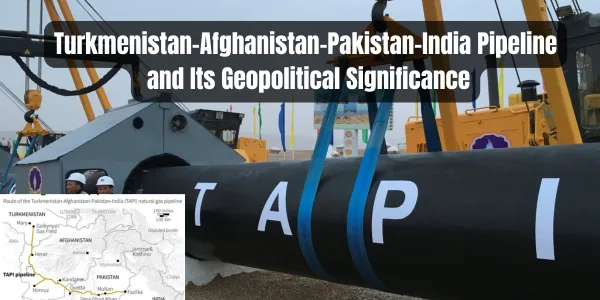
The TAPI Project connects Turkmenistan’s gas fields to South Asia through Afghanistan and Pakistan, offering major economic and strategic benefits to the region.
What is the TAPI Project?
The TAPI, or Turkmenistan-Afghanistan-Pakistan-India Gas Pipeline, is one of Asia’s most ambitious energy initiatives aimed at transporting natural gas from Turkmenistan’s vast reserves to energy-hungry South Asian nations. Conceived in the 1990s and formally launched in 2010, the TAPI Project symbolizes regional collaboration across four countries with diverse political systems and economic priorities.
The TAPI Project begins at the massive Galkynysh gas field in Turkmenistan—one of the world’s largest natural gas reserves—and passes through Afghanistan (Herat and Kandahar), into Pakistan (via Quetta and Multan), before ending at Fazilka in India’s Punjab.
The total length is approximately 1,814 kilometers: 214 km in Turkmenistan, 773–816 km in Afghanistan, and 827 km in Pakistan. With a 56-inch diameter pipeline, it is designed to transport up to 33 billion cubic meters (bcm) of natural gas per year.
The gas distribution under the TAPI Project is planned as 14 bcm each for Pakistan and India (42% each) and around 5 bcm for Afghanistan (16%). The project is intended to operate for at least 30 years, ensuring a long-term supply of clean energy across the region.
Must Read: Indian Embassy in Kabul Upgrade Signals Strategic Shift in India-Afghanistan Relations
Who Manages and Finances the TAPI Project?
The TAPI Project is managed by TAPI Pipeline Company Limited (TPCL), established in 2014. Turkmengaz, Turkmenistan’s state-owned energy giant, holds an 85% majority stake, while the remaining 15% is shared equally among Afghan Gas Enterprise, Inter State Gas Systems (Pakistan), and GAIL (India).
The total cost of the TAPI Project is estimated at $7–7.7 billion, financed through a combination of equity (around 75%) and debt (25%). Key financial support comes from institutions like the Asian Development Bank (ADB) and the Islamic Development Bank. The project’s earlier cost estimates were close to $10 billion, later optimized due to technological and operational adjustments.
As of 2025, the Turkmen section of the TAPI Project is almost complete, and work in Afghanistan has resumed under the Taliban government. Pakistan signed new implementation plans in 2023, though full operationalization has faced delays due to security concerns, funding challenges, and geopolitical friction. Notably, Kazakhstan expressed interest in joining the TAPI Project in 2025, expanding its potential reach.
Why is the TAPI Project Important?
1. Economic Benefits
The TAPI Project carries immense economic potential for all four nations.
- Turkmenistan will diversify its energy export markets beyond China and Russia, earning up to $1 billion annually.
- Afghanistan will collect $400–500 million in annual transit fees and create nearly 10,000 jobs, contributing to post-war reconstruction and infrastructure development.
- Pakistan will secure affordable natural gas to offset its 20% energy shortfall, reducing dependency on imported LNG and stabilizing industrial growth.
- India will gain a stable and cleaner energy supply to support its rapidly expanding economy.
Overall, the TAPI Project represents a $7–10 billion investment that could stimulate trade, create jobs, and strengthen regional infrastructure.
2. Geopolitical and Strategic Significance
The TAPI Project also holds major geopolitical implications.
It enhances Turkmenistan’s strategic autonomy by reducing dependence on traditional export routes, while fostering cooperation among historically strained neighbors like India and Pakistan. For Afghanistan, the project offers not just transit revenue but also political leverage and incentives for peace.
Supported by the U.S. and international financial institutions, the TAPI Project serves as a counterbalance to China’s Belt and Road Initiative and Russia’s regional influence. It also aligns with global goals for cleaner energy transition and economic connectivity.
3. Regional Integration and Environmental Impact
Beyond economics and politics, the TAPI Project promotes regional integration between Central and South Asia. It complements projects like CASA-1000, which transmits electricity from Kyrgyzstan and Tajikistan to Afghanistan and Pakistan. By linking these economies, TAPI can transform Afghanistan into a regional energy transit hub, fostering peace through shared prosperity.
Environmentally, the TAPI Project encourages a shift from coal and oil to cleaner natural gas, reducing carbon emissions while meeting the rapidly growing energy demand in India and Pakistan.
Must Read: Global Terrorism 2025: The World’s 10 Most Dangerous Terrorist Organizations
Challenges Ahead
Despite its promise, the TAPI Project faces persistent obstacles—chief among them security instability in Afghanistan, slow financial mobilization, and land acquisition issues in Pakistan. Political uncertainty and fluctuating regional dynamics continue to test the project’s progress. India’s sustained participation will also determine its long-term viability.
Conclusion
The TAPI Project is more than a pipeline—it is a vision for regional cooperation, shared energy security, and economic interdependence. If successfully completed, it could redefine the energy map of Asia by linking Central Asia’s natural wealth with South Asia’s energy demand, transforming the geopolitical landscape in the process.