
TheInterviewTimes.com | February 24, 2026 | 10:30 PM IST | New Delhi
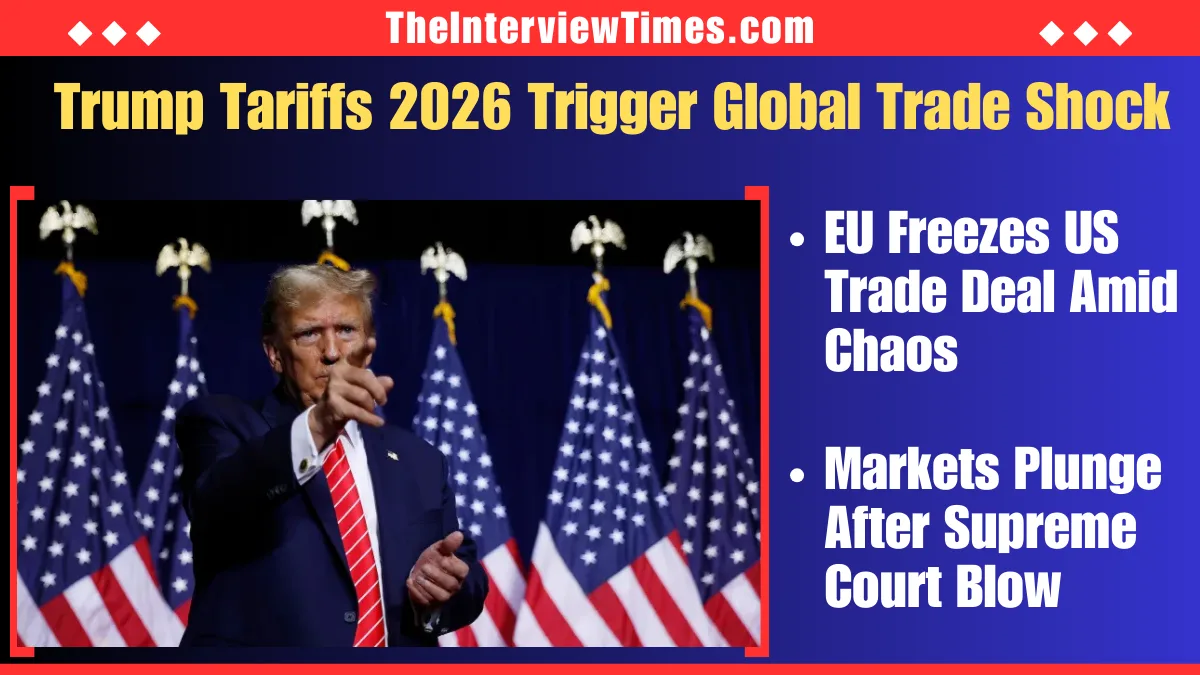
Trump tariffs 2026 take effect at 10% amid Supreme Court ruling chaos. EU freezes US trade deal, stocks slide sharply. Full details on President’s warnings, market turmoil, and next steps.
Background on Trump Tariffs 2026 Escalation
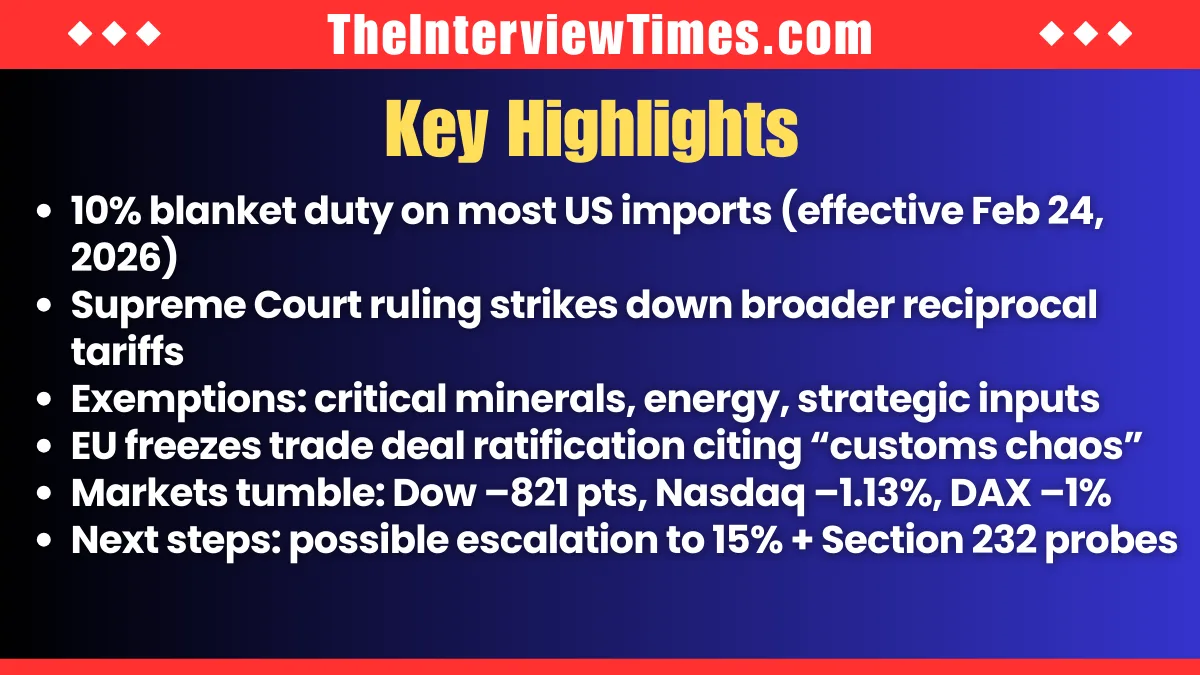
Trump tariffs 2026 officially took effect at 12:01 a.m. ET on February 24, 2026, imposing a 10% blanket duty on most US imports.
President Donald Trump invoked Section 122 of the Trade Act of 1974 after the Supreme Court of the United States delivered a 6–3 ruling striking down his broader “reciprocal tariffs” that had been introduced under the International Emergency Economic Powers Act (IEEPA).
The court ruled that IEEPA did not authorize sweeping import duties, invalidating tariff rates that had reached as high as 145% on China and steep penalties on countries including India and Brazil.
The new 10% tariff will remain in force for 150 days, unless Congress moves to extend or formalize it. The administration confirmed exemptions for:
- Critical minerals
- Energy products
- Strategic industrial inputs
Trump had earlier pledged a 15% universal tariff, but officials described the 10% rate as an “initial stabilization measure,” leaving room for escalation through other trade authorities.
Trump’s Stark Warning to Trade Partners
Posting on Truth Social, Trump warned foreign governments against interpreting the court’s decision as a weakness.
He wrote that any country attempting to “play games” with what he called a “ridiculous Supreme Court decision” would face “much higher tariffs — and worse.”
The administration is now exploring additional actions under:
- Section 232 investigations (national security grounds)
- Potential export licensing frameworks
- Targeted duties on telecom, batteries, and industrial chemicals
Officials indicated that fresh Section 232 probes may cover:
- Power grid components
- Semiconductor inputs
- Telecommunications equipment
- Industrial chemicals
If national security risks are formally established, new tariffs could bypass the legal vulnerabilities exposed in the IEEPA ruling.
EU Freezes US Trade Deal Ratification
The European Union has responded sharply.
The European Parliament’s trade committee postponed ratification votes on the EU-US trade agreement, citing what Chair Bernd Lange described as “pure customs chaos.”
The European Commission reiterated that prior negotiated tariff caps — including a 15% ceiling on certain EU exports — must be honored.
Officials emphasized:
“A deal is a deal.”
Brussels signaled it would resist any attempt by Washington to raise tariffs beyond previously agreed terms. The EU remains America’s largest trading partner, making the freeze a significant diplomatic escalation.
Global Market Reaction: Stocks Slide
Markets reacted immediately to the Trump tariffs 2026 rollout and legal uncertainty.
On Monday:
- Dow Jones Industrial Average fell 821 points (–1.66%) to 48,804
- S&P 500 declined 1.04%
- Nasdaq Composite dropped 1.13%
- CBOE Volatility Index surged more than 10% to 21.01
European markets followed:
- DAX fell 1%
- STOXX Europe 600 slipped 0.5%
In India:
- NIFTY 50 declined nearly 1%
- BSE Sensex also dropped about 1%, pressured by export-oriented sectors
Investors cited uncertainty over:
- Future tariff increases
- Supply chain disruptions
- Retaliatory trade actions
- Currency volatility
The market reaction reflects concerns that global tariffs 2026 could trigger renewed trade fragmentation similar to earlier US-China disputes.
Legal Fallout: Supreme Court Blow to Reciprocal Tariffs
The Supreme Court ruling represents one of the most significant checks on presidential trade authority in decades.
By striking down the reciprocal tariffs framework under IEEPA, the court clarified that emergency powers do not extend to broad trade restructuring without congressional backing.
However, Section 122 of the Trade Act allows temporary tariffs in response to balance-of-payments concerns — giving Trump a legal bridge for 150 days.
Legal analysts say Congress could now become central to shaping permanent US import duties 2026 policy.
What Comes Next?
Attention now turns to Trump’s State of the Union address on February 24, 2026, where further trade signals could shape market direction.
Possible next steps include:
- Raising the 10% rate to 15%
- Launching formal Section 232 investigations
- Expanding targeted industrial tariffs
- Seeking congressional authorization for permanent universal duties
The current 10% tariff acts as a transitional framework, but global markets remain on edge.
With the EU trade deal freeze, Supreme Court constraints, and volatile equity markets, Trump tariffs 2026 have reignited global trade tensions at a critical economic moment.
Whether this marks a negotiating tactic or the beginning of a long-term restructuring of global commerce will likely become clearer in the coming weeks.
Top News: India US Trade Talks Postponed After Supreme Court Strikes Down Trump Tariffs Latest Updates
