
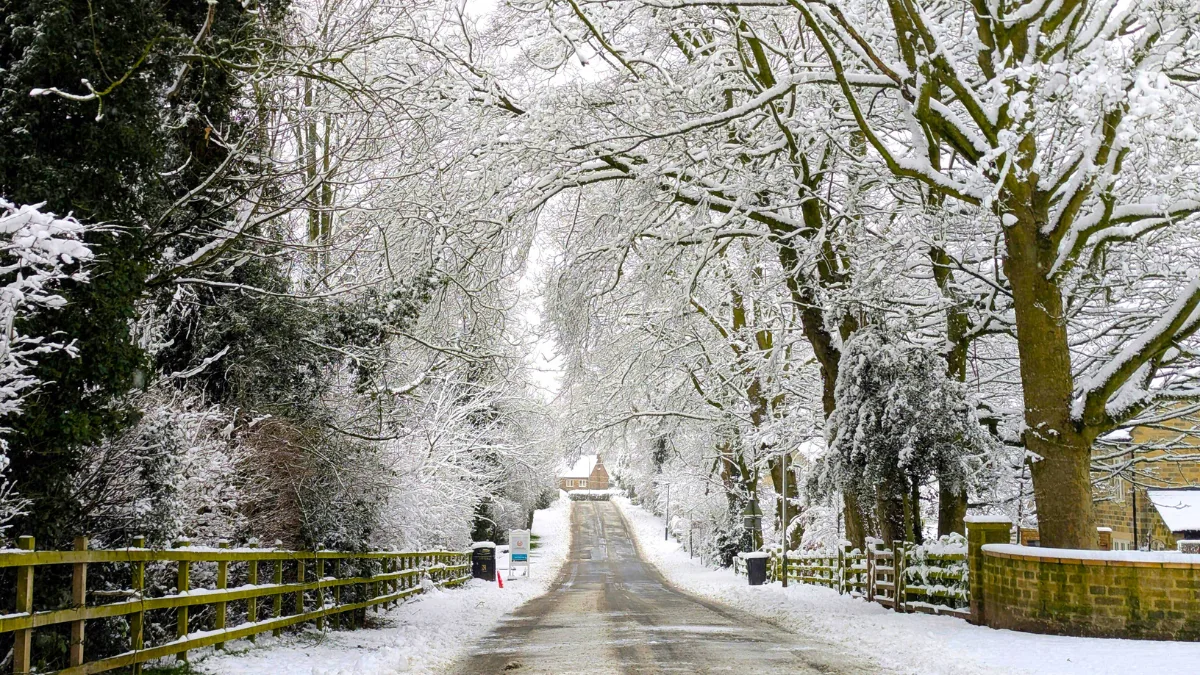
The Winter 2025-2026 Forecast warns of an extreme season driven by a rare November sudden stratospheric warming event and a weak La Niña. Meteorologists predict severe cold, heavy snow, and Arctic outbreaks in northern and eastern U.S. regions, while southern states face a warmer, drier winter. Learn how this unusual winter pattern will unfold.
Winter 2025-2026 Forecast: A Season Defined by Extremes
TheInterviewTimes.com | November 16, 2025: The Winter 2025-2026 Forecast reveals a highly unusual season shaped by two rare atmospheric forces acting together for the first time in decades—a weak La Niña and an exceptionally early sudden stratospheric warming (SSW) event. Meteorologists warn that this combination will produce sharp regional contrasts across North America, creating a winter of extremes.
The season is expected to deliver severe cold, heavy snow events, and Arctic intrusions across the northern and eastern United States, while the southern and southwestern regions may experience warmer and drier conditions through most of the winter.
Must Read: Tech Giants’ $73 Billion Bond Surge Sparks AI Debt Bubble Fears in Global Markets
Rare November Stratospheric Warming Disrupts the Polar Vortex
A sudden stratospheric warming event in November is one of the rarest atmospheric occurrences recorded. Typically forming in late January or February, this early event has not appeared in more than 50 years of satellite observations.
During the event, stratospheric temperatures over the Arctic spiked by more than 100°F within days, causing the polar vortex to weaken, split, and send displaced Arctic air southward.
Experts from NOAA, ECMWF, and MIT climatologist Judah Cohen note that this early disruption is likely to send cold waves into the central and eastern U.S. by late November and early December. Analysts expect a surge in early-season snowfall, accompanied by a high probability of severe cold spells.
Forecast models suggest the disruption will peak around November 26, creating ideal conditions for a powerful early-winter outbreak.
La Niña’s Influence: Sharpening the Regional Divide
The weak La Niña, expected to persist through December 2025 to February 2026, will act as the second major driver of the Winter 2025-2026 Forecast. According to NOAA’s Climate Prediction Center, La Niña typically shifts the jet stream to favor colder, wetter northern regions and milder southern states.
Key projections from NOAA’s winter outlook include:
- Below-average temperatures across the northern Plains, upper Midwest, Great Lakes, and interior Northeast.
- Above-average precipitation in the Pacific Northwest, northern Rockies, upper Midwest, and Great Lakes—areas likely to see intensified lake-effect snowfall due to lake temperatures 4–5°F above normal.
- Warmer, drier conditions across the southern U.S., particularly the Southwest, southern High Plains, and Gulf Coast.
- Minor chances of unusual freeze events or light snow in southern states as Arctic surges interact with local weather patterns.
This combination of phenomena means northern states may see repeated blizzard conditions, while much of the southern U.S. may experience a comparatively mild and dry winter.
Scientific Backing and Climate Research Insights
Peer-reviewed research on La Niña winters consistently highlights shifts in jet stream behavior that bring:
- Increased snowfall to the northern U.S.
- Heightened cold risks for the Midwest and Northeast
- Prolonged dry patterns in the southern tier states
Some climate researchers also warn of a potential intensification of multi-year La Niña cycles, which can amplify drought risks, alter agricultural output, and increase the frequency of extreme winter weather events.
The rare November SSW event adds another layer of unpredictability, with scientists observing that early polar vortex splits can dramatically magnify winter volatility.
Preparation and Expected Winter 2025-2026 Impacts
Forecasters urge residents, utilities, and government agencies to prepare for:
- Major blizzards and high-impact snowstorms
- Short but intense Arctic outbreaks
- Prolonged cold spells across northern and eastern states
- Potential heating demand spikes
- Risks of travel disruption during early and mid-winter
The biggest uncertainty remains the duration and strength of the polar vortex disruption. If the vortex remains weak, the northern U.S. could see repeated waves of deep winter cold through January.
Winter 2025-2026 Forecast: Key Takeaways
- The Winter 2025-2026 Forecast warns of an extreme season shaped by a rare November SSW event and a persistent La Niña pattern.
- Northern and eastern U.S. regions should expect cold, snowy, and stormy conditions.
- The southern U.S. will likely experience a warmer and drier winter, though occasional Arctic surges remain possible.
- Weather agencies recommend readiness for volatile conditions, especially through early December and mid-winter.
- This winter will be one of the most atmospherically complex in recent decades.