
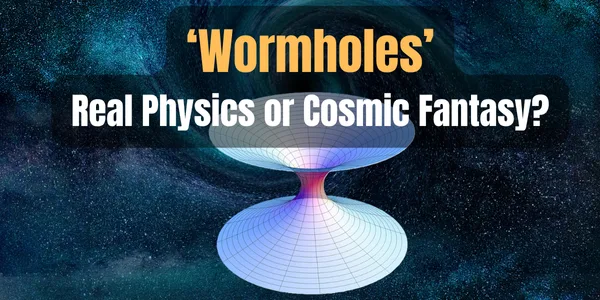
Are wormholes real or science fiction? Explore the 2025 research, physics theories, and latest claims about gravitational “wormhole echoes.”
Introduction: When Science Meets Imagination
Few concepts in astrophysics ignite curiosity like wormholes — the hypothetical tunnels through spacetime that could connect distant galaxies or even parallel universes. Once confined to science fiction, from Star Trek to Interstellar, wormholes now occupy a gray zone between mathematics and metaphysics.
With new excitement in September 2025 over a possible “wormhole echo” detected in gravitational waves, the question resurfaces: Are wormholes grounded in science, or still in the realm of sci-fi?
Must Read: Time Travel Possibility: Physics Explains If It Can Be Real
What Exactly Is a Wormhole?
At its core, a wormhole is a theoretical passage through spacetime that connects two distant points. Picture folding a sheet of paper so two distant dots touch — the fold represents the wormhole, enabling instant travel without crossing the surface.
The concept originates from Albert Einstein’s theory of general relativity, which describes gravity as the warping of spacetime by mass and energy. In 1935, Einstein and Nathan Rosen proposed what we now call the Einstein-Rosen bridge — a mathematical solution linking two black holes or even separate universes.
Theoretical physicists later refined this into the Morris-Thorne wormhole, whose structure can be described mathematically but requires “exotic matter” with negative energy density to keep it open — something nature hasn’t yet revealed.
The Science Behind the Theory
Contrary to popular belief, wormholes aren’t pure fantasy. They are valid solutions to Einstein’s equations and align with certain predictions of quantum mechanics.
Quantum effects such as the Casimir effect — where a vacuum between two metal plates produces negative energy — suggest exotic conditions might exist. However, these effects occur on microscopic scales, far too small to stabilize a human-sized wormhole.
Advanced frameworks like string theory and loop quantum gravity even hint that wormholes could exist at the Planck scale (10⁻³⁵ meters), potentially woven into the universe’s very fabric.
While experiments with metamaterials and quantum systems have created “analog” wormholes, none have physically bent spacetime — they only simulate the equations.
The Roadblocks: Why Wormholes May Stay Theoretical
Despite mathematical elegance, real wormholes face three monumental challenges:
- Exotic Matter Requirement
Traversable wormholes need negative energy or mass — substances violating the known laws of physics. Even if they exist, producing enough would require stellar-scale energy. - Instability and Collapse
Wormholes would likely collapse instantly. Stephen Hawking’s Chronology Protection Conjecture (1992) suggests that nature forbids time-travel paradoxes, ensuring such shortcuts close before use. - Energy and Scale Limits
Creating or stabilizing a wormhole demands technology beyond anything humanity can imagine. Even minor distortions in spacetime require enormous energy inputs.
Recent models in Physical Review D and Classical and Quantum Gravity refine wormhole equations but remain firmly theoretical.
Recent Developments: The 2025 “Wormhole Echo” Controversy
In September 2025, a team led by Qi Lai from the University of Chinese Academy of Sciences revisited the 2019 gravitational wave event GW190521 — previously attributed to a massive black hole merger.
Their paper proposed a stunning possibility: the signal might be an “echo” from a collapsing wormhole in a parallel universe. The idea suggests a wormhole formed by an external cosmic event could vibrate through spacetime, briefly visible in our detectors.
While intriguing, mainstream physicists remain skeptical. The lack of a clear “chirp” pattern could simply reflect an unusual black hole merger rather than exotic physics. Publications like ScienceAlert and Daily Mail reported on it, but experts stress caution: “It’s thought-provoking, but far from proof.”
Meanwhile, 2024–2025 studies on rotating Lorentzian wormholes and quantum temporal links continue to explore whether spacetime shortcuts can exist in expanding universes — all without observational evidence yet.
Wormholes in Pop Culture
From Stargate to Interstellar, wormholes symbolize humanity’s yearning to outpace light and conquer cosmic distances.
Physicist Kip Thorne, who advised on Interstellar, ensured the film’s wormhole visuals were scientifically accurate — but real wormholes would be unstable, microscopic, and likely unusable for travel.
Still, such portrayals inspire scientific inquiry, fueling real-world research into gravity, quantum mechanics, and cosmic topology.
Verdict: More Science Than Fiction, But Still Beyond Reach
Wormholes are not imaginary; they emerge naturally from Einstein’s equations, the same framework that correctly predicted black holes and gravitational waves. Yet, without empirical evidence or a means to stabilize them, they remain beyond practical reach.
Future instruments — perhaps the next generation of LIGO, Einstein Telescope, or even James Webb Space Telescope — could uncover hints. Until then, wormholes dwell at physics’ most mysterious frontier: where mathematics meets imagination.
Key Takeaways
- Wormholes are real mathematical solutions in general relativity, but not experimentally verified.
- Exotic matter with negative energy is needed to keep them open — currently impossible to produce.
- The 2025 “wormhole echo” claim remains speculative and unproven.
- For now, wormholes are scientifically plausible but practically impossible.