
TheInterviewTimes.com | March 31, 2026 | 8:45PM IST | New Delhi
Iran Conflict: Donald Trump lashes out at UK and France over Iran strikes, warns allies to defend themselves as oil crisis and global tensions escalate.
Article Summary
US President Donald Trump has sharply criticized key European allies over their limited support in the Iran conflict, escalating tensions within NATO and raising concerns over global energy security.
Key Highlights
- Trump tells allies to “defend themselves” amid Iran war tensions
- UK and France directly targeted for lack of military support
- Oil prices surge over 20% due to Strait of Hormuz disruption
- Europe pushes back, urging restraint on energy infrastructure attacks
- NATO unity faces serious strain during a critical geopolitical moment
Trump’s Sharp Attack on Allies
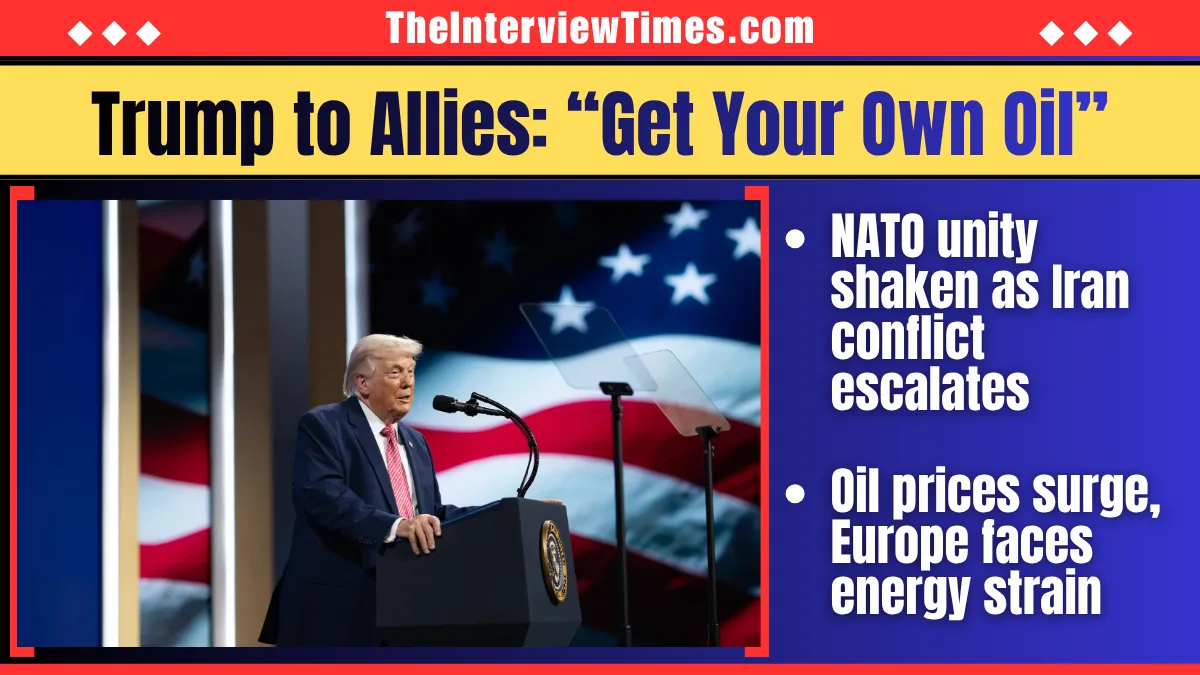
U.S. President Donald Trump has triggered fresh geopolitical tensions after issuing a blunt warning to allies, telling them to “go get your own oil” amid the ongoing conflict with Iran.
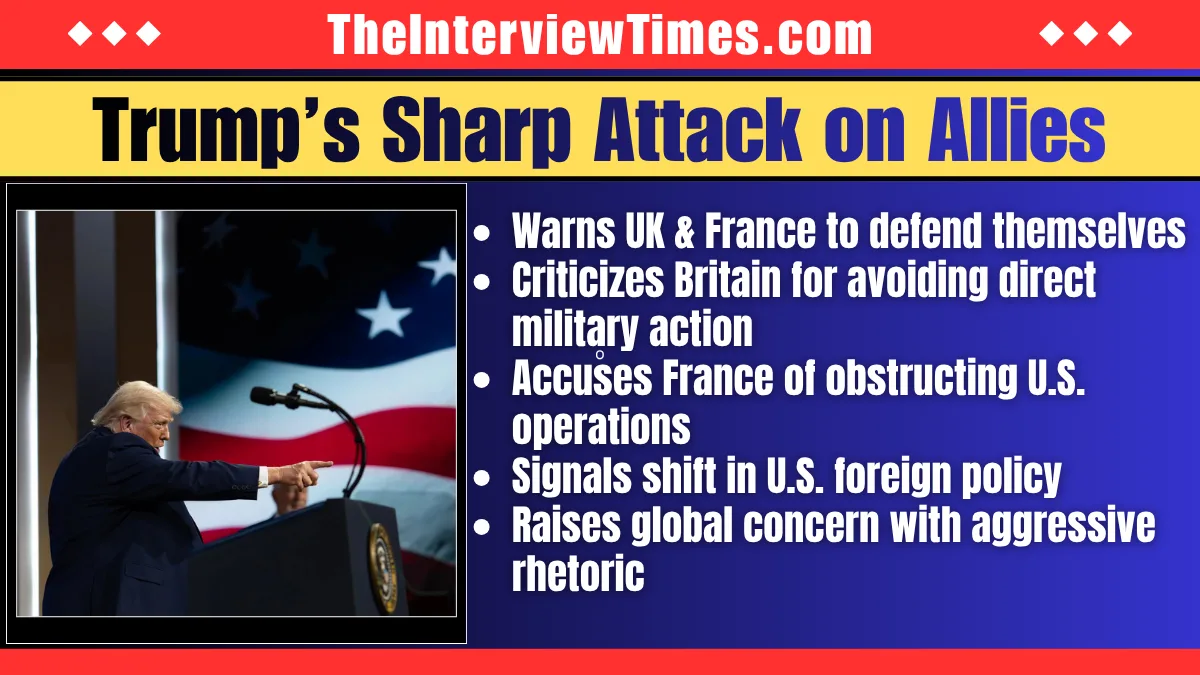
In a series of posts on Truth Social, Trump accused the United Kingdom and France of failing to support U.S.-led military strikes. He signaled a potential shift in American foreign policy, warning that Washington may no longer defend allies that do not reciprocate support.
Trump specifically criticized Britain’s decision to stay out of direct military action, despite facing fuel shortages linked to disruptions in the Strait of Hormuz. He suggested the UK should secure its own energy supplies, even using aggressive language that raised global concern.
France also came under fire, with Trump accusing it of obstructing U.S. military operations by limiting airspace access.
“All of those countries that can’t get jet fuel because of the Strait of Hormuz, like the United Kingdom, which refused to get involved in the decapitation of Iran, I have a suggestion for you…” – President Donald J. Trump pic.twitter.com/aPYmL0qspa
— The White House (@WhiteHouse) March 31, 2026
Europe’s Cautious Stand
European nations have shown hesitation in fully backing the U.S.-Israel campaign. While some countries have provided logistical support, many have avoided direct military involvement.
Reports indicate that Spain denied overflight permissions, while Italy restricted access to key military bases. Meanwhile, the UK has allowed limited use of its bases but has firmly avoided entering the conflict.
British Prime Minister Keir Starmer reiterated that the country “will not be dragged into war,” reflecting domestic and political caution.
In a joint statement, several nations including Germany, Italy, and Japan called for a halt to attacks on civilian and energy infrastructure, signaling concern over escalating military tactics.
Rising Tensions in the Iran Conflict
The conflict, involving the U.S. and Israel against Iran, has entered its fifth week. The strikes have targeted key Iranian facilities, including sites in Isfahan, intensifying regional instability.
The disruption in the Strait of Hormuz, one of the world’s most critical oil routes, has sent shockwaves through global markets. Oil prices have surged by more than 20%, with Brent crude nearing $110 per barrel, heavily impacting energy-dependent economies, particularly in Europe.
Global Implications and Strategic Risks
Trump’s remarks echo his long-standing “America First” doctrine, but experts warn that such rhetoric could deepen fractures within NATO at a crucial time.
Geopolitical analysts suggest that allies are balancing multiple concerns, including legal constraints, domestic political pressure, and the risk of wider regional escalation.
The situation also places renewed pressure on European nations to increase defense spending and reduce dependence on external energy supplies.
Uncertain Road Ahead
As diplomatic efforts struggle to gain momentum, uncertainty continues to dominate the global stage. While Trump has claimed that “the difficult part is over,” many allies remain skeptical about the long-term consequences.
The key question now is whether Europe’s cautious approach will stabilize the situation or further strain Western alliances during one of the most volatile geopolitical crises in recent years.
Key Takeaways
- Trump’s remarks signal a major shift in US alliance strategy.
- European nations are avoiding direct military involvement in the Iran conflict.
- The Strait of Hormuz crisis is driving global oil prices higher.
- NATO unity is under pressure amid growing geopolitical tensions.
- The outcome could reshape global energy and security dynamics in 2026.
