
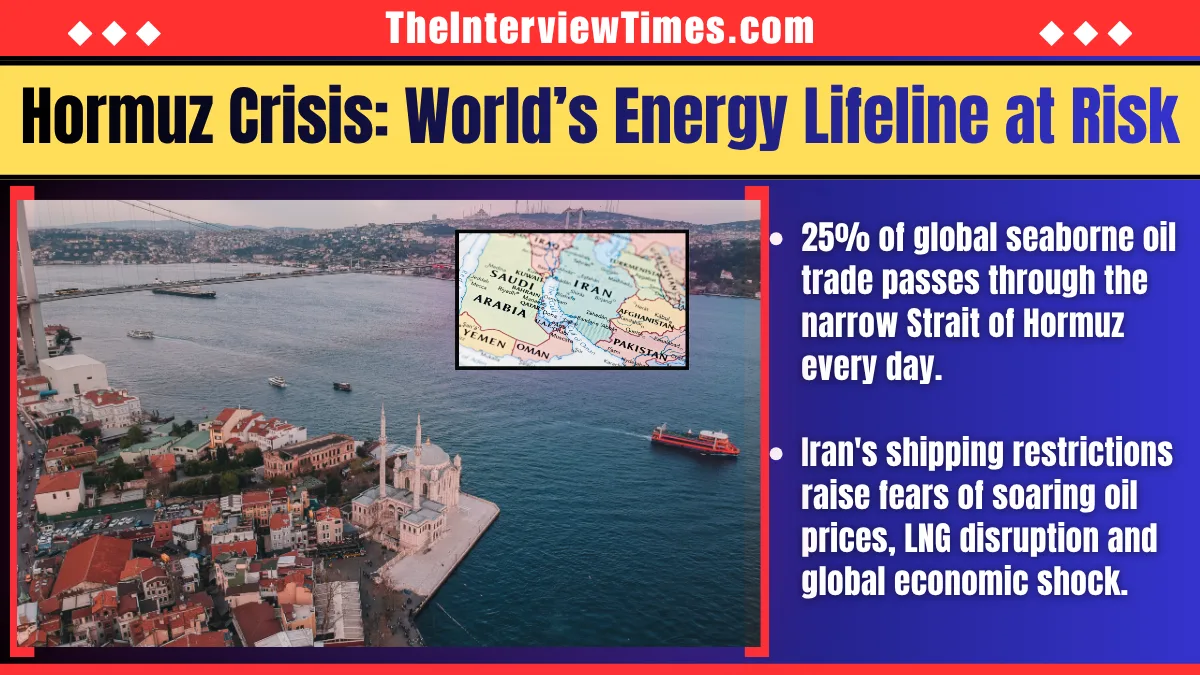
What is the Strait of Hormuz and why is it vital to global oil supplies? Explore Iran’s restrictions, shipping disruptions, India’s exposure and the global economic impact.
TheInterviewTimes.com | November 2, 2026 | New Delhi
Strait of Hormuz Explained: Why It Matters to Global Oil and Economy
The Strait of Hormuz has become one of the most strategically important flashpoints in the ongoing Middle East conflict. As Iran tightens restrictions on maritime traffic and attacks on commercial vessels disrupt shipping, concerns are growing over the future of global energy supplies.
The narrow waterway connects the Persian Gulf with the Gulf of Oman and the Arabian Sea. Although geographically small, it carries a significant share of the world’s oil and liquefied natural gas (LNG) shipments.
According to the International Energy Agency (IEA), approximately 20 million barrels of crude oil and petroleum products passed through the strait every day in 2025, accounting for around 25% of global seaborne oil trade.
With commercial shipping facing serious disruption, the situation has consequences far beyond Iran and its regional neighbours. From energy prices and international trade to economic stability, the Strait of Hormuz has become central to the global geopolitical crisis.
Where Is the Strait of Hormuz?
The Strait of Hormuz is located between southern Iran and Oman’s Musandam Peninsula. It connects the Persian Gulf to the Gulf of Oman, providing access to the Arabian Sea and wider international shipping routes.
At its narrowest point, the strait is approximately 39 kilometres wide. Its designated shipping lanes are much narrower, with separate channels for incoming and outgoing vessels.
The waterway is surrounded by major oil and gas producers, including Saudi Arabia, Iran, Iraq, Kuwait, Qatar, Bahrain and the United Arab Emirates.
For several of these countries, it is the principal maritime route for exporting energy products to international markets.
Its geography makes it difficult to replace. Unlike many commercial shipping routes, there are limited alternative pathways capable of handling comparable volumes of energy shipments.
Why Is the Strait of Hormuz So Important for Global Oil Supplies?
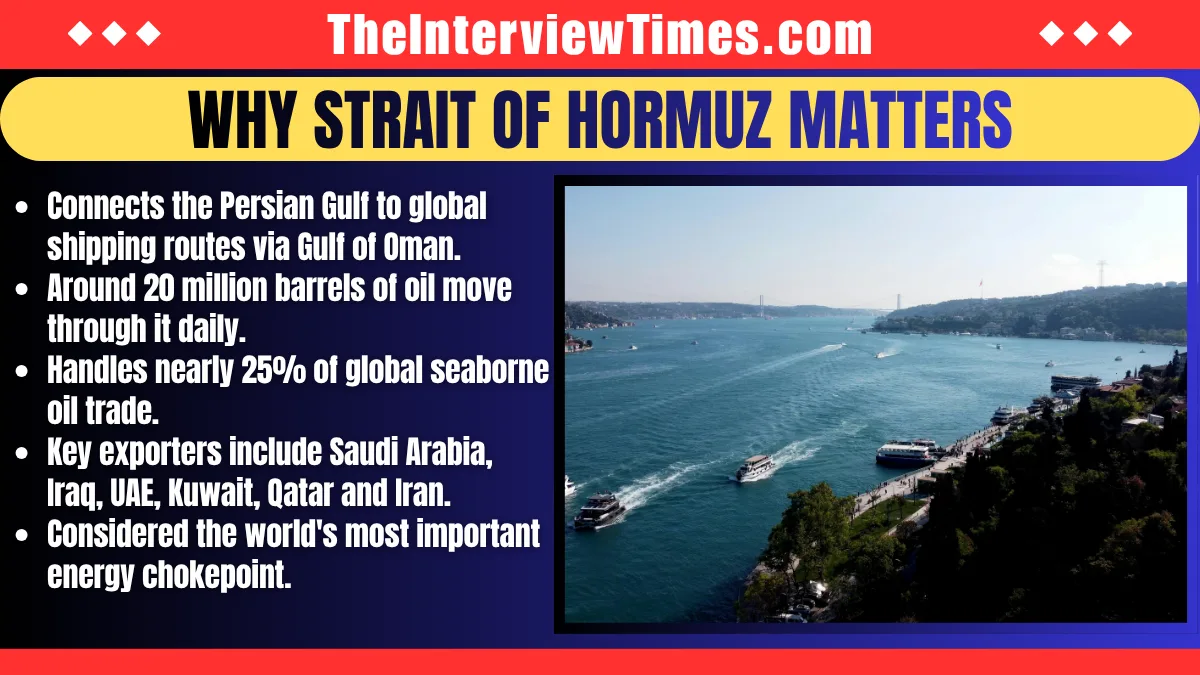
The Strait of Hormuz is one of the world’s most important energy chokepoints.
A chokepoint is a narrow geographical passage through which a substantial volume of international trade must travel. Any disruption can affect supply chains, transportation costs and commodity prices.
According to IEA data for 2025:
- Approximately 20 million barrels of oil and petroleum products crossed the strait daily.
- This represented around 25% of global seaborne oil trade.
- Nearly 15 million barrels per day consisted of crude oil and condensates.
- Around 80% of the oil and petroleum shipments were destined for Asian markets.
- China and India together received 44% of the crude oil exports passing through the waterway.
Saudi Arabia, Iraq, the UAE, Iran, Kuwait and Qatar are among the major exporters using this route.
The strait is equally important for natural gas. Approximately 93% of Qatar’s LNG exports and 96% of the UAE’s LNG exports pass through it, representing around 19% of global LNG trade.
This makes Hormuz essential not only for the petroleum industry but also for electricity generation, manufacturing and international energy security.
What Is Happening in the Strait of Hormuz in 2026?
The current crisis is connected to the wider military confrontation involving Iran, the United States and Israel.
Since the conflict escalated on February 28, 2026, maritime security in the Gulf region has deteriorated significantly. Iran has imposed restrictions on vessels attempting to pass through the strait and has targeted ships it considers to be violating those restrictions.
On November 1, Iran’s Islamic Revolutionary Guard Corps (IRGC) Navy claimed that two oil tankers had exploded after striking mines while travelling through what Tehran described as an unauthorised route.
The claim was reported by Iranian state media and Reuters. The circumstances of the alleged explosions were not independently verified in the Reuters report.
Shipping activity has also fallen sharply. According to Kpler data reported by Reuters on November 1, only five commodity vessels crossed the strait on Saturday, while no crossings were recorded on Sunday. The previous weekend had seen 31 crossings.
The slowdown followed attacks on commercial vessels and stalled negotiations between Washington and Tehran.
The situation illustrates how shipping can be disrupted even without a formally declared blockade. When shipowners and insurers consider a route too dangerous, commercial vessels may stop operating regardless of whether the waterway remains technically navigable.
What Would Happen If Iran Completely Blocked the Strait?
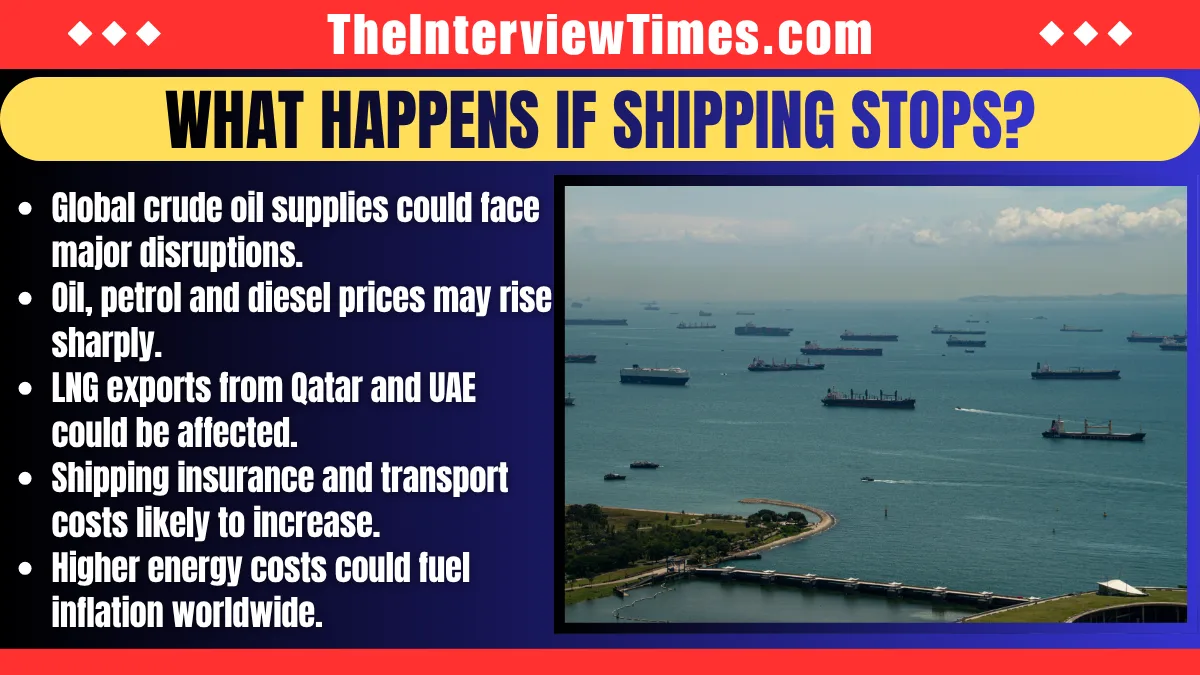
A prolonged closure could create one of the most serious energy supply disruptions in modern history.
The immediate consequence would be a reduction in the availability of oil from major Gulf producers. International buyers would have to compete for alternative supplies, potentially pushing crude oil prices higher.
Higher oil prices could increase petrol, diesel and transportation costs. Manufacturing industries, airlines and logistics companies would also face additional expenses.
The impact would not stop with petroleum.
Qatar and the UAE are important LNG exporters, and a disruption to their shipments could increase natural gas prices and electricity-generation costs in importing countries.
Shipping companies would also face higher insurance premiums, security expenses and delivery delays.
The economic consequences could therefore spread through several industries, contributing to inflation and increasing pressure on economies already dealing with geopolitical uncertainty.
Can Gulf Countries Bypass the Strait of Hormuz?
Some Gulf producers have alternative export infrastructure, but it cannot fully replace the Strait of Hormuz.
Saudi Arabia operates the East-West Pipeline, which transports crude oil towards Yanbu on the Red Sea. The UAE operates the Abu Dhabi Crude Oil Pipeline, connecting its oil-producing facilities with Fujairah, outside the strait.
According to the IEA, approximately 3.5 million to 5.5 million barrels per day of additional pipeline capacity could potentially be available to redirect crude oil away from Hormuz.
However, this is significantly lower than the approximately 20 million barrels of oil and petroleum products that normally pass through the strait every day.
Countries such as Kuwait, Qatar, Iraq and Bahrain remain particularly exposed because they have limited alternative export options.
Consequently, pipelines can reduce the impact of a disruption but cannot eliminate the global energy risks associated with a prolonged closure.
Why Is the Strait of Hormuz Important for India?
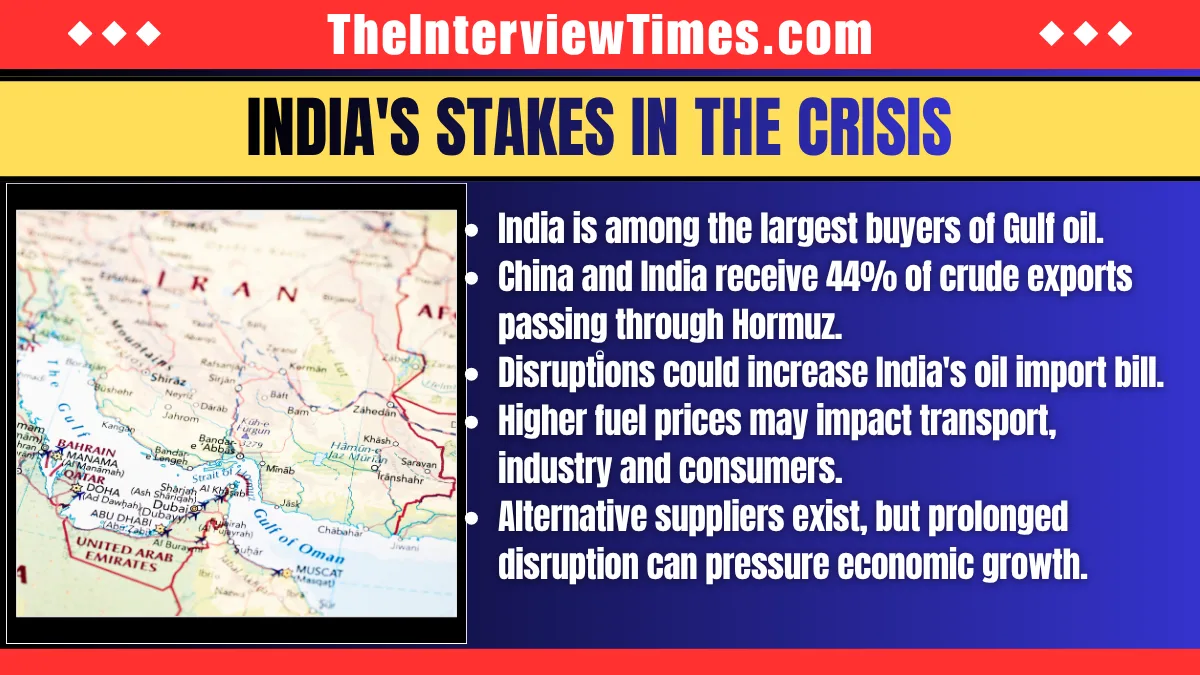
India is among the major Asian economies exposed to disruptions in the Strait of Hormuz.
As one of the world’s largest oil-importing countries, India depends on international energy supplies to support transportation, manufacturing, agriculture and electricity-related industries.
A prolonged disruption could increase India’s crude oil import bill and put pressure on the domestic economy.
Higher international oil prices could contribute to increased fuel and transportation costs. They could also raise production expenses for businesses and put additional pressure on inflation.
Currency movements and the cost of importing energy could create further challenges.
However, a disruption does not automatically mean India would run out of oil. The country can purchase crude from alternative suppliers, draw on available inventories and adjust its procurement arrangements.
The scale of the economic impact would depend on how long shipping remains disrupted and how successfully alternative supplies can compensate for the lost volumes.
Can Iran Legally Close the Strait of Hormuz?
The legal status of the waterway is another important aspect of the confrontation.
Under the United Nations Convention on the Law of the Sea (UNCLOS), international straits used for navigation between different parts of the high seas or exclusive economic zones are generally subject to the principle of transit passage.
This principle allows ships and aircraft to pass through such straits continuously and expeditiously.
Iran has signed UNCLOS but has not ratified it. Tehran has also disputed aspects of the convention’s application to the Strait of Hormuz.
Nevertheless, many countries and international legal experts maintain that important principles of freedom of navigation are also reflected in customary international law.
This creates a legal and diplomatic dispute over Iran’s restrictions, but it does not provide an immediate mechanism for restoring commercial shipping.
What Happens Next?
The future of the Strait of Hormuz will depend largely on negotiations between Iran and the United States and the wider military situation in the Middle East.
A diplomatic agreement could help restore commercial shipping and reduce pressure on international energy markets.
However, if restrictions and attacks continue, shipping companies may remain reluctant to use the route. Even after a ceasefire or agreement, restoring confidence among shipowners and insurers could take time.
A further military escalation could create additional risks for commercial vessels and energy infrastructure across the Gulf.
The Strait of Hormuz is therefore much more than a regional shipping route. It is a critical link in the global energy system, and any prolonged disruption has the potential to affect economies across the world.
The central question is whether Iran and the United States can find a diplomatic solution that restores safe navigation before the crisis develops into an even wider international economic and security challenge.
Must Read: The Arteries of the World: Maritime Chokepoints That Control Global Trade – theinterviewtimes.com