
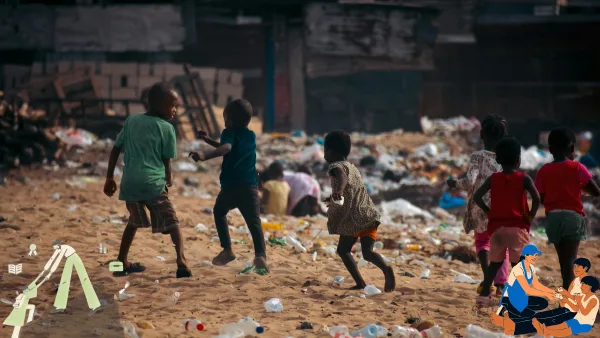
The Global Multidimensional Poverty Index 2025 reveals 1.1 billion people living in poverty, with 80% exposed to heat, floods, and air pollution.
A Double Burden of Poverty and Climate Change
The Interview Times | New Delhi | October 27, 2025 — The Global Multidimensional Poverty Index 2025 (MPI 2025), released by the Oxford Poverty and Human Development Initiative (OPHI) and the United Nations Development Programme (UNDP), reveals that 1.1 billion people — or 18.3% of the population across 109 countries — are still living in acute multidimensional poverty.
But what makes this year’s Global Multidimensional Poverty Index 2025 alarming is the growing overlap between poverty and climate hazards — from deadly heatwaves to floods and air pollution — creating what researchers describe as a “double burden of deprivation and danger.”
Must Read: The Global Hunger Crisis 2025: A Stark Reality on World Food Day
Children and Rural Poor at the Epicentre
According to the Global Multidimensional Poverty Index 2025, children remain the most vulnerable. Around 27.8% of all children — approximately 586 million — live in multidimensional poverty, more than double the rate among adults (13.5%).
Rural areas are the hardest hit. Nearly 83.5% of multidimensionally poor people live in rural regions, though they make up only half of the world’s population. The MPI 2025 report highlights that poverty in rural zones is not just deeper but more persistent, often accompanied by deprivation in nutrition, education, and housing.
1.1 billion people today live in multidimensional poverty.
— UN Development (@UNDP) October 27, 2025
And a vast majority live with climate hazards every day.
The world’s most vulnerable cannot be left behind as the planet warms.
Find out more in our 🆕 #MultidimensionalPoverty Index Report: https://t.co/Pn05IEPZ6c pic.twitter.com/rCpgYDt0Rk
Middle-Income Countries: The Hidden Poverty Hubs
Contrary to conventional assumptions, the Global Multidimensional Poverty Index 2025 finds that two-thirds of the world’s poor—about 740 million people—live in middle-income countries.
Of these, 637 million live in lower-middle-income nations such as India, Bangladesh, Nigeria, and Pakistan, while 103 million are in upper-middle-income nations.
The report warns that these countries also face the highest exposure to climate risks, amplifying vulnerabilities among communities already struggling with poor health, unsafe housing, and inadequate sanitation.
Climate Hazards Deepen Human Deprivation
The Global Multidimensional Poverty Index 2025 underscores how climate disasters are aggravating poverty worldwide:
- 887 million poor people are exposed to at least one major climate hazard.
- 608 million face extreme heat, 577 million endure air pollution, 465 million live in flood-prone regions, and 207 million experience frequent droughts.
- Over 651 million people confront two or more climate hazards, while 309 million face three or four simultaneously.
The MPI 2025 report identifies South Asia and sub-Saharan Africa as global epicentres of these overlapping hardships. In South Asia alone, 99% of poor people live in regions affected by at least one climate hazard, while 59% face multiple threats at once.
Must Read: Gender Equality: A Pillar for Sustainable Development and Social Justice
India and South Asia: Progress Shadowed by Climate Risk
India, highlighted prominently in the Global Multidimensional Poverty Index 2025, has recorded one of the fastest reductions in global poverty. Between 2005–06 and 2019–21, India’s multidimensional poverty rate fell from 55.1% to 16.4%, lifting over 414 million people out of poverty.
Bangladesh and Nepal achieved similar gains, showing that large-scale poverty reduction is possible even in developing economies.
Yet, the MPI 2025 warns that South Asia’s climate exposure is now among the highest globally, threatening to reverse progress unless climate resilience and adaptation are integrated into poverty eradication strategies.
Living Standards Show Persistent Gaps
Across all countries assessed by the Global Multidimensional Poverty Index 2025, the report finds critical gaps in living standards:
- 970 million people still lack clean cooking fuel.
- 878 million live in substandard housing.
- 830 million do not have adequate sanitation.
- 635 million experience undernourishment, while 581 million live in households with no adult who has completed six years of schooling.
These interlinked deprivations underscore how multidimensional poverty extends far beyond income — capturing health, education, and basic human dignity.
Poverty Reduction Stalling After the Pandemic
One of the most concerning insights from the Global Multidimensional Poverty Index 2025 is that poverty reduction has stagnated globally since 2018.
Out of 26 countries with post-2021 data, only 16 showed significant improvement. Nations like Afghanistan and Kyrgyzstan recorded increases in both poverty incidence and intensity — a reversal of earlier progress.
Experts warn that without urgent global intervention, climate shocks could double extreme poverty by 2050.
Future Outlook: More Heat Ahead for Poor Nations
Projections in the Global Multidimensional Poverty Index 2025 suggest that countries with the highest poverty levels will experience 37 more days of extreme heat annually by 2040–2059, and up to 92 additional hot days by 2080–2099 under high-emission scenarios.
These same countries also face limited capacity to cope — lacking financial, infrastructural, and technological resilience.
Must Read: Snow Leopards in Danger: Climate Change Threatens Central Asia’s “Ghosts of the Mountains”
A Call for Global Action and Climate Finance
The MPI 2025 report concludes with an urgent call to align poverty reduction, climate adaptation, and sustainable development. It urges high-income nations and international institutions to provide scaled-up financing, early warning systems, and adaptive social protection for low- and lower-middle-income countries.
“The world’s poorest are now trapped at the intersection of deprivation and disaster,” the report states. “Resolving the dual crises of poverty and climate change must become a shared global priority.”
Mahendra Singh is a seasoned journalist and editor at TheInterviewTimes.com with over 28 years of experience. An alumnus of IIMC, he writes on international affairs, politics, education, environment, and key social issues.