
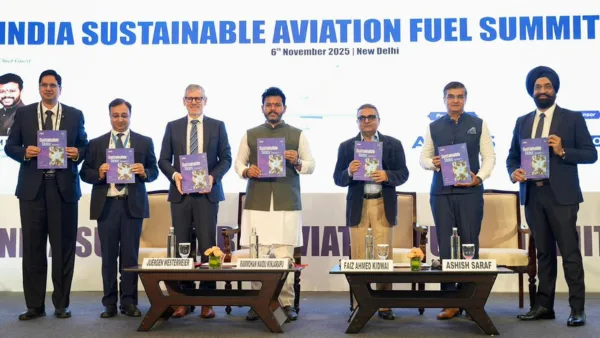
India SAF Summit 2025: India Unveils Ambitious Sustainable Aviation Fuel Policy for a Greener Future
India SAF Summit 2025 marks a turning point as India launches its Sustainable Aviation Fuel Policy, targeting cleaner skies and green economic growth.
TheInterviewTimes.com | New Delhi | November 6, 2025 — India is preparing to revolutionize its aviation sector with the launch of its Sustainable Aviation Fuel Policy, a key highlight at the India SAF Summit 2025. The policy aims to accelerate the transition toward cleaner skies while driving economic and rural development. It underscores India’s ambition to become a global leader in sustainable aviation, aligning growth goals with strong climate action.
Ambitious SAF Blending Targets Announced at India SAF Summit 2025
Union Civil Aviation Minister Ram Mohan Naidu, addressing the India SAF Summit 2025, announced progressive blending targets for Sustainable Aviation Fuel (SAF) in aviation turbine fuel. The policy mandates 1% SAF blending by 2027, 2% by 2028, and 5% by 2030.
These milestones align with India’s commitment under the Carbon Offsetting and Reduction Scheme for International Aviation (CORSIA). The minister emphasized that SAF can directly replace conventional jet fuel, ensuring compatibility without the need for major infrastructure changes. This initiative positions India to meet global sustainability standards while taking advantage of the booming demand for green aviation fuel.
Today, Hon’ble Civil Aviation Minister Shri Ram Mohan Naidu addressed the India SAF Summit, which served as a key forum for engagement among regulators, oil companies, certifying agencies, and sustainability experts on advancing sustainable aviation fuel initiatives.
— MoCA_GoI (@MoCA_GoI) November 6, 2025
The… pic.twitter.com/IeX7VV0LSL
Economic and Rural Development Opportunities
At the India SAF Summit 2025, leaders highlighted the enormous economic potential of SAF. India’s rapidly growing airline industry, projected to cross 1,700 aircraft orders, demands sustainable alternatives to reduce dependence on imported crude oil.
The new Sustainable Aviation Fuel Policy could lower India’s crude oil import bill by $5–7 billion annually and generate over one million green jobs. More importantly, rural communities stand to benefit directly. With over 750 million tonnes of biomass and 213 million tonnes of agricultural residue available annually, SAF production can raise farmer incomes by 10–15%.
The policy encourages the use of multiple feedstocks — from agricultural waste to used cooking oil — allowing small farmers and rural entrepreneurs to join the emerging green fuel ecosystem.
New Delhi: On India Sustainable Aviation Fuel (SAF) Summit, Union Minister Ram Mohan Naidu Kinjarapu says, "I just participated in the India SAF Summit and observed significant interest and enthusiasm around Sustainable Aviation Fuel (SAF) in the country. This comes at a time… pic.twitter.com/A74yyGAEBk
— IANS (@ians_india) November 6, 2025
Major Environmental Gains from Sustainable Aviation Fuel
Sustainable aviation fuel can reduce lifecycle CO₂ emissions by up to 80% compared to conventional jet fuel. With India’s aviation fuel demand expected to reach 15–16 million tonnes by 2030 and double by 2040, SAF is essential for the nation’s decarbonization roadmap.
As discussed at the India SAF Summit 2025, scaling up SAF production will deliver nationwide climate benefits while reinforcing India’s potential to become a net exporter of sustainable fuel by 2040. This marks a strategic move toward meeting international climate commitments and achieving cleaner, more energy-resilient skies.
Must Read: Mountain Gorillas Face New Climate Threat as Population Recovery Hangs in Balance
India’s Strategic Edge in Global SAF Leadership
India’s leadership in Sustainable Aviation Fuel stems from its rich bio-based feedstocks and established refining capacity. The Indian Oil Corporation (IOC) recently announced that its Panipat refinery will be certified to produce 35,000 tonnes of SAF annually starting December 2025.
Global demand for Sustainable Aviation Fuel is projected to reach 183 million tonnes by 2040, offering massive export potential. The India SAF Summit 2025 showcased India’s readiness to capitalize on this market, leveraging innovation, technology, and sustainability to emerge as a frontrunner in green aviation fuel exports.

Industry Response and Future Outlook
The announcement at the India SAF Summit 2025 received strong support from airline operators, biofuel producers, farmer groups, and policymakers. The launch of the India SAF Alliance during the event signifies a collaborative push toward building a robust SAF supply chain and innovation ecosystem.
Experts suggest that continued policy incentives, production subsidies, and market development programs will be vital to scaling SAF adoption. However, India’s successful track record in bioenergy and renewable feedstock management gives it a clear head start in building a thriving green aviation economy.
Conclusion: India SAF Summit 2025 Sets the Path for a Sustainable Aviation Future
The India SAF Summit 2025 marks a defining moment in India’s clean energy transition. The new Sustainable Aviation Fuel Policy integrates environmental responsibility with economic opportunity, strengthening both climate action and rural livelihoods.
By mobilizing domestic resources, promoting innovation, and enabling partnerships across sectors, India is positioning itself as a global leader in sustainable aviation fuel production. This initiative not only supports national energy security but also sets a global benchmark for balancing growth, climate resilience, and green development.