
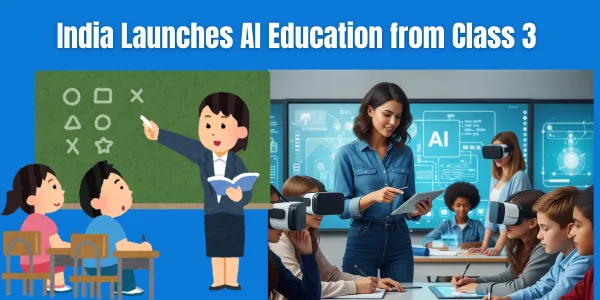
Discover how AI Education in India is transforming schools, with AI becoming part of the curriculum from Class 3 starting 2026-27, aligning with NEP 2020 to prepare students for a tech-driven future.
New Delhi | October 12, 2025 | The Interview Times — In a groundbreaking move toward preparing young minds for a technology-driven future, the Ministry of Education has announced that AI Education in India will officially begin from Class 3, starting in the 2026–27 academic session. Rooted in the vision of the National Education Policy (NEP) 2020, this bold reform aims to promote digital literacy, creativity, and innovation among schoolchildren—positioning India as a global leader in AI-driven learning.
A New Era for AI Education in India
The integration of Artificial Intelligence into the school curriculum marks a transformative step for AI Education in India. The Central Board of Secondary Education (CBSE) has been entrusted with designing age-appropriate AI modules to help young students understand core concepts through engaging, hands-on activities. The goal is to make learning both fun and futuristic.
Currently, over 18,000 CBSE schools already offer AI as a skill module from Class 6. However, the new policy expands this framework dramatically, making AI Education in India a mandatory subject from Class 3 in more than 31,000 schools.
Students as young as eight years old will be introduced to AI applications, helping them understand how technologies like chatbots, image recognition, and voice assistants work in daily life.
These early lessons in AI Education in India will focus on foundational skills—pattern recognition, logic, and ethical awareness—while older students will progress toward advanced topics like data interpretation and machine learning basics.
Must Read: Nvidia CEO Jensen Huang, One of the World’s Richest, Challenges the Degree-Only Path to Success
Empowering Teachers for AI Education
For AI Education in India to succeed, well-trained educators are crucial. The Ministry of Education has already initiated pilot programs to train teachers in AI-based tools, lesson planning, and digital evaluation methods. The objective is to train nearly 10 million teachers nationwide within the next three years.
Through this initiative, educators will learn not only how to teach AI but also how to incorporate it into existing subjects like mathematics, science, and social studies. This interdisciplinary model will make AI Education in India more impactful and practical for both urban and rural learners.
Economic Impact and the India AI Mission
The push for AI Education in India aligns with the broader India AI Mission, aimed at democratizing access to AI tools and knowledge. A recent NITI Aayog report titled “AI and Jobs” highlighted that while AI may displace around 2 million jobs by 2030, it can also generate up to 8 million new roles in AI-related industries such as data science, robotics, and automation.
By introducing AI Education in India at the school level, the government aims to build a future-ready workforce. Students exposed to AI concepts from an early age will be better equipped to contribute to India’s growing digital economy, ensuring that the country becomes a global AI innovation hub.
Challenges in Implementing AI Education
Despite its promise, implementing AI Education in India nationwide presents challenges—especially in rural areas where access to computers and internet connectivity remains limited. The Ministry of Education, along with NITI Aayog, plans to bridge this gap through the India AI Mission, focusing on infrastructure development and equitable access to digital tools.
Another important aspect of AI Education in India is ethics. Students will be taught about responsible AI usage, data privacy, and algorithmic bias. This will ensure that India’s future innovators use technology ethically and inclusively.
A Future-Ready India
As School Education Secretary Sanjay Kumar stated, “We are not just teaching students to use technology but empowering them to create it.” This vision perfectly captures the essence of AI Education in India—moving from passive learning to creative problem-solving.
With AI becoming part of the curriculum from Class 3, India is taking a historic step toward shaping a generation ready for a digital and automated world. Parents, educators, and policymakers can access more information about AI Education in India on the Ministry of Education website and the CBSE portal.
As this visionary initiative unfolds, AI Education in India is set to redefine how young learners engage with technology, innovation, and the future itself—making India a true leader in AI-driven education.