
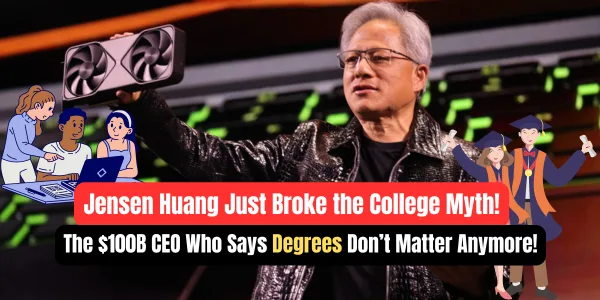
Nvidia CEO Jensen Huang urges youth to value skilled trades and practical science over traditional degrees, redefining success in the AI-driven economy.
In the evolving landscape dominated by artificial intelligence (AI), Nvidia CEO Jensen Huang has sparked a global conversation by questioning the long-held belief that a university degree is the primary path to career success.
Huang advocates that practical skills, particularly in the skilled trades, hold tremendous value and can be just as, if not more, important than academic achievements in meeting the demands of this new era.
The Value of Skilled Trades in the AI Economy
Nvidia CEO Jensen Huang emphasizes that the AI revolution depends not just on software engineers and computer scientists, but heavily on the physical infrastructure that supports AI systems. Behind every complex AI algorithm lies a vast network of data centers requiring construction, wiring, cooling, and maintenance.
According to Nvidia CEO Jensen Huang, electricians, plumbers, carpenters, and HVAC technicians are essential workforce segments needed to build and sustain these AI “factories.”
He stated in a recent interview, “If you’re an electrician, a plumber, a carpenter—we’re going to need hundreds of thousands of them to build all these factories… the skilled craft segment of every economy is going to see a boom.”
This assertion challenges traditional perspectives that prioritize four-year college degrees over vocational education. Huang argues that society has “overvalued four-year degrees while undervaluing vocational training,” urging a reassessment of how we prepare the workforce for future demands.
Must Read: NVIDIA CEO Jensen Huang: AI as India’s Empowerment Tool, Not a Threat
A Call for Practical Science and Foundational Skills
Reflecting on his educational journey, Nvidia CEO Jensen Huang revealed that if he were a student today, he would concentrate more on physical sciences—such as physics, chemistry, and material science—rather than exclusively on software.
He believes that understanding these fundamentals underpins all emerging technologies and yields practical expertise critical for the AI era.
His perspective underscores the need for education systems and career aspirants to balance theoretical and applied knowledge, urging young people to rethink conventional career paths to include trades and physical sciences as viable, lucrative choices.
The Future Is Hybrid: Bridging Technical and Practical
While reiterating the importance of trades, Nvidia CEO Jensen Huang does not discount the role of software engineers, data scientists, or machine learning experts who advance AI technology.
Instead, he envisions the most future-ready workforce blending technical fluency and hands-on skills. Hybrid skill sets that combine domain expertise, practical knowledge, and the ability to interface effectively with AI will drive the next workforce wave.
Huang also stresses that succeeding with AI involves understanding how to interact with AI tools thoughtfully. He compares engaging with AI to an art form: asking the right questions and critically evaluating AI outputs requires advanced cognitive skills, reasoning, and creativity.
Impact on Education and Workforce Planning
Huang’s statements align with broader discussions among tech leaders questioning the primacy of traditional university education for all. As data center construction accelerates worldwide to meet AI demand, industry reports indicate rising wages for skilled tradespeople, signalling a fundamental shift in labour market dynamics.
His insights prompt governments, educators, and industries to explore policies that promote vocational training, apprenticeships, and dual-track education systems that value practical skills alongside academic accomplishments.
Must Read: Who is Aravind Srinivas? Inside the Billionaire Journey of India’s AI Prodigy
Conclusion
Nvidia CEO Jensen Huang’s challenge to the status quo encourages a holistic view of career preparation in the AI age.
By highlighting the indispensable role of practical trades and foundational physical sciences, alongside advanced AI literacy, Huang reframes success as achievable through multiple pathways—not solely the traditional university degree.
His message to the younger generation is clear: adaptability, practical skills, and thoughtful AI interaction will define their opportunities, reshaping how society values education and work in an AI-driven future.
About the Author: Authors at The Interview Times are part of a dynamic editorial team committed to factual, research-based journalism. Our contributors cover a wide range of topics — from education and technology to governance and global issues — with a focus on clarity, credibility, and public interest. Stay connected with us on Facebook, X