
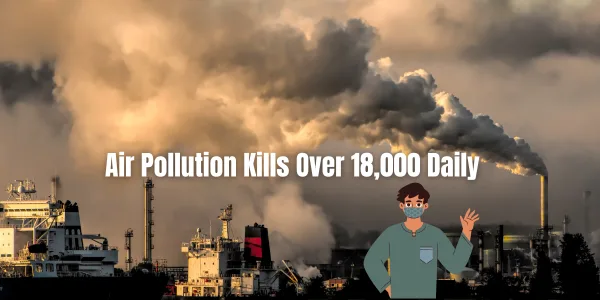
On Clean Air Day 2025, the world faces a stark reminder that air pollution causes over 8 million deaths annually, reduces life expectancy, fuels dementia, and costs the global economy trillions. Urgent action is needed to secure clean air for all.
New Delhi, India – Today, September 7, 2025, marks the International Day of Clean Air for Blue Skies, also known as “Clean Air Day.” The 2025 theme, “Racing for Air. Every Breath Matters,” mobilizes collective action across government, business, and civil society to combat air pollution and safeguard public health.
Air pollution stands among humanity’s most dangerous threats, directly endangering health, longevity, and the very blueprint of economic and environmental sustainability.
Must Read: Global Plastic Pollution Treaty Talks Stall: Urgent Action Needed to Combat Plastic Waste
Staggering Health Toll Across the Globe
- Roughly 8.1 million fatalities in 2021 were attributed globally to air pollution—ranking it the second-highest risk factor for death worldwide.
- The World Health Organization (WHO) estimates around 6.7 million annual deaths from air pollution, with 4.2 million due to outdoor exposure.
- In low- and middle-income countries, especially across South-East Asia and the Western Pacific, the burden is heaviest: 89% of outdoor pollution-related premature deaths occur there.
- In India, ambient air pollution alone claims ~670,000 lives annually, severely aggravating heart and respiratory ailments. Household pollution sources add significantly to this toll.
- Air pollution shrinks average life expectancy—by 2.1 years in Andhra Pradesh, and up to 8.2 years in Delhi.
Evolving Threats: Dementia, Wildfires & Indoor Pollution
- A new Johns Hopkins study establishes a disturbing link between PM₂.₅ exposure and Lewy body dementia, showing that air pollution can accelerate neurodegenerative decline.
- The World Meteorological Organization (WMO) reports that wildfires, worsened by climate change, are raising global particulate pollution to levels comparable to fossil fuel burning. The WHO attributes 4.5 million premature deaths annually to ambient air pollution alone.
- Even indoor spaces offer no safe haven: Wildfire smoke infiltrates homes, exposing over 1 billion people annually to dangerous PM₂.₅. Mitigation costs are projected between $68 billion and $4 trillion, underscoring the need for government-led solutions.
Economic Fallout and Inequity
- Air pollution inflicts vast economic damage:
- $6 trillion in global health-related costs annually.
- A 5% reduction in global GDP due to lost productivity and diminished life expectancy.
- The World Bank warns that 90% of humanity faces threats from pollution, land degradation, and water stress—urging enhanced resource efficiency and a shift away from destructive subsidies.
- Persistent inequalities mean that the poorest communities, especially in developing regions, bear the brunt—while solutions like air purifiers and clean cooking remain out of reach for millions.
Must Read: Older Vehicles Fuel Delhi-NCR’s Air Pollution Crisis: Latest Data Highlights Urgent Need for Action
Why This Matters – Right Now
- Air pollution is avoidable—and reversible. Evidence from Europe, China, and other regions shows that targeted policies yield rapid health gains.
- The International Day of Clean Air for Blue Skies is more than symbolic—it’s a launchpad for collaborative global action, guided by sustainable development goals like SDG 3 (healthy lives) and SDG 11 (sustainable cities).
Key Facts at a Glance
| Issue | Impact & Insight |
| Global Death Toll | 6.7–8.1 million annually |
| Children under 5 | ~709,000 deaths in 2021 |
| Life Expectancy Loss | 2.1 years (Andhra Pradesh); up to 8.2 years (Delhi) |
| Dementia Risk | PM₂.₅ exposure linked to Lewy body dementia |
| Wildfire Impact | Major contributor to pollution; indoor infiltration widespread |
| Economic Cost | $6 trillion health costs; 5% global GDP loss |
| Indoor Cooking | 3.1 million deaths globally in 2021 due to household smog |
A Global Call to Action
As we observe Clean Air Day 2025, its clarion call echoes in every smokestack shutdown, every clean-transport policy, and every green rooftop. Clean air is not a luxury—it’s a fundamental right and an urgent public health imperative. Immediate, equitable, science-based action can restore each breath as a gift—not a hazard.