
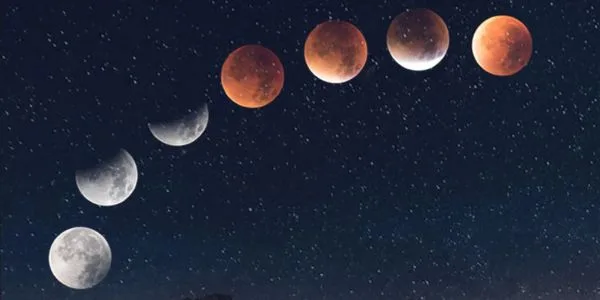
India will witness a rare Blood Moon eclipse on September 7–8, 2025. Check timings, visibility, and tips to watch this stunning total lunar event.
As the night sky prepares for a dazzling celestial show, skywatchers across India are gearing up for the highly anticipated Blood Moon eclipse on September 7–8, 2025. This total lunar eclipse, known for its reddish glow, will last 82 minutes of totality, making it one of the most spectacular astronomical events of the year. With favorable weather conditions expected in many regions, millions in India will be able to enjoy this cosmic spectacle.
What Is a Blood Moon Eclipse?
A Blood Moon eclipse is a type of total lunar eclipse in which the Moon turns a deep red color. This happens when Earth moves directly between the Sun and the Moon, blocking sunlight and casting its shadow on the lunar surface. Earth’s atmosphere scatters blue light, while red wavelengths bend around and illuminate the Moon, giving it a striking crimson appearance.
What makes this eclipse special is its rarity. Belonging to Saros series 128, it comes just days before the Moon’s perigee (closest point to Earth), giving it a subtle “Supermoon” effect. For India, this is the second total lunar eclipse of 2025, but the first fully visible from the subcontinent.
Must Read: AI-Powered Stethoscope Detects Heart Conditions in Just 15 Seconds
Timings for the Blood Moon Eclipse in India
The lunar event will unfold over several stages, all visible in Indian Standard Time (IST):
- Penumbral Eclipse begins: 8:58 PM, Sept 7
- Partial Eclipse begins: 9:57 PM
- Total Eclipse (Blood Moon) begins: 11:00 PM
- Totality ends: 12:22 AM, Sept 8
- Partial Eclipse ends: 1:25 AM
- Penumbral Eclipse ends: 2:25 AM
This means skywatchers in India will enjoy more than five hours of eclipse activity, with the blood-red phase lasting nearly 82 minutes.
Visibility Across India and Beyond
The Blood Moon eclipse will be visible across all of India, including major cities such as Delhi, Mumbai, Kolkata, Chennai, Bengaluru, Hyderabad, Pune, and Lucknow. Rural areas with minimal light pollution—hill stations, deserts, or coastal regions—will offer the clearest views.
Globally, this eclipse will be visible in most of Asia, Australia, Africa, Europe, and parts of the Americas—covering nearly 77% of the world’s population.
For Indian viewers, local weather conditions may affect visibility, so checking forecasts closer to the date is recommended.
Must Read: New Research: Donating Blood Changes Your Genes
How to Watch the Blood Moon Eclipse Safely
Unlike solar eclipses, the Blood Moon eclipse is safe to watch with the naked eye. No protective glasses are required. However, binoculars or telescopes can enhance details like lunar craters and surface textures.
Photography enthusiasts should use a tripod and long-exposure settings to capture the Moon’s rich red tones. For those under cloudy skies, several websites such as Timeanddate.com and Space.com will live stream the eclipse.
Cultural and Spiritual Significance in India
In Indian traditions, lunar eclipses carry cultural and spiritual meaning. Many communities observe “Sutak Kaal”, an inauspicious period beginning nine hours before the eclipse. During this time, cooking, eating, and certain rituals are avoided. Temples may close temporarily, reopening with purification rituals once the eclipse ends.
The Blood Moon eclipse of September 2025 thus becomes not just an astronomical event but also a moment of cultural reflection, blending modern science with ancient traditions.
As September 7 approaches, the Blood Moon eclipse of 2025 promises to be a breathtaking sight for India and much of the world. Whether you are in a bustling city or a quiet countryside, this is a night to step outside, look up, and witness the universe’s grandeur.
FAQs on the Blood Moon Eclipse
Q1. Is the Blood Moon eclipse visible in India?
Yes, the September 7–8, 2025 Blood Moon eclipse will be visible across all of India, weather permitting.
Q2. What time is the Blood Moon eclipse in India?
Totality begins at 11:00 PM on September 7 and lasts until 12:22 AM on September 8, 2025.
Q3. Do we need special glasses to watch it?
No. Unlike a solar eclipse, a lunar eclipse is completely safe to view with the naked eye.
Q4. Why is it called a “Blood Moon”?
Because Earth’s atmosphere filters sunlight during the eclipse, scattering blue light and casting a red glow on the Moon.