

TheInterviewTimes.com | March 14, 2026 | 10:57 AM IST | New Delhi
China adopts the Ecological and Environmental Code, a sweeping law replacing 10 statutes to combat pollution, protect ecosystems, and drive low-carbon development from August 2026.
Key Highlights
- China has adopted its first Ecological and Environmental Code, consolidating more than 30 environmental statutes.
- The sweeping law contains 1,242 articles across five sections and will take effect August 15, 2026.
- It replaces 10 major environmental laws, creating a unified national system to tackle pollution and ecological damage.
- The code embeds carbon neutrality goals, biodiversity protection, and pollution monitoring into national legislation.
- Experts say the law could become a global benchmark for environmental governance and green development.
China has adopted its first Ecological and Environmental Code, a landmark legal framework designed to unify environmental governance and accelerate the country’s transition toward sustainable development.
The legislation was approved on March 12, 2026, during the fourth session of the 14th National People’s Congress (NPC) in Beijing. Lawmakers unanimously endorsed the comprehensive statute, which consolidates decades of environmental regulations into a single, coordinated legal structure.
Containing 1,242 articles, the code merges provisions from more than 30 existing statutes and over 100 administrative regulations. Once implemented on August 15, 2026, it will replace 10 major environmental laws, creating a streamlined system to regulate pollution, protect biodiversity, and enforce ecological accountability across the country.
The adoption marks one of the most ambitious environmental legal reforms in China’s modern history.
A Legislative Milestone in China’s Green Transition
The Ecological and Environmental Code reflects Beijing’s long-term policy vision of building an “ecological civilization,” a governing principle that emphasizes harmony between economic growth and environmental protection.
Over the past decade, China has faced mounting challenges related to air pollution, water contamination, soil degradation, and biodiversity loss. Rapid industrialization lifted millions out of poverty but also placed severe stress on ecosystems.
By integrating fragmented regulations into a single code, policymakers aim to strengthen enforcement, reduce bureaucratic overlap, and create a more coherent framework for environmental governance.
Legal experts described the move as a historic codification of China’s environmental reforms.
The drafting process began in early 2025, with multiple rounds of consultation involving academic institutions, environmental groups, industry representatives, and provincial governments.
Structure of the Ecological and Environmental Code
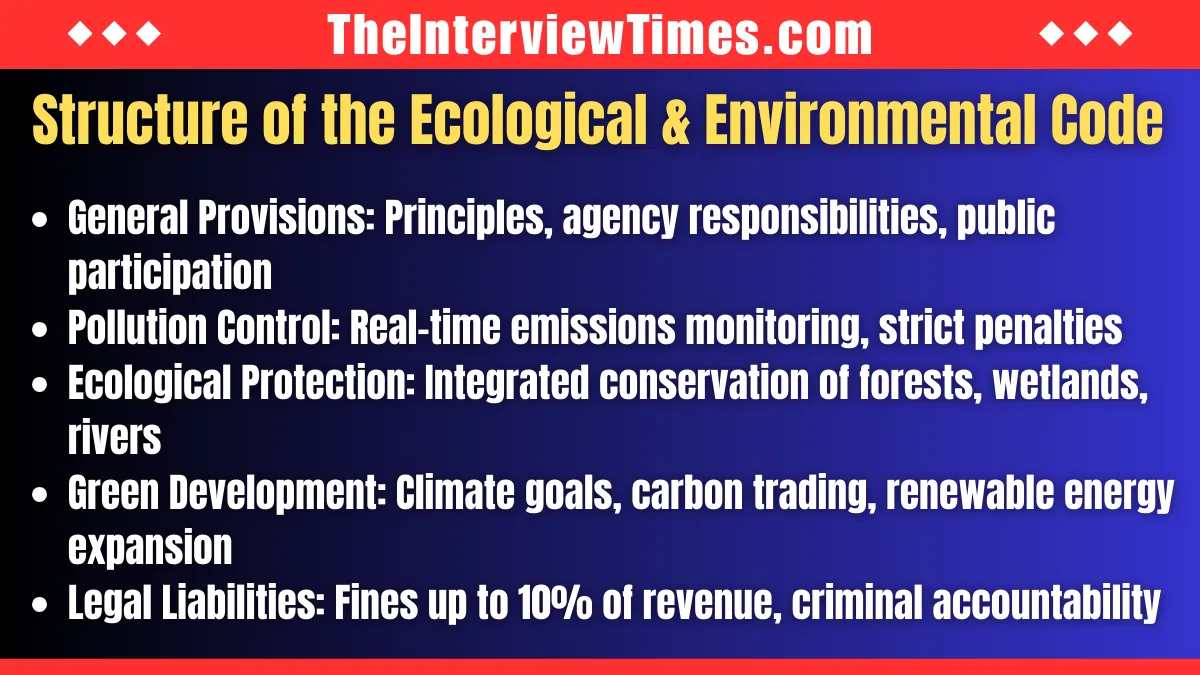
The Ecological and Environmental Code is organized into five major sections, each focusing on a different dimension of environmental management.
1. General Provisions
This section establishes the guiding principles of environmental governance. It defines the responsibilities of government agencies, outlines environmental impact assessment procedures, and introduces mechanisms for public participation and ecological compensation.
It also sets nationwide standards to ensure consistent implementation across provinces.
2. Pollution Prevention and Control
The second section addresses traditional environmental threats such as air pollution, water pollution, soil contamination, noise, solid waste, and radioactive substances.
New provisions require real-time emissions monitoring for major industrial facilities. Companies that exceed pollution limits could face heavy penalties, operational suspensions, or criminal prosecution.
3. Ecological Protection
The third section focuses on preserving ecosystems and biodiversity. It promotes integrated conservation strategies covering forests, wetlands, grasslands, rivers, farmland, lakes, and deserts.
China’s environmental planners increasingly emphasize managing these ecosystems as interconnected natural systems, rather than isolated resources.
The code also introduces mechanisms to handle human-wildlife conflicts in rapidly developing regions.
4. Green and Low-Carbon Development
One of the most innovative features of the code is a dedicated chapter focused on climate and sustainability.
This section embeds China’s national climate goals directly into law, including:
- Carbon emissions peaking before 2030
- Carbon neutrality by 2060
It also promotes carbon trading markets, renewable energy expansion, energy-efficiency standards, and recycling systems for technologies such as solar panels and electric-vehicle batteries.
5. Legal Liabilities and Enforcement
The final section outlines penalties for violations and expands enforcement powers.
Polluters could face fines reaching up to 10% of annual revenue, along with criminal liability in severe cases.
The code also strengthens public interest litigation, allowing environmental groups and prosecutors to take legal action against violators.
Must Read: Every Year, 10M Hectares of Forests Vanish-Halting Deforestation Is Our Only Hope
Technology and Public Participation
A major innovation in the Ecological and Environmental Code is the integration of digital monitoring systems.
Industries will be required to install automated sensors that track emissions in real time. Data will be transmitted directly to government monitoring platforms.
Authorities are also encouraging public involvement through mobile apps and reporting systems, enabling citizens and environmental organizations to report violations quickly.
These mechanisms aim to improve transparency and strengthen accountability in environmental governance.
Global Significance of the Law
China’s new code has attracted international attention because of its scale and ambition.
As the world’s largest carbon emitter and a major renewable energy investor, China plays a crucial role in global climate policy.
Environmental analysts say the Ecological and Environmental Code could become a model for other nations seeking comprehensive environmental legislation.
The law also aligns with international commitments under the Paris Climate Agreement, incorporating adaptation strategies for climate risks such as sea-level rise, extreme weather, and ecological degradation.
Implementation Challenges Ahead
Despite the law’s sweeping scope, experts caution that its success will depend on effective enforcement.
China’s environmental governance often relies on local governments, which must balance economic growth with ecological protection.
Implementing the new code will require stronger regulatory capacity, improved monitoring systems, and greater coordination among agencies.
Industries will also need to adapt to stricter environmental standards and compliance mechanisms.
A Turning Point for Environmental Governance
The Ecological and Environmental Code signals China’s determination to embed sustainability at the heart of its development strategy.
By transforming the slogan “lucid waters and lush mountains are invaluable assets” into binding legislation, Beijing aims to shift the country toward a greener growth model.
If effectively implemented, the code could reshape environmental governance not only in China but also across the developing world.
Top News: UN Report Warns Global Warming Still on Track for Dangerous 2.5°C Rise
