
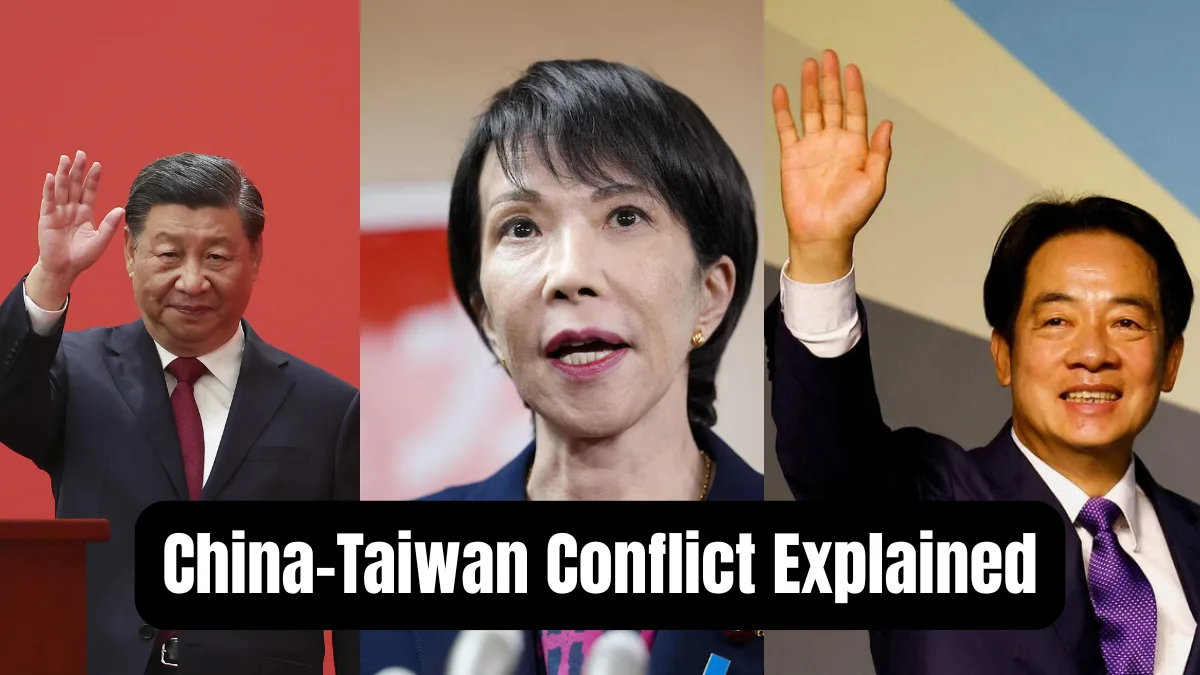
The long-running China-Taiwan conflict has taken a dramatic turn, reaching the United Nations as China escalates its dispute involving Japan and Taiwan. On November 22, 2025, China formally brought accusations against Japan to the UN, alleging Tokyo’s threat of military intervention over Taiwan. This development highlights the persistent geopolitical tensions in East Asia and underscores the complexity of one of the world’s most sensitive territorial disputes.
What is the China-Taiwan Conflict?
The China-Taiwan conflict is primarily a dispute over sovereignty and legitimacy between the People’s Republic of China (PRC) and Taiwan, officially called the Republic of China (ROC). The PRC claims Taiwan as a breakaway province that must be reunified with the mainland, by force if necessary.
Taiwan rejects Beijing’s authority, governing itself as a constitutional democracy with its own political institutions, military, and foreign relations. Taiwan’s ambiguous international status and the strategic interests of regional powers have perpetuated a state of unresolved tension marked by diplomatic isolation, military posturing, and complex alliances.
Though the PRC controls mainland China, Taiwan operates as a de facto autonomous nation since 1949 when the ROC government retreated to the island after losing the Chinese Civil War. The dispute is rooted in competing political ideologies and claims to Chinese legitimacy that persist intolerably to this day.

Japanese version of the Treaty of Shimonoseki, April 17, 1895 (Source: wikipedia.org)
Historical Origins of the China-Taiwan Conflict
The roots of the China-Taiwan Conflict lie mainly in the Chinese Civil War and earlier colonial histories, set against broader East Asian and global shifts in power during the 19th and 20th centuries.
The Treaty of Shimonoseki (1895)
The story begins in 1895 with the Treaty of Shimonoseki, signed at the end of the First Sino-Japanese War. Under this treaty, the Qing Dynasty ceded Taiwan and the Penghu Islands “in perpetuity and full sovereignty” to Japan, marking the shift of Taiwan from Chinese rule to Japanese colonial control. Taiwan then entered a 50-year period as a Japanese colony, transforming its economy, infrastructure, and society under Japanese influence despite local resistance.
Japanese Rule and Taiwan’s Transformation
During Japanese rule from 1895 to 1945, Taiwan developed as a strategic military base and an economic asset for Japan. The colonial government implemented infrastructure projects, education reforms, and industrialization policies, which also introduced modern governance structures and societal changes. However, Taiwan’s inhabitants faced cultural assimilation and political repression during this era.
Post World War II and the Return to China (1945)
Japan’s defeat in World War II resulted in Taiwan’s return to Chinese control as stipulated by the Cairo Declaration of 1943 and the Potsdam Declaration of 1945. The Republic of China (ROC) resumed administration over Taiwan. October 25, 1945, marked the formal surrender of Japanese forces in Taiwan to the ROC, which set the stage for Taiwan’s post-war future under Chinese rule.
The Chinese Civil War and the Retreat to Taiwan (1949)
While Taiwan was reintegrated with China in 1945, a separate continental conflict—the Chinese Civil War—was underway between the Nationalist Kuomintang (KMT) government and the Chinese Communist Party (CCP). After years of warfare, the CCP decisively won control over mainland China, proclaiming the People’s Republic of China (PRC) on October 1, 1949, with Beijing as its capital.
In contrast, the KMT government, led by Chiang Kai-shek, retreated to Taiwan with approximately 1.2 million refugees, including government officials, military personnel, and civilians. They established Taipei as the temporary capital of the ROC, claiming themselves as the legitimate government of all China. This political bifurcation created a de facto division of Chinese sovereignty—the PRC on the mainland and the ROC on Taiwan.
Taiwan under Martial Law and Political Consolidation
Taiwan was placed under martial law from 1949 until 1987, a period known as the “White Terror,” characterized by political repression, censorship, and suppression of dissent. During this time, the ROC government worked to rebuild and strengthen the island’s economy, society, and military, projecting itself as the defender of Chinese nationalism distinct from Communist rule.
Key Events from 1895 to 1949 Shaping Taiwan’s Status
- 1895: The Treaty of Shimonoseki ends the First Sino-Japanese War, with Taiwan ceded to Japan, marking the beginning of Japanese colonial rule.
- 1895-1945: Taiwan undergoes modernization and integration into the Japanese Empire as a strategic colony.
- 1945: Following Japan’s defeat in World War II, Taiwan is restored to Chinese administration under the ROC.
- 1947: The February 28 Incident—a major anti-government uprising in Taiwan—leads to deadly suppression and the imposition of martial law.
- 1948-1949: The ROC government retreats to Taiwan amid the Communist victory on the mainland, establishing Taipei as the seat of ROC authority and creating a geopolitical split.

Treaty of Shimonoseki. Painting of the conference at Shimonoseki, By Nagatochi Hideta 永地秀太 (1873–1942) – http://sukeikai.meijijingu.or.jp/meijitenno/2997.html, Public Domain, https://commons.wikimedia.org/w/index.php?curid=124630008
Consequences of the Treaty of Shimonoseki on Taiwan’s International Status
The Treaty of Shimonoseki drastically reshaped Taiwan’s international status. For the first time, the island was formally transferred from Chinese sovereignty under the Qing Dynasty to foreign rule by Japan. This legal cession marked Taiwan’s transition from a Chinese territory to a Japanese colony, fundamentally altering its political and diplomatic identity. Japan’s governance imposed new systems but also entrenched Taiwan’s separation from the Chinese mainland.
After World War II, Taiwan’s international status remained complex. The Cairo and Potsdam Declarations envisioned the return of Taiwan to China, but the ensuing Chinese Civil War complicated sovereignty claims. The ROC’s retreat to Taiwan created an unresolved situation: while the PRC controlled mainland China and claimed Taiwan, the ROC maintained international recognition as the legitimate Chinese government until the 1970s.
The Treaty set a precedent for Taiwan’s contested sovereignty that remains unresolved in international law and diplomacy, fueling the ongoing China-Taiwan dispute. Taiwan became a unique case of an island with a complicated colonial history, returned but sharply divided politically from its former sovereign mainland state.
Must Read: Strait of Malacca: The World’s Busiest Trade Artery Driving $3.5 Trillion in Global Commerce
Contemporary Significance: UN Escalation and Regional Implications
China’s decision to raise its dispute with Japan over Taiwan to the United Nations marks a major diplomatic escalation. The letter from Chinese Ambassador Fu Cong to UN Secretary-General Antonio Guterres accuses Japan of threatening military intervention—a move widely condemned by Beijing as a violation of international law and a provocation.
Japan’s Prime Minister Sanae Takaichi previously indicated Japan might deploy forces if China attacked Taiwan, breaking decades of strategic ambiguity. China’s response involves economic sanctions, cultural restrictions, and military posturing, including patrols near disputed islands.
This latest development highlights how Taiwan’s status remains a flashpoint in East Asia, drawing in major powers and complicating global security dynamics. It underscores the fragile balance in regional geopolitics where historical grievances and modern strategic interests collide.
Must Read: Violence Against Women: WHO-UN Report Finds 840 Million Survivors and No Progress in 20 Years
Why Understanding the China–Taiwan Conflict Matters
The China-Taiwan conflict is not just a regional issue but a global one impacting international diplomacy, trade, and security. Taiwan’s advanced economy and democratic values contrast with the PRC’s authoritarian model, symbolizing broader ideological contests. The unfolding tensions at the UN illustrate the urgent need for nuanced diplomacy to avoid escalation.
In summary, the China-Taiwan conflict is rooted in historical treaties, colonial legacies, and civil war outcomes that shaped Taiwan’s contested sovereignty. The latest UN confrontation over Japan’s role underlines how historical complexities continue to influence today’s geopolitics, making the issue essential for global observers and policymakers alike.
Stay updated on this China-Taiwan conflict evolving story as it shapes the future of East Asia and international relations.