
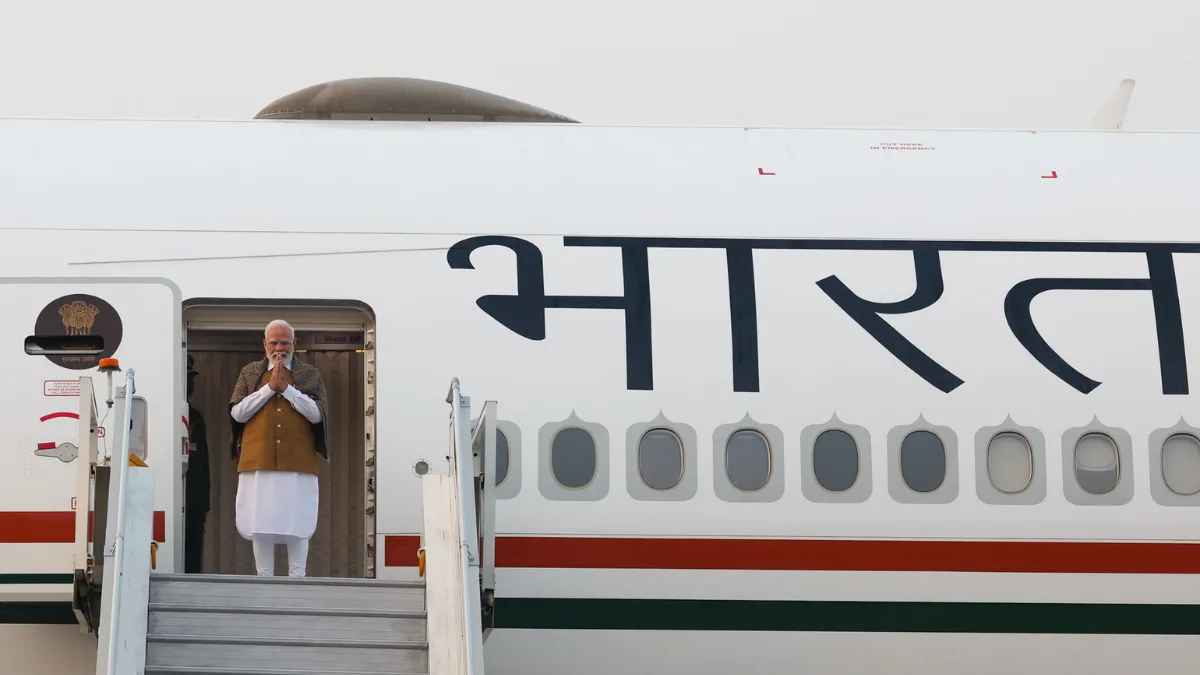
Prime Minister Narendra Modi attends the historic G20 Leaders’ Summit 2025 in Johannesburg, the first G20 on African soil. With key global leaders absent, the summit focuses on Global South priorities—climate resilience, debt relief, AI governance and inclusive development—under South Africa’s presidency.
TheInterviewTimes.com | November 21, 2025: Prime Minister Narendra Modi has arrived in Johannesburg for the landmark G20 Leaders’ Summit, the first edition of the world’s premier economic forum ever held on African soil. Hosted by South Africa from November 21 to 23, 2025, the summit carries special significance for developing nations, emerging economies and the broader Global South. The G20 Leaders’ Summit is unfolding amid sharp geopolitical fissures and unprecedented diplomatic boycotts, reshaping the global conversation around fairness, sustainability and multilateral reforms.
Modi Pushes Inclusivity, AI Governance and South-South Cooperation
Prime Minister Modi is scheduled to address all three high-level sessions at the G20 Leaders’ Summit, reinforcing India’s call for “Solidarity, Equality, Sustainability.” His interventions will focus on inclusive development, climate resilience, transparent critical mineral supply chains and responsible artificial intelligence.
Modi reiterated India’s commitment to the principle of “One Earth, One Family, One Future,” emphasizing that the G20 Leaders’ Summit must produce actionable outcomes that reflect the needs of developing nations. On the sidelines, he will participate in the sixth IBSA (India-Brazil-South Africa) Leaders’ Meeting, strengthening trilateral cooperation rooted in democratic values and South-South solidarity.
Bilateral talks with several visiting leaders are expected to highlight sustainable growth, digital public infrastructure, climate financing and the next phase of Global South collaboration.
Global South at the Forefront as Africa Hosts Its First G20
This year’s G20 Leaders’ Summit marks the fourth consecutive presidency led by the Global South—after Indonesia, India and Brazil—indicating a profound geopolitical shift in global economic governance. The African Union, which became a permanent G20 member during India’s presidency in 2023, now plays a defining role.
Key discussion themes include:
- Debt relief mechanisms for low-income economies
- Just energy transitions
- Sustainable Development Goals integration
- Critical mineral security and AI regulation
Experts note that this G20, hosted on African soil, gives developing countries stronger leverage to push for multilateral reforms and equitable climate finance. The summit is also expected to advance poverty eradication, health resilience and education access through long-term global frameworks.
Boycotts Shape a Tense Diplomatic Backdrop
The G20 Leaders’ Summit is shadowed by high-stakes diplomatic tensions. U.S. President Donald Trump has boycotted the summit, accusing South Africa of discriminatory policies—claims denied by Pretoria. In a historic move, the United States has sent no delegation at all.
China’s Xi Jinping is absent, with Premier Li Qiang representing Beijing. Russia’s Vladimir Putin remains unable to travel due to the International Criminal Court warrant. Argentina’s President Javier Milei has also joined the boycott, adding to the geopolitical rifts.
Despite this, African analysts underscore that the absences may refocus attention on developmental challenges rather than power rivalries. Experts also warn that Washington’s non-participation could expand China and Russia’s diplomatic influence among emerging economies.
The Indian Ministry of External Affairs stated that the summit remains an opportunity to amplify “issues facing developing countries in the Global South instead of leader absences.”
Must Read: G20 Summit 2025: Johannesburg Set to Host Historic Gathering Focused on Africa’s Economic Future
Key Priorities and Expected Outcomes
Deliberations at the G20 Leaders’ Summit will center on:
- Inclusive growth for the Global South
- Climate change mitigation and disaster resilience
- Governance of artificial intelligence
- Critical minerals and supply chain transparency
- Debt sustainability for vulnerable nations
Modi is likely to advocate for diversified mineral partnerships, digital innovation aligned with ethical AI standards and actionable global climate finance commitments.
Observers expect joint declarations on poverty reduction, global health, climate transitions and sustainable technology governance—reflecting the G20’s goal of delivering measurable developmental outcomes.
Key Takeaways
- The G20 Leaders’ Summit is being held for the first time in Africa, marking a historic milestone for the Global South.
- Modi’s agenda emphasizes AI governance, inclusive development and critical mineral transparency.
- Major boycotts by the U.S., Argentina and absent leaders heighten diplomatic tensions.
- Africa and India are pushing reforms on debt relief, climate finance and SDG integration.
- The summit’s success will be judged on its ability to deliver practical, inclusive and sustainable outcomes.