NASA and IBM have unveiled Surya, an open-source AI model that forecasts solar flares up to 2 hours in advance. Learn how AI is reshaping space weather prediction and protecting Earth’s satellites, power grids, and communication systems.
At A Glance
- Project Name: Surya – NASA-IBM’s open-source AI model
- What It Does: Forecasts solar flares up to 2 hours in advance
- Accuracy Boost: Improves predictions by ~16% over traditional models
- Why It Matters: Protects satellites, power grids, aviation, and astronaut safety
- Open-Source Impact: Enables global scientific collaboration and transparency
- Big Picture: AI Meets Solar Storms to shield Earth from disruptive space weather
Introduction: The Sun’s Unseen Threats
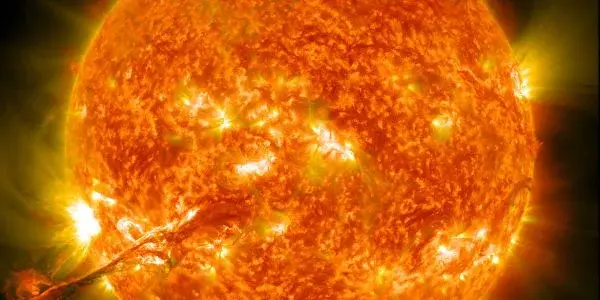
The Sun is both life-giver and disruptor. While its energy sustains life on Earth, sudden solar flares and coronal mass ejections (CMEs) can unleash storms that threaten satellites, power grids, and communication systems. Until now, predicting these events with precision has remained a challenge.
In August 2025, NASA and IBM announced “Surya”, an open-source artificial intelligence model designed to forecast solar flares up to two hours in advance—a breakthrough that could transform how humanity prepares for space weather.
Must Read: The AI That Talks to Trees: A New Era of Environmentalism
What Is Surya?
Surya is an AI-powered forecasting system trained on decades of solar observation data. By analyzing patterns in solar activity, it can predict when and where a flare is likely to occur.
- Lead Developers: NASA’s Heliophysics Division in partnership with IBM Research
- Core Strength: Improves solar flare prediction accuracy by ~16% compared to existing models
- Open-Source Design: Released to the global scientific community, encouraging collaboration and upgrades
Its name, “Surya,” fittingly draws from the ancient Sanskrit word for the Sun.
Why Predicting Solar Storms Matters
Solar flares are bursts of electromagnetic radiation, while CMEs hurl charged particles across space. When these strike Earth, the effects can be severe:
- Satellites: Navigation systems, weather monitoring, and defense assets can be disabled.
- Power Grids: Strong geomagnetic storms can trigger massive blackouts.
- Aviation & Communication: Radio signals, GPS, and flight routes near the poles may be disrupted.
- Astronaut Safety: Crews aboard the ISS or future lunar missions are exposed to harmful radiation.
By giving a two-hour early warning, Surya allows operators to switch satellites to safe modes, power companies to protect grids, and airlines to reroute flights.
Must Read: AI in National Security: Will Future Wars Be Run by Algorithms?
The Role of AI in Space Weather
Traditional forecasting methods rely on physics-based models and direct solar observations. But the Sun is complex and chaotic. AI changes the game by:
- Pattern Recognition: Detects subtle variations in solar magnetic fields invisible to human analysts.
- Real-Time Forecasts: Processes data streams continuously for faster warnings.
- Adaptive Learning: Improves predictions as new solar data is added.
This marks a shift toward machine learning in astrophysics, where AI complements traditional science.
The Open-Source Advantage
Unlike proprietary systems, Surya is open-source, meaning its code and models are freely available. This ensures:
- Global Collaboration: Researchers worldwide can refine it.
- Transparency: Predictions can be independently verified.
- Scalability: Governments and industries can adapt it for their specific needs, from defense to energy.
In effect, Surya is not just NASA’s tool but a shared global resource.
Linking Space Science and Public Safety
The partnership between NASA and IBM highlights how science and technology converge to safeguard society. In an era when humanity relies heavily on satellites for everything from ATMs to weather forecasts, space weather is no longer an abstract concern—it is a public safety issue.
Conclusion: Preparing for the Next Solar Storm
The launch of Surya is more than a technological milestone—it is a step toward resilience in a space-driven world. While we cannot stop solar storms, we can prepare for them. With AI offering more accurate forecasts, Earth’s critical infrastructure gains precious time to defend itself against the Sun’s volatile moods.
As solar activity approaches its next peak in the 11-year solar cycle, tools like Surya will be essential in ensuring that the light of our star continues to nurture, not disrupt, life on Earth.