

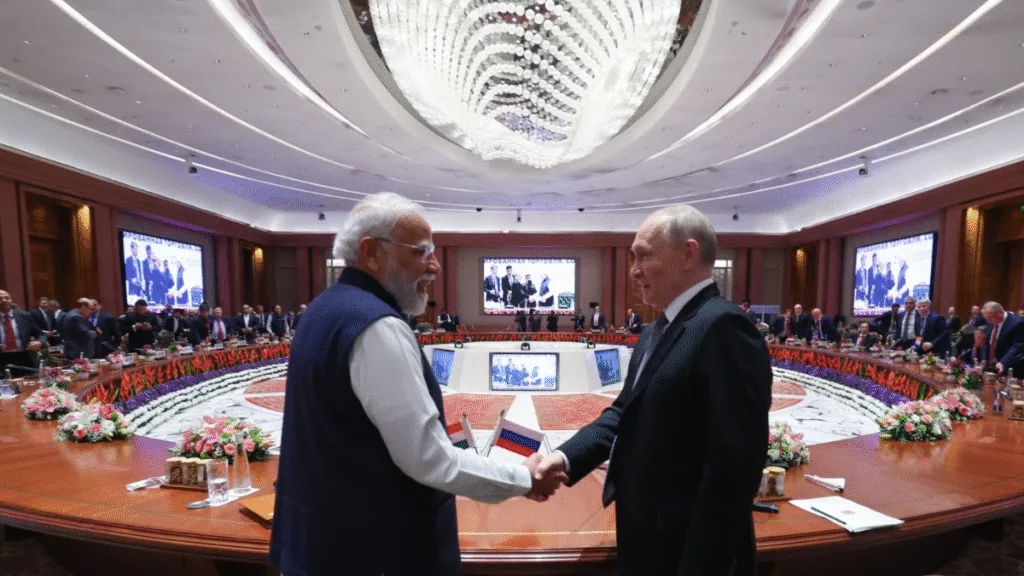
During the Putin India Visit 2025, Prime Minister Narendra Modi and Russian President Vladimir Putin sealed the landmark “Vision 2030” roadmap to push India-Russia trade to $100 billion by 2030. Signed amid escalating U.S. tariff threats, the summit delivered major breakthroughs across defense, energy, de-dollarization, and connectivity, reaffirming India’s strategic autonomy.
Putin India Visit 2025: Modi, Putin Launch ‘Vision 2030’ to Transform Trade
TheInterviewTimes.com | December 5, 2025: Russian President Vladimir Putin concluded his two-day state visit to New Delhi on Friday, sealing a far-reaching “Vision 2030” pact aimed at expanding India-Russia trade to $100 billion by 2030. The high-stakes summit unfolded amid sharp U.S. tariff warnings, turning the Putin India Visit 2025 into a major signal of India’s strategic autonomy.
Modi personally received Putin at Palam Air Base on Thursday—a rare gesture underscoring the political weight of the visit. This was Putin’s first trip to India in four years, marked earlier by the pandemic and the fallout of the Ukraine war. The two leaders—meeting for the 17th time since 2014—described the partnership as resilient, time-tested, and essential to Eurasian stability.
Must Read: Dubai Blue Chip Scam Explained: How 700 Investors Lost Over $100 Million in 2024–2025
Vision 2030: A New Blueprint for Diversified, Balanced Trade
The centrepiece of the summit was the India-Russia Economic Cooperation Programme till 2030, a legally binding framework designed to diversify a trade relationship currently dominated by discounted Russian oil.
Key trade shifts under Vision 2030 include:
- Greater Indian exports in pharmaceuticals, machinery, textiles, and IT services.
- Expanded Russian investments in fertilizers, agriculture, and critical minerals.
- New connectivity initiatives aimed at reducing Asia-Europe shipping times via the Chennai-Vladivostok corridor.
Modi wrote on X:
“We have agreed on an Economic Cooperation Programme till 2030 to diversify our trade and investment ties and expand cooperation in energy, critical minerals, skills, shipbuilding and connectivity.”
President Putin’s visit will add vigour to India-Russia ties….@KremlinRussia_E pic.twitter.com/NPUSZKAGgA
— Narendra Modi (@narendramodi) December 5, 2025
Defense Boost: RELOS, Nuclear Submarine Lease, and Arctic Access
Defense cooperation—marking 25 years of the “Special and Privileged Strategic Partnership”—saw major upgrades.
Key defense outcomes:
- RELOS Agreement: India and Russia gain reciprocal access to each other’s bases, ports, and airspace, extending India’s reach through the Northern Sea Route (NSR).
- Second Akula-Class Nuclear Submarine Lease: A $2 billion deal that allows India to operate two leased nuclear-powered submarines simultaneously.
- Expansion of joint military exercises, logistics cooperation, and Arctic maritime training.
Officials described RELOS as a “historic interoperability leap” without creating permanent bases.
Energy Security: Oil, LNG, Nuclear Fuel and New Reactors
Energy dominated the second day as Putin assured uninterrupted crude and LNG supplies through 2035, despite sanctions constraining shipping insurers and payment systems.
Major energy announcements:
- Co-development of small modular nuclear reactors.
- New agreements with Rosatom on nuclear fuel and component manufacturing.
- Long-term fertilizer supply contracts, including plans for 2–3 Russian-backed urea plants in India.
Putin’s remark at the business forum—“Why does America import our nuclear fuel but punish India for buying our oil?”—drew attention to rising tariff confrontations with Washington.
De-Dollarization, Payments, Labor Mobility and Maritime Links
Several large-scale agreements broadened the partnership beyond trade and defense:
- RuPay–Mir interoperability, enabling seamless rupee-rouble payments, with 96% of bilateral trade already de-dollarized.
- Labor mobility pact for 50,000 Indian workers annually, plus social security coordination.
- Joint shipbuilding of Arctic-class tankers and revival of the Chennai–Vladivostok maritime corridor cutting transit times by 40%.
- New cooperation in vaccine production, cancer research, and medical devices.
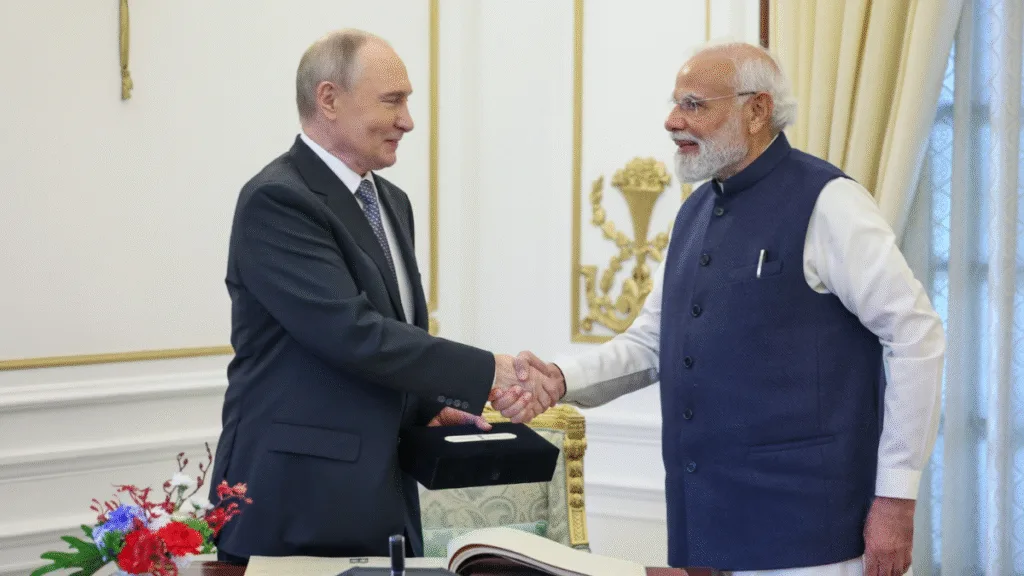
In a symbolic gesture, Modi gifted Putin an illustrated Bhagavad Gita, echoing cultural commitments made at the 2019 SCO Summit.
Must Read: Ukraine 2025: Key Facts About the World’s Most Watched Conflict
Geopolitical Impact: India Balances Multipolar Pressures
The summit also carried a decisive geopolitical message. Leaders discussed Ukraine, counter-terrorism, BRICS expansion, and global energy access. India reiterated its role as a neutral mediator while maintaining ties with both Russia and Western partners.
Brookings scholar Tanvi Madan noted that the Putin India Visit 2025 was “a clear assertion of strategic autonomy,” contrasting India’s strong Quad engagements with its stable Russia policy. Former diplomat Ajay Bisaria said the RELOS pact could “reshape maritime coordination for the next decade”.
The U.S. angle remained unmistakable. President-elect Donald Trump’s proposed 50% tariffs on Indian goods—linked to India’s purchase of Russian oil—triggered sharp diplomatic pushback from New Delhi.
Сегодняшний 23-й индийско-российской ежегодный саммит дал нам возможность всеобъемлюще обсудить различные аспекты индийско-российского сотрудничества. Мы согласовали Программу экономического сотрудничества до 2030-го года с целью диверсификации наших торговых и инвестиционных… pic.twitter.com/3uGfciE6DK
— Narendra Modi (@narendramodi) December 5, 2025
A Symbolic Farewell and a High-Impact Joint Statement
Putin departed late Friday after a private dinner at Modi’s residence, featuring a curated Indian-Russian menu and tributes to Tolstoy and Tagore. The final joint statement emphasized “mutual trust” and targeted full Northern Sea Route operationalization by 2027.
India now stands as a bridge-builder between Eurasian blocs, balancing competitive pressures while expanding its own strategic space.
Key Takeaways
- Modi and Putin launched Vision 2030, targeting $100 billion in bilateral trade.
- Defense ties surged with RELOS and a second Akula-class submarine lease.
- India secured long-term oil, LNG, nuclear, and fertilizer commitments.
- Payments shifted further to rupee-rouble, with 96% de-dollarization.
- The Putin India Visit 2025 reinforced India’s strategic autonomy amid US tariff threats.