
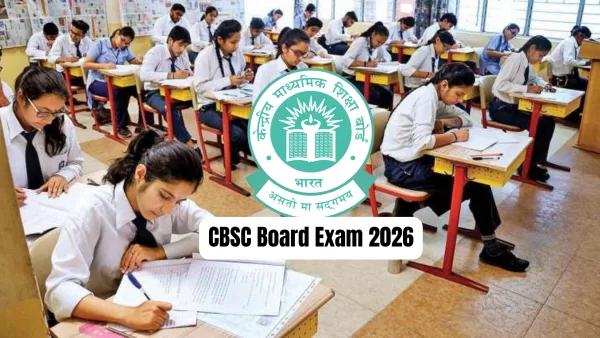
CBSE Board Exam 2026 introduces dual exams for Class 10, competency-based papers, and early schedules to reduce stress and align with NEP 2020.
CBSE Board Exam 2026: Major Reforms Bring Dual Exams and Competency-Based Assessment
New Delhi, October 31, 2025 — The CBSE Board Exam 2026 will mark a historic shift in India’s school assessment system, introducing dual examinations for Class 10 and competency-based evaluation across both secondary and senior secondary levels. The Central Board of Secondary Education (CBSE) announced these reforms alongside the early release of final date sheets — 110 days ahead of schedule — to help students plan better and reduce exam anxiety.
This early move supports the National Education Policy (NEP) 2020 vision for flexible, student-centric, and holistic education. The CBSE Board Exam 2026 will begin on February 17, 2026, for both Class 10 and Class 12 students, with detailed schedules available on cbse.gov.in.
Dual Exams for Class 10 Under CBSE Board Exam 2026
The biggest transformation under the CBSE Board Exam 2026 is the introduction of two board exams for Class 10 students. As per the new structure, the first exam, compulsory for all students, will be held from February 17 to March 10, 2026.
A second exam window, from May 15 to June 1, 2026, will allow students to improve their performance in up to three subjects, such as Science, Mathematics, Social Science, or Languages. The best of two scores will be considered final. This dual-window approach, inspired by NEP 2020’s Para 4.37, reduces the pressure of a single high-stakes test and encourages continuous improvement.
CBSE officials clarified that students failing to pass in the first attempt can reappear in the second under the compartment category. The results for both exams will be declared by June 30, 2026, ensuring a uniform academic cycle.
Must Read: Student Stress 2025: Coping Mechanisms to Boost Mental Health
Single Annual Exam for Class 12
For Class 12, the CBSE Board Exam 2026 will follow a single annual format from February 17 to April 9, 2026. This structure gives students ample time to prepare for competitive exams like JEE Main and NEET.
All theory exams begin at 10:30 a.m. (IST) and last between two and three hours. Schools will conduct internal assessments and practicals in advance. The CBSE Board Exam 2026 schedule also ensures no overlap of major subjects, helping students plan revision efficiently.
Competency-Based Question Pattern in CBSE Board Exam 2026
A defining feature of the CBSE Board Exam 2026 is its focus on competency-based learning rather than rote memorization. For Class 10, 50% of the paper will consist of competency-based questions, including MCQs, case studies, and reasoning-based problems.
For Class 12, the competency portion will be 40%, with 20% objective and 40% descriptive questions. This structure promotes critical thinking, problem-solving, and application-based learning — reflecting the NEP 2020’s mission to make Indian education globally competitive.
Must Read: Social Media Addiction in 2025: Global Trends, Key Studies, and Mental Health Impacts
Technology Integration and Transparency
To ensure transparency, the CBSE Board Exam 2026 process includes DigiLocker integration for digital mark sheets and provisional certificates. This enables faster admissions for Class 11 and higher education. CBSE has also advised students to rely only on official notifications and avoid misinformation on social media.
The sample papers and marking schemes for the CBSE Board Exam 2026, released on August 30, 2025, mirror the new format. Students are urged to use these resources for targeted preparation.
Teacher Training and NEP 2020 Alignment
The CBSE Board Exam 2026 reforms are directly linked to the NEP 2020’s educational overhaul, particularly its emphasis on flexibility, assessment modularity, and stress-free learning. As part of this transformation, CBSE has begun nationwide teacher training programs focused on STEM, vocational skills, and competency-based pedagogy.
Education Minister Dharmendra Pradhan praised these efforts, calling the dual-exam model “a step toward a more humane and equitable education system.”
Stakeholder Reactions and Next Steps
Educators and parents have widely welcomed the CBSE Board Exam 2026 reforms. The early release of date sheets allows students to structure their studies effectively. Many experts see these changes as a step toward global educational parity, helping Indian students adapt to modern evaluation systems used internationally.
CBSE has also issued region-specific guidelines for winter-bound schools, ensuring smooth exam conduct. With more than 46 lakh students expected to appear from India and 26 other countries, the 2026 exams will test the board’s new competency model at scale.
Conclusion: A New Era for CBSE Board Exam 2026
The CBSE Board Exam 2026 stands as a turning point in India’s educational journey — moving from rote-based assessment to a competency-driven, student-friendly framework. Early scheduling, dual exams, and structured question papers all aim to make learning more meaningful.
Students preparing for the CBSE Board Exam 2026 should focus on conceptual clarity, real-world application, and time management to thrive in this new system.