
TheInterviewTimes.com | New Delhi | August 2, 2026
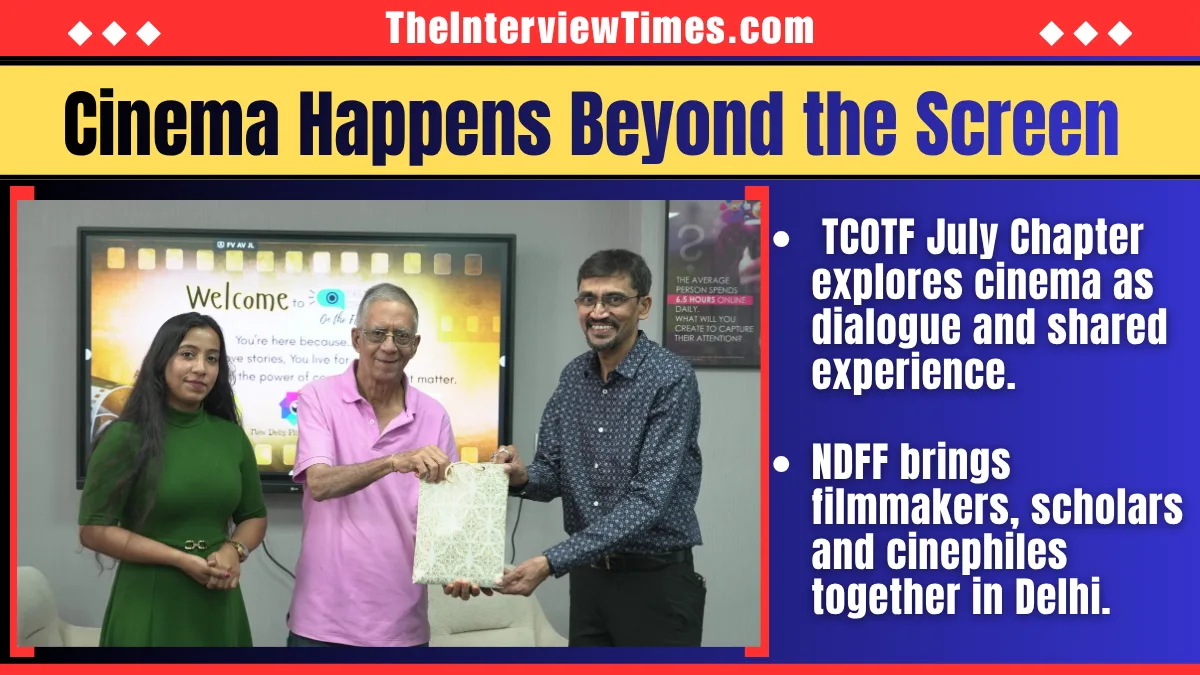
NDFF’s TCOTF July Chapter at IICS, New Delhi, explored visual storytelling, cinema culture and meaningful conversations through expert sessions.
Article Summary
The July Chapter of Talk Cinema On The Floor (TCOTF), organised by the New Delhi Film Foundation (NDFF), brought together filmmakers, scholars, students and cinema enthusiasts in New Delhi to discuss visual storytelling, Delhi’s cinema culture and the evolving role of cinema in society.
Key Highlights
- NDFF organised the July Chapter of TCOTF in New Delhi.
- Cinematographer Koustabh Mukherjee conducted a masterclass on visual storytelling.
- Cinema scholar Sandeep Pahwa discussed six decades of Delhi’s cinema culture.
- Four generations of cinema lovers participated in the event.
- NDFF announced progress under its Make Cinema Campaign.
A Growing Community for Meaningful Cinema
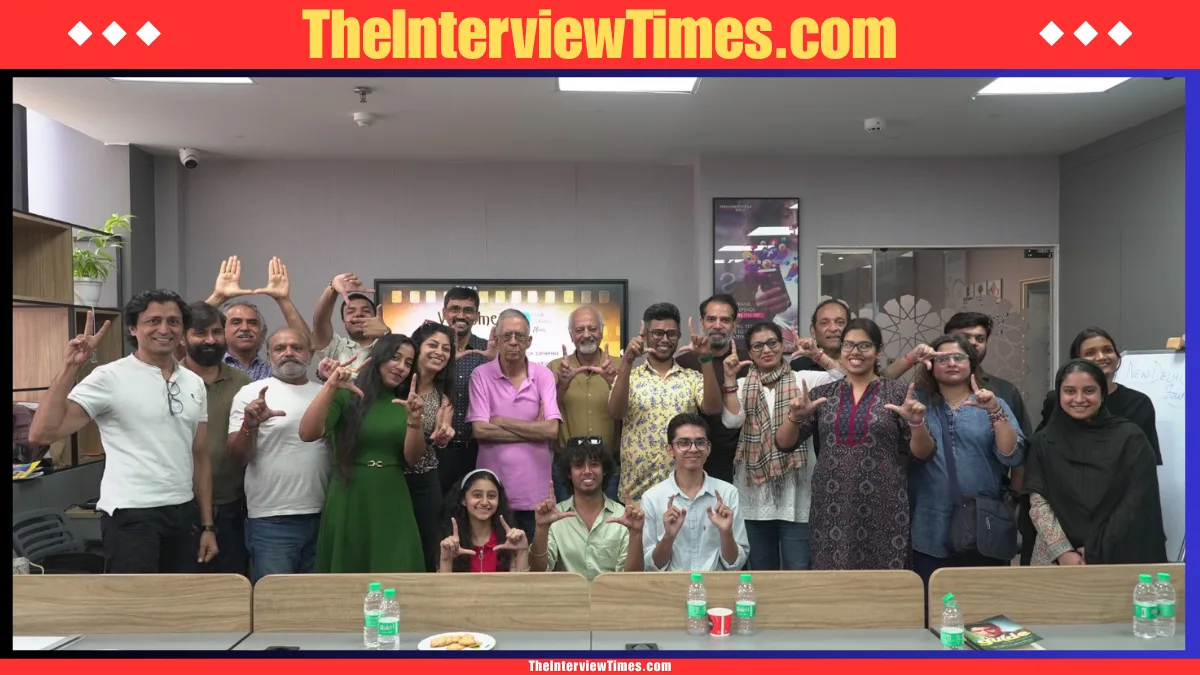
The July Chapter of Talk Cinema On The Floor (TCOTF), the monthly cinema dialogue series of the New Delhi Film Foundation (NDFF), was held on Saturday at the Indian Institute of Creative Skills (IICS), Lajpat Nagar, New Delhi. Organised with the support of the Sri Aurobindo Centre for Arts & Creativity (SACAC) and the Media & Entertainment Skills Council (MESC), the event brought together filmmakers, actors, writers, cinematographers, media professionals, researchers, students and cinema enthusiasts from across Delhi NCR.
Beyond Films: Understanding Cinema as Culture
The programme aimed to go beyond discussions on films and explore the relationship between cinema, society, culture, technology and visual expression. Throughout the day, participants engaged in meaningful conversations on the evolving role of cinema in contemporary society.
NDFF Reaffirms Its Vision
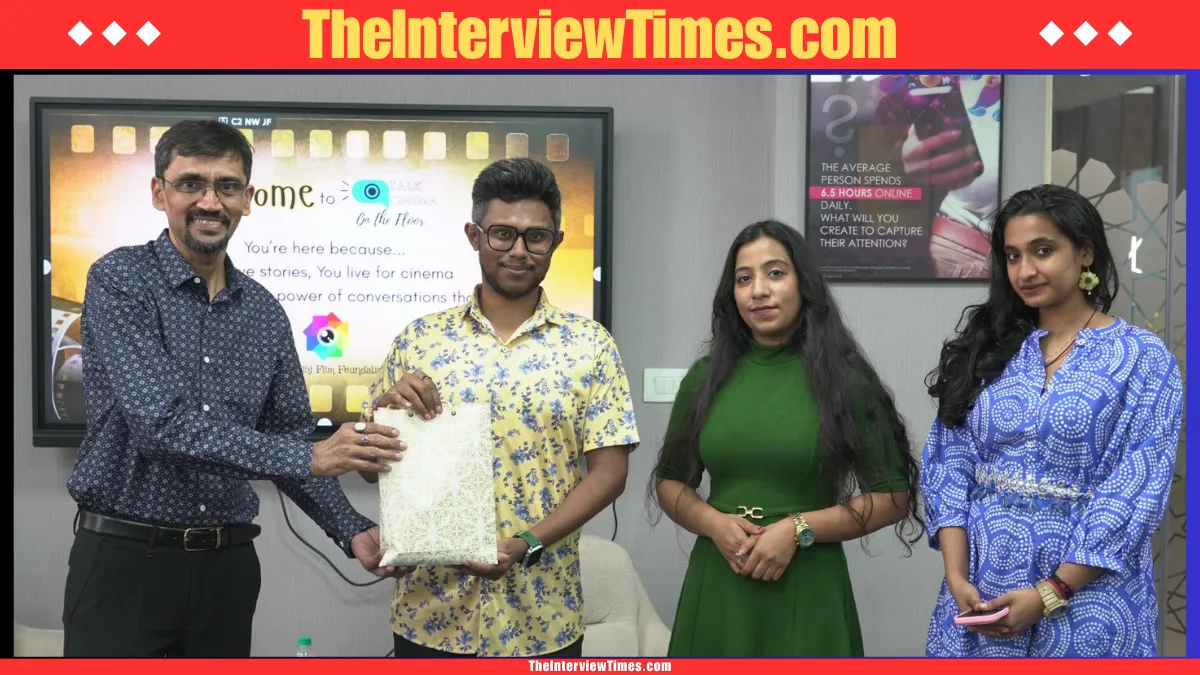
Opening the programme, Ashish K. Singh, Founder and General Secretary of the New Delhi Film Foundation, said that NDFF is committed not merely to film screenings, festivals, talks or filmmaking, but to building a vibrant culture of dialogue, learning and collaboration around meaningful cinema. He observed that great cinema begins not only with a camera but with curiosity, sensitivity and a deeper understanding of society.
Conversations & Collaborations, Participation & Production
Referring to NDFF’s recent association with PRITHVI – The Palaeoscience Film Festival of India as its Film Partner, and his participation in a national panel discussion during the festival, Singh said the Foundation is increasingly collaborating with institutions that use cinema as a medium to engage with science, environment, education and society. He also announced that NDFF’s Make Cinema Campaign has entered its next phase, with the Foundation’s first short film set to move into production shortly.
The programme began with TCOTF’s signature Warm-up Session, where participants briefly introduced themselves and shared their perspectives on contemporary cinema before the two featured sessions.
Craft & Crew: Decoding the Language of Images
The first session, Craft & Crew, featured acclaimed cinematographer and visual storyteller Koustabh Mukherjee, who conducted an engaging masterclass on Visual Storytelling & Visual Communication. Focusing on both the audience’s and the filmmaker’s perspective, Mukherjee explained how every viewer interprets cinematic images differently, making perception an integral part of storytelling. Using sequences from Children of Men, Mission: Impossible 2 and his Marathi film Toda, he demonstrated how the same human emotion—fear—can be expressed through different cinematic languages and how context shapes audience perception. He also emphasised that strong cinematography begins with observation, and that visual writing during the screenplay stage plays a crucial role in emotionally engaging the audience.
Must Read: PRITHVI 2026: Cinema Transforms Science into Experience – theinterviewtimes.com
Spotlight: Six Decades of Delhi’s Cinema Culture
The Spotlight Session featured veteran cinephile and cinema scholar Sandeep Pahwa, who shared rare anecdotes from the golden era of Indian cinema and reflected on Delhi’s evolving cinema culture—from the age of single-screen theatres to today’s OTT ecosystem. He recalled how his father, Basant Pahwa, offered Shakti Samanta his first opportunity as a film director through the classic Bahu, a turning point in Indian film history. Pahwa also narrated fascinating stories surrounding the release of films such as Guide, Anand and Sholay, along with memories of first-day-first-show audiences, house-full theatres and the culture of buying tickets in black. According to him, cinema once served as a truly shared cultural experience across social classes, whereas today’s audience has become increasingly segmented in terms of both content choices and affordability.
Four Generations, One Conversation
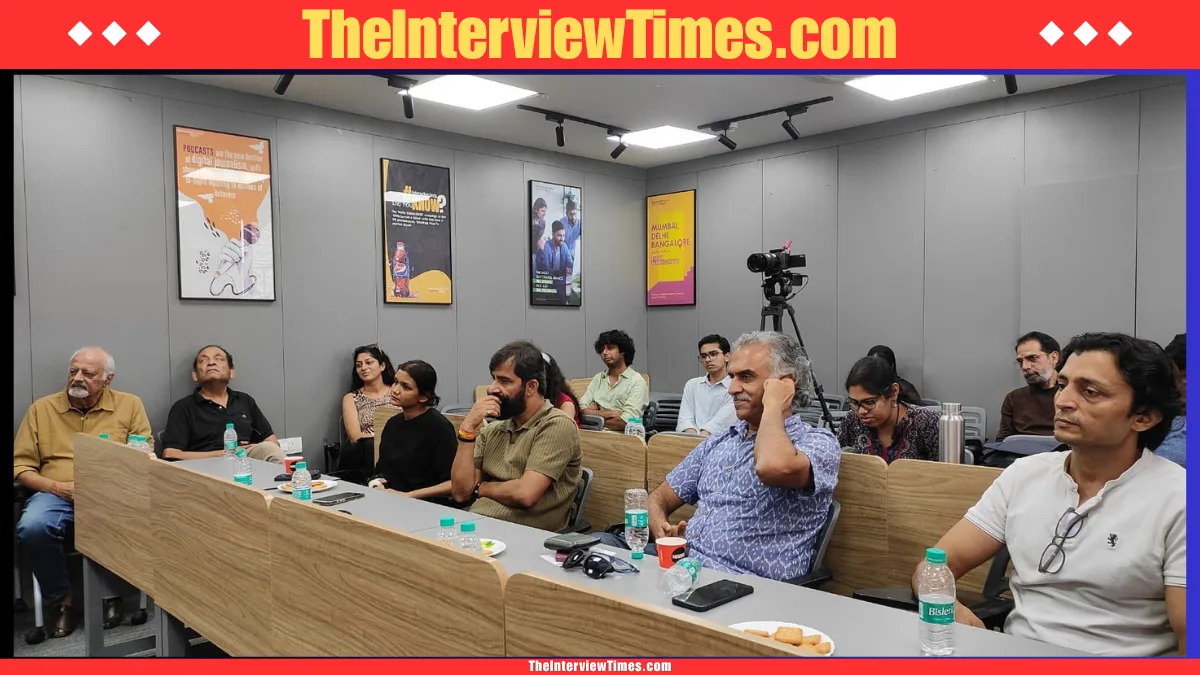
One of the defining features of the event was the participation of four generations of cinema lovers, ranging in age from around 12 to 80 years. Veteran businessman Anup Gupta reminisced about visiting the iconic Sheesh Mahal set of Mughal-e-Azam during his childhood in Mumbai. Asha Batra, founder of Cinemazi, engaged Sandeep Pahwa in a stimulating discussion on India’s cinematic heritage, while film scholar Vibha Jha, who travelled from Pune, interacted with members of Generation Z to understand their viewing habits and evolving relationship with cinema and audio-visual media.
Cinema, Community and Continuing Conversations
The discussions continued with active audience participation on filmmaking, changing audience behaviour, visual language and the social role of cinema. The session concluded with a shared belief that meaningful cinema flourishes not only through good films, but through sustained conversations, collaborative learning and creative communities—a vision that continues to define Talk Cinema On The Floor and the New Delhi Film Foundation.
Top News: Comparison Trap: 5 Powerful Ways to Stop Comparing Yourself to Others – theinterviewtimes.com