
TheInterviewTimes.com | March 14, 2026 | 03:30 PM IST | New Delhi
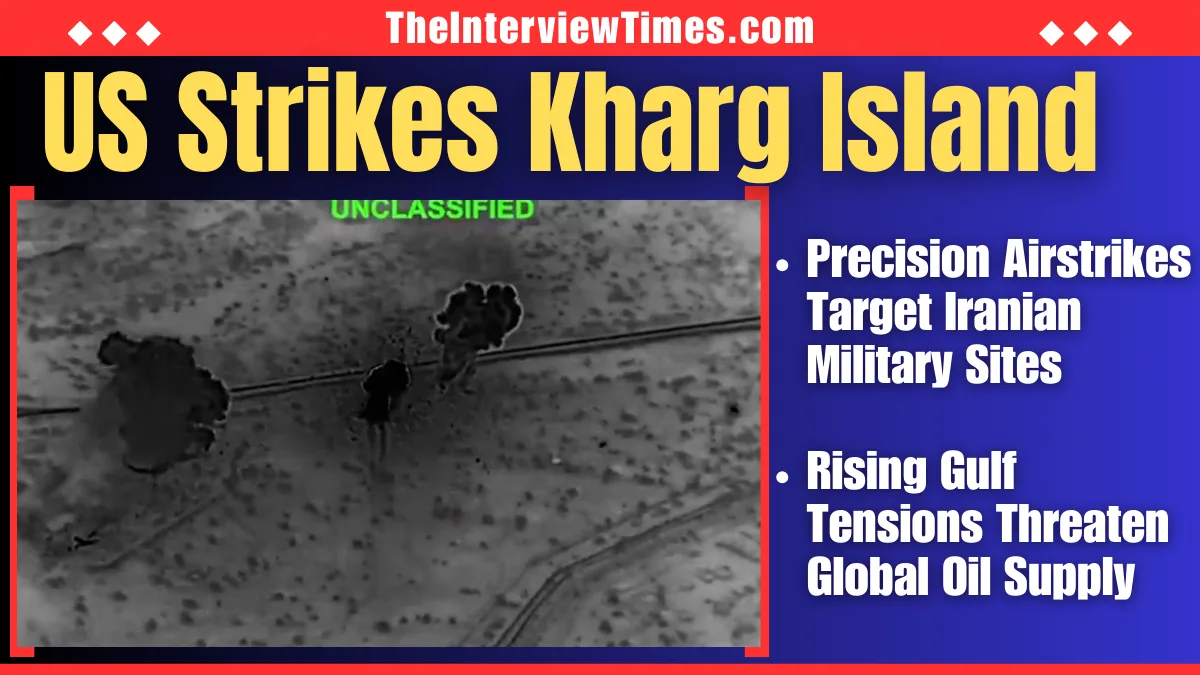
US strikes Kharg Island with precision airstrikes targeting Iranian military sites. The escalation raises fears over Strait of Hormuz security and global oil supply disruptions.
Key Highlights
- The United States launched precision airstrikes on Kharg Island on March 13, 2026, targeting Iranian military installations.
- US forces used F-35 stealth fighters, B-2 bombers, and AGM-158 standoff missiles in the operation.
- President Donald Trump warned Iran not to disrupt shipping in the Strait of Hormuz.
- Iran condemned the attack as a “barbaric violation of sovereignty” and vowed retaliation.
- Kharg Island handles nearly 90 percent of Iran’s oil exports, making it a key global energy chokepoint.
Breaking Down the Airstrikes: A Calculated US Military Operation
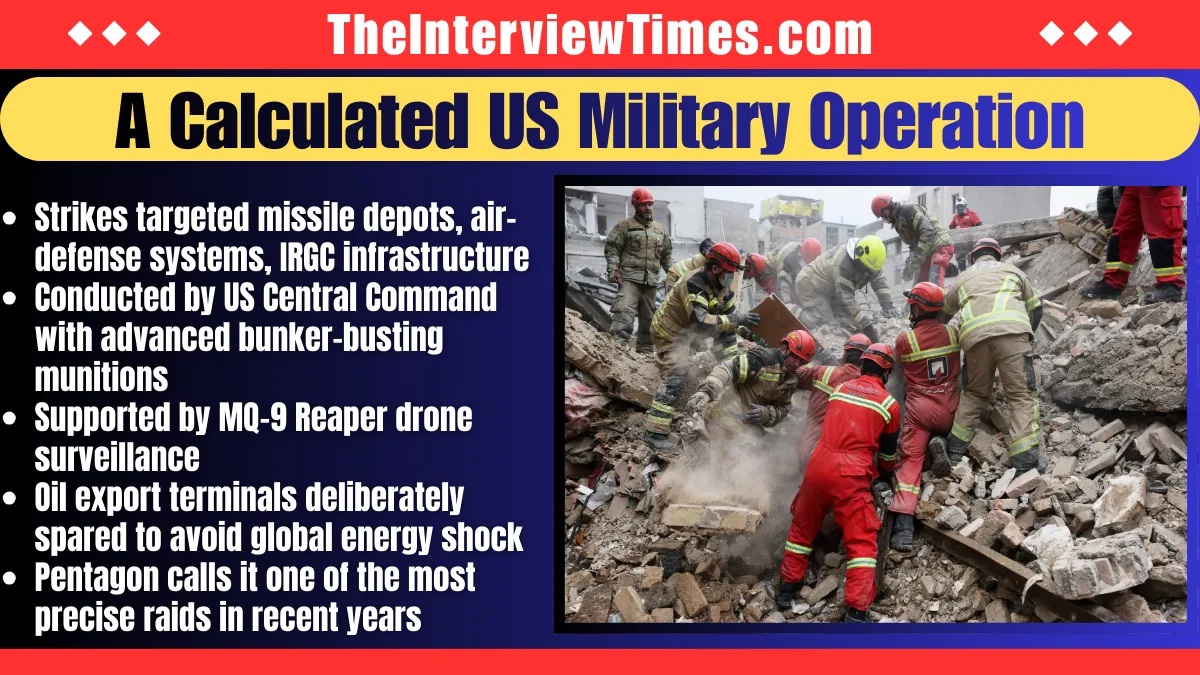
On March 13, 2026, the United States launched a series of precision airstrikes on Kharg Island, Iran’s most important oil export terminal in the Persian Gulf.
The operation was conducted by the United States Central Command and targeted missile storage facilities, air-defense systems, and other military infrastructure linked to the Iranian Revolutionary Guard Corps.
According to US officials, the mission used F-35 stealth fighters and B-2 strategic bombers, supported by AGM-158 Joint Air-to-Surface Standoff Missiles launched from American bases in Qatar. Advanced bunker-busting munitions were used to destroy hardened targets.
The strikes came after several days of intelligence gathering, including surveillance flights by MQ-9 Reaper drones earlier in the week.
Maritime monitoring networks reported multiple explosions across the island, lighting up the night sky. However, oil export infrastructure such as loading jetties and crude storage tanks appeared untouched.
This suggests the United States deliberately avoided damaging Iran’s oil exports in order to limit disruption to global energy markets.
Pentagon officials described the raid as one of the most precise military operations in recent years, with preliminary battle damage assessments indicating that most targeted military installations were destroyed.
“Moments ago, at my direction, the United States Central Command executed one of the most powerful bombing raids in the History of the Middle East, and totally obliterated every MILITARY target in Iran’s crown jewel, Kharg Island… Iran has NO ability to defend anything that we… pic.twitter.com/2iEzCOyA3P
— The White House (@WhiteHouse) March 13, 2026
Trump’s Warning to Iran Over Strait of Hormuz
President Donald Trump quickly confirmed the operation on social media, declaring that US forces had “totally obliterated every military target” on Kharg Island.
He described the strike as one of the most powerful bombing operations in the Middle East and released declassified video footage showing missile impacts and secondary explosions.
Trump also issued a direct warning to Iran regarding the Strait of Hormuz, the world’s most important oil transit chokepoint.
Nearly 20 percent of global oil shipments pass through this narrow waterway, making it a critical artery for global energy markets.
“If you mess with the Strait, we will hit your oil next,” Trump said in a statement from the White House.
At the same time, the United States announced the deployment of 2,500 additional troops to the Gulf region, reinforcing naval escort operations for oil tankers and commercial vessels.
Analysts say the message is clear: Washington is trying to deter Iran while avoiding a full-scale energy crisis.
Must Read: Why Kharg Island Matters: The Oil Hub at the Center of the US-Iran Crisis
Tehran’s Defiant Response and Threats of Retaliation
Iran reacted strongly to the US strikes.
The office of Ali Khamenei condemned the attacks as a “barbaric violation of Iranian sovereignty.”
Iran’s Islamic Revolutionary Guard Corps (IRGC) warned that the United States would face “devastating countermeasures” if attacks continue.
Iranian officials suggested potential retaliation against energy infrastructure in the Middle East, including oil facilities in Saudi Arabia and natural gas terminals in Qatar.
Iran’s foreign ministry also called for an emergency meeting of the United Nations Security Council, seeking international condemnation of the US action.
Military analysts believe Tehran may rely on proxy groups such as Hezbollah or the Houthis to respond indirectly rather than launching direct attacks on US forces.
Satellite imagery from March 14 shows increased IRGC patrol activity around Kharg Island, suggesting Iran is reinforcing its defenses.
Must Read: Strait of Hormuz Explained: Why This Narrow Waterway Controls the World’s Oil Supply
Why Kharg Island Is Vital for Global Energy Markets
Kharg Island is one of the most strategically important energy hubs in the Middle East.
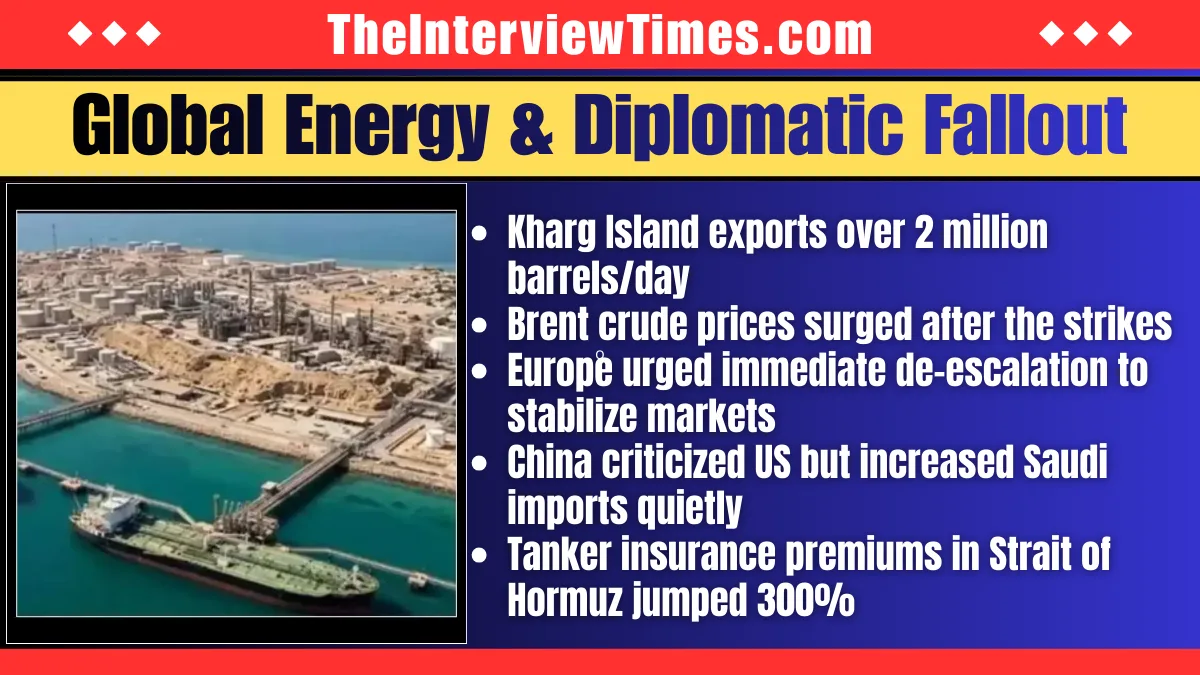
Although the island covers only about 18 square kilometers, it handles more than two million barrels of oil exports per day.
Nearly 90 percent of Iran’s crude oil shipments pass through Kharg’s export terminals.
Because of this concentration, the island represents a single point of failure for Iran’s oil economy, which generates tens of billions of dollars annually.
Any disruption to operations at Kharg could quickly send global crude prices sharply higher, particularly in Asian markets that rely heavily on Iranian oil.
Following the strikes, Brent crude briefly surged amid fears that the conflict could spread to oil infrastructure.
Global Reactions and Market Impact
The US strikes Kharg Island operation has already triggered diplomatic and economic reactions worldwide.
European governments called for immediate de-escalation, warning that a wider conflict could destabilize global energy markets.
China criticized the strikes as “unilateral aggression”, though reports indicate Beijing is quietly increasing crude imports from Saudi Arabia to secure supplies.
India, a major energy importer, is closely monitoring the situation because disruptions in Gulf supplies could push domestic fuel prices higher.
Financial markets also reacted quickly.
Oil traders reported increased hedging activity, and tanker insurance premiums for vessels passing through the Strait of Hormuz have reportedly jumped more than 300 percent in recent days.
What Happens Next?
The coming 72 hours could determine whether the crisis escalates further.
US aircraft carrier groups operating in the Arabian Sea remain on high alert, ready to intercept possible Iranian attacks on shipping.
At the same time, diplomats from Oman and other regional mediators are attempting to open back-channel talks to prevent the conflict from spiraling out of control.
With political pressure rising both in Washington and Tehran, the US strikes Kharg Island incident may become a turning point in the current Gulf crisis.
Whether it leads to negotiation or a wider confrontation could shape the future of global oil markets and Middle East security.
Top News: Iran’s New Supreme Leader Mojtaba Khamenei Demands US Bases Closure and Vows Revenge Amid Oil Crisis
