
TheInterviewTimes.com | March 22, 2026 | 7:31 PM IST | New Delhi
Russian oil tankers reroute to India from China amid Strait of Hormuz crisis. US waiver helps India secure crude supply as global oil markets face disruption.
Article Summary
India is rapidly securing its oil supply by diverting Russian tankers originally headed to China amid the ongoing Strait of Hormuz crisis. A US waiver has enabled this shift, helping India stabilize energy imports despite global disruptions.
Key Highlights
- At least 7 Russian oil tankers rerouted to India from China
- India bought nearly 30 million barrels of crude in one week
- US waiver (March 6) allowed import of already-at-sea Russian oil
- Around 20% of global oil supply affected due to Hormuz disruption
- India increased non-Hormuz sourcing to 70% from 55%
Tanker Diversions Signal India’s Strategic Energy Pivot
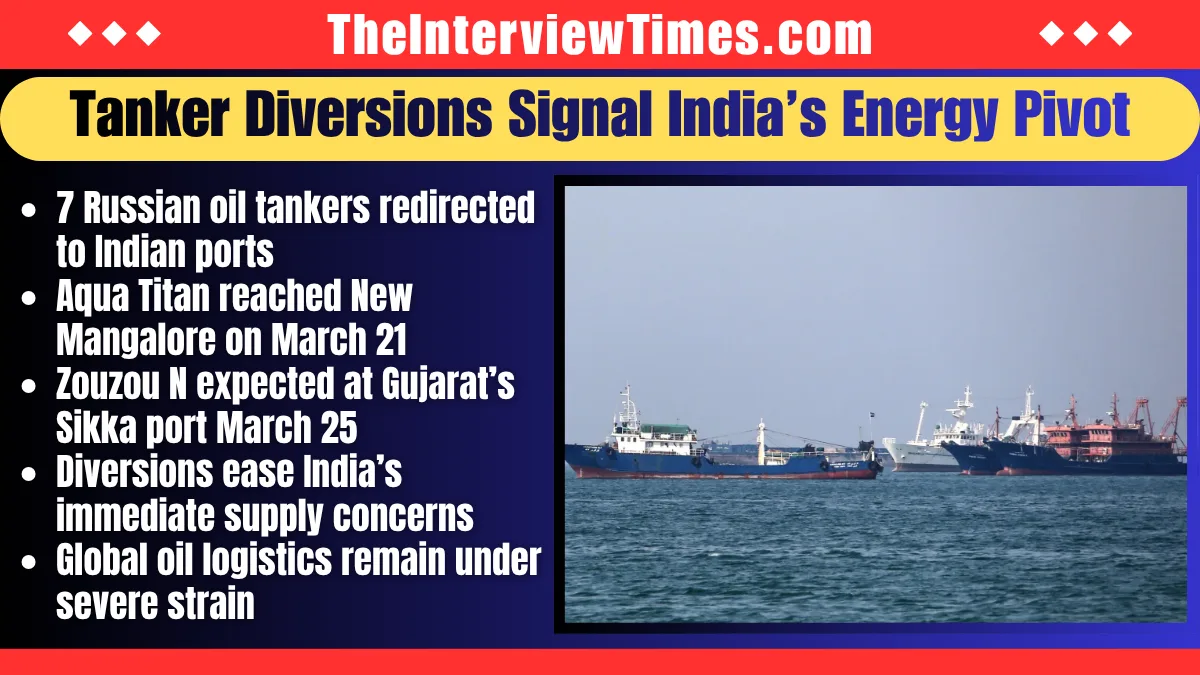
India has moved quickly to safeguard its energy needs by redirecting Russian oil shipments amid escalating tensions in the Strait of Hormuz. Multiple tankers that were initially bound for China have been diverted toward Indian ports, signaling a sharp and strategic pivot in global oil flows.
One such vessel, the Aframax tanker Aqua Titan, carrying Urals crude from the Baltic Sea, reversed its course in mid-March and successfully reached New Mangalore Port on March 21. Another vessel, the Suezmax Zouzou N, loaded with Kazakh CPC Blend, is expected to arrive near Sikka port in Gujarat around March 25.
According to ship-tracking data from Vortexa, at least seven tankers have been rerouted, helping India ease immediate supply concerns at a time when global energy logistics are under severe strain.
US Waiver Enables India to Secure Critical Oil Supplies
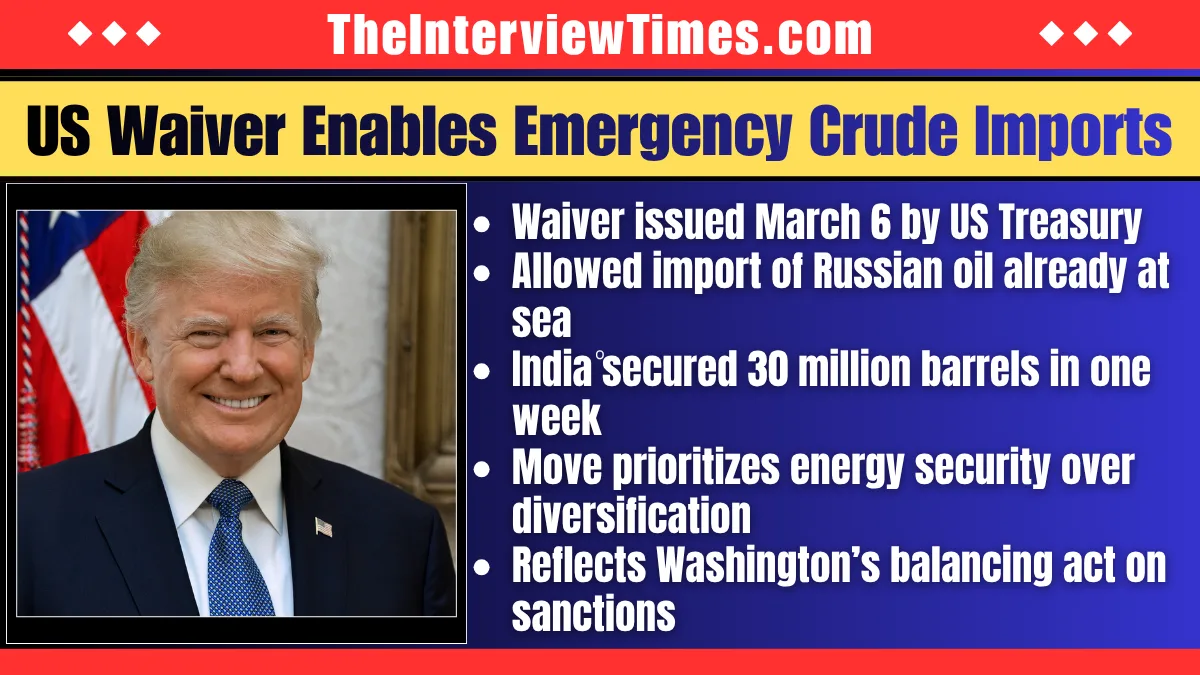
The sudden shift in tanker routes follows a key policy move by the United States. On March 6, the US Treasury issued a waiver allowing countries like India to import Russian crude that was already at sea without directly supporting Russian revenues.
This decision triggered a rapid response from Indian refiners, who secured nearly 30 million barrels of crude within a week. The move reflects India’s pragmatic approach, prioritizing energy security over earlier diversification efforts away from Russian oil.
The waiver highlights a broader geopolitical balancing act, where Washington seeks to maintain sanctions pressure while ensuring that key allies like India do not face energy shortages.
Top News: What Is International Law During War and Who Enforces It Globally? – theinterviewtimes.com
Roots of the Strait of Hormuz Crisis
The crisis began after the Strait of Hormuz, a critical global energy chokepoint, was effectively shut down following US-Israel military strikes on Iran starting February 28 under Operation Epic Fury.
These strikes targeted Iranian military and nuclear facilities and reportedly resulted in the death of Supreme Leader Ali Khamenei. In response, Iran launched missile attacks on US bases and Israeli cities, escalating the conflict rapidly.
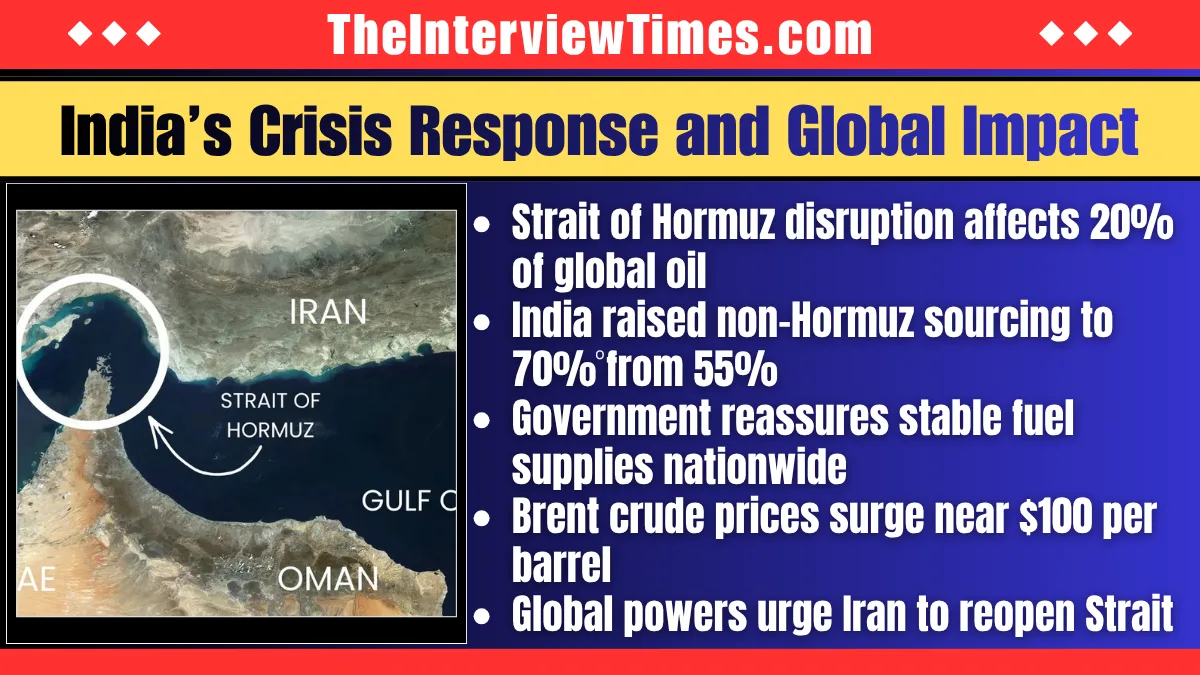
The Strait of Hormuz handles nearly 20 percent of global crude, LNG, and LPG flows, making its disruption one of the most significant energy shocks in recent history. As tensions escalated, maritime traffic halted, leaving nearly 500 oil tankers stranded in the region.
For India, the impact has been particularly severe. Earlier, 40 to 50 percent of its crude imports passed through this route. Currently, 37 Indian vessels with over 1,100 crew members remain stuck in the Persian Gulf and Gulf of Oman, although diplomatic efforts have helped a few ships exit safely.
Government Response and India’s Energy Security Strategy
India has responded with a mix of diplomacy, diversification, and rapid procurement. Petroleum Minister Hardeep Singh Puri informed Parliament on March 9 that India has already secured crude supplies exceeding pre-crisis levels.
Non-Hormuz sourcing has increased significantly to 70 percent of total imports, compared to 55 percent at the start of the crisis. This shift demonstrates India’s ability to adapt quickly to global supply disruptions.
The government has also reassured citizens that there is no shortage of essential fuels. Puri dismissed panic buying of LPG as unnecessary and confirmed stable supplies of petrol, diesel, and aviation fuel across the country.
Global Impact and Rising Oil Prices
The Hormuz crisis has sent shockwaves across global energy markets. Brent crude prices have surged close to $100 per barrel, reflecting fears of prolonged supply disruptions.
With India relying on imports for nearly 88 percent of its crude oil needs, such global shocks pose a serious economic risk. The ongoing tanker diversions and US policy adjustments have provided temporary relief, but uncertainty remains high.
Meanwhile, major global powers including the United Kingdom, France, and Japan have urged Iran to reopen the Strait and ensure safe passage for commercial vessels. However, escalating tensions and continued military threats suggest that a quick resolution remains unlikely.
Key Takeaways
- India has quickly adapted by redirecting Russian oil tankers to secure supply
- The US waiver played a crucial role in enabling emergency crude imports
- The Strait of Hormuz crisis has disrupted nearly 20% of global oil trade
- India’s shift to 70% non-Hormuz sourcing shows strong crisis response
- Global oil markets remain volatile with prices nearing $100 per barrel
