
TheInterviewTimes.com | May 22, 2026 | New Delhi
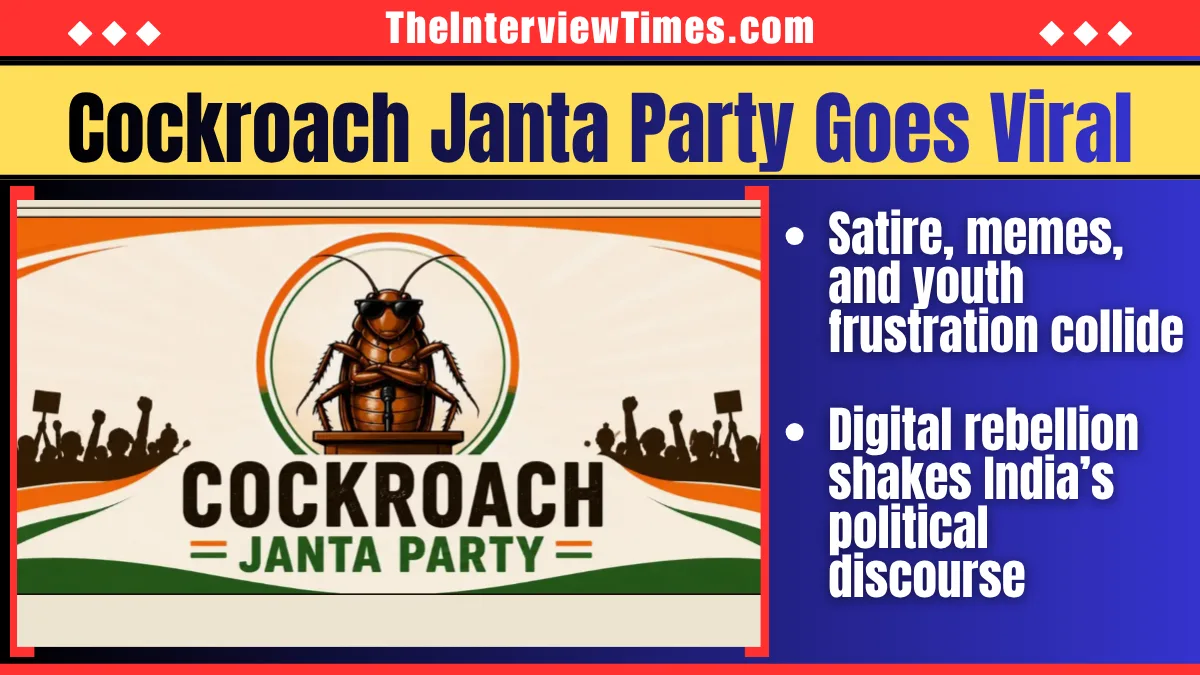
The Cockroach Janta Party has emerged as a viral youth movement in India, blending satire, memes, and political frustration over unemployment and institutional distrust.
Article Summary
The Cockroach Janta Party (CJP), launched as a satirical online movement, has rapidly evolved into a major digital phenomenon among Indian youth. Triggered by outrage over remarks made during a Supreme Court hearing, the movement reflects growing frustration around unemployment, inequality, and political distrust.
Key Highlights
- Cockroach Janta Party founded on May 16, 2026, by Abhijeet Dipke.
- Movement reportedly crossed 15 million Instagram followers within days.
- Viral campaign emerged after controversial “cockroach” remarks linked to a Supreme Court hearing.
- CJP mixes satire, meme culture, and political messaging aimed at Gen Z.
- Analysts say the movement reflects deep youth frustration over jobs and governance.
- The party’s X account was withheld in India following a legal demand.
Cockroach Janta Party: From Satirical Meme to Viral Youth Movement Shaking Indian Politics
New Delhi: In a matter of days, the Cockroach Janta Party (CJP) has transformed from a satirical online joke into one of India’s most discussed digital political movements. Founded on May 16, 2026, by Abhijeet Dipke, the movement has exploded across social media platforms, particularly Instagram, where it reportedly amassed more than 15 million followers within a week.
The sudden rise of the Cockroach Janta Party has drawn national attention because it taps into growing frustration among India’s younger generation over unemployment, economic inequality, exam controversies, and distrust in institutions. What began as meme-driven satire is now being viewed by many analysts as a symbol of wider youth dissatisfaction in India’s political environment.
The Remark That Sparked the Movement
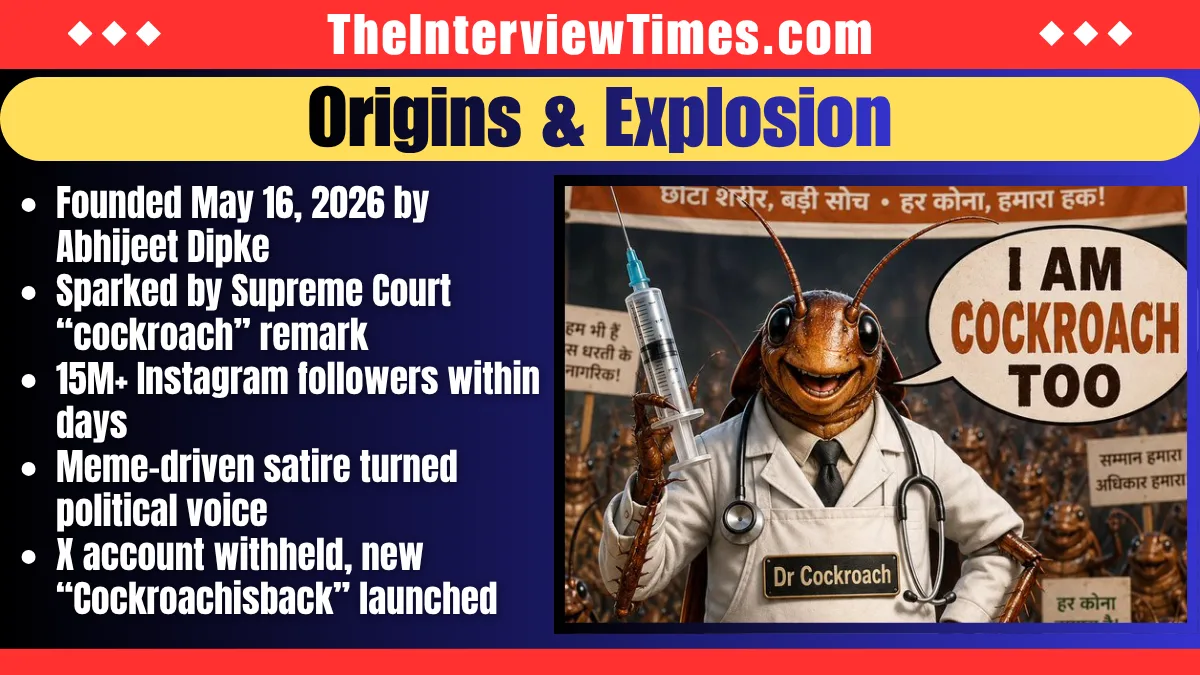
The origins of the movement trace back to a Supreme Court hearing on May 15, 2026, during which Chief Justice of India Surya Kant reportedly used the words “cockroaches” and “parasites” while referring to certain unemployed youth and social media activists. The comments quickly triggered outrage online.
Although later clarifications suggested that the remarks were directed toward individuals allegedly entering the legal profession with questionable credentials, the controversy had already gone viral across Indian social media platforms.
Soon after, Abhijeet Dipke posted a provocative message online asking, “What if all cockroaches come together?” The phrase rapidly gained traction among digitally active youth communities.
Dipke then launched the website Cockroach Janta Party alongside a Google registration form using the tagline “Voice of the Lazy & Unemployed.”
Who is Abhijeet Dipke?
Abhijeet Dipke is a political communications strategist originally from Maharashtra and currently studying at Boston University in the United States.
He reportedly has prior experience in journalism, public relations, and political campaign management. Reports also suggest he previously contributed to meme campaigns linked to the Aam Aadmi Party, although Dipke has described the Cockroach Janta Party as an independent and non-partisan initiative.
Observers say the movement’s rapid growth has been fueled by aggressive meme culture, AI-assisted content creation, viral political satire, and highly relatable messaging aimed at Gen Z audiences.

Cockroach Janta Party Manifesto Goes Viral
The Cockroach Janta Party describes itself as a “political front of the youth,” blending humor with political demands. Its manifesto includes several controversial and attention-grabbing proposals:
- No post-retirement Rajya Sabha positions or government rewards for Chief Justices.
- Legal action against election officials involved in deletion of legitimate votes.
- 50% reservation for women in Parliament and Union Cabinet positions.
- Investigations into large media houses and “Godi media” allegations.
- A 20-year ban on defecting MLAs and MPs from contesting elections.
The party’s membership conditions are intentionally humorous and internet-driven. Applicants are encouraged to identify as “chronically online,” physically lazy, and capable of “professional ranting.”
The movement claims it does not discriminate on the basis of caste, religion, gender, or region.
Social Media Explosion and Political Debate
The Cockroach Janta Party has rapidly become one of India’s most visible online political phenomena. Viral memes, protest videos, parody content, and AI-generated campaign visuals have spread widely across Instagram, X, and YouTube.
Offline protests inspired by the movement have also surfaced in some cities, with participants reportedly wearing cockroach-themed costumes and carrying satirical political placards.
However, critics have questioned the movement’s long-term seriousness and sustainability. Some political observers argue that its links to meme politics and prior political campaign networks raise questions about whether it could eventually evolve into a more organized political platform.
The movement also faced a setback on May 21, when its primary X account was reportedly withheld in India following a legal request. Dipke responded by launching a new account named “Cockroachisback,” signaling that the campaign would continue despite restrictions.
Why India’s Youth Are Connecting With CJP
Analysts believe the popularity of the Cockroach Janta Party reflects deeper structural frustrations among educated young Indians.
India continues to face major debates around youth unemployment, competitive exam leaks, economic pressure, rising living costs, and dissatisfaction with traditional political narratives. Many young citizens increasingly express themselves through meme culture and online activism rather than formal political structures.
The movement’s success demonstrates how internet-driven political communication is evolving in India. Satire, humor, and viral content are now becoming powerful tools for political engagement, especially among Gen Z voters.
Whether the Cockroach Janta Party remains a temporary digital rebellion or develops into a larger political movement ahead of the 2029 general elections remains uncertain. However, its sudden rise has already forced political observers to pay attention to the growing anger and disillusionment among India’s online youth population.
For now, the “cockroaches” are continuing to multiply online, one viral post at a time.
Key Takeaways
- Cockroach Janta Party has emerged as one of India’s fastest-growing online political movements.
- The movement began after controversial remarks during a Supreme Court hearing.
- Founder Abhijeet Dipke transformed the insult into a viral youth campaign.
- The party combines satire, memes, and political frustration to attract Gen Z audiences.
- Analysts say the movement reflects deeper concerns about unemployment and institutional distrust in India.