
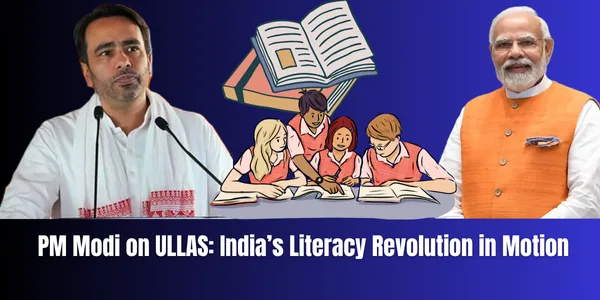
PM Modi highlights the ULLAS programme’s success in boosting rural and female literacy, advancing India’s adult education and NEP 2020 goals.
New Delhi, October 7, 2025 | The Interview Times — Prime Minister Narendra Modi has brought national attention to the ULLAS (Understanding of Lifelong Learning for All in Society) programme, lauding its success in advancing adult education and literacy across India.
In a social media post from the PMO India handle on X, Modi praised an article by Union Minister of State for Education Jayant Chaudhary, emphasizing the programme’s impact on rural and female literacy rates.
Must Read: Zoho Swadeshi Push: Education Ministry Makes Zoho Office Suite Mandatory for All Officials
A Key Pillar of NEP 2020
Launched in 2022, ULLAS — also known as the New India Literacy Programme (NILP) — is a major initiative under the National Education Policy (NEP) 2020. The scheme empowers adults aged 15 years and above who missed formal schooling, offering them a second chance to learn and grow.
With an outlay of ₹1,037.90 crore (2022–2027), the programme focuses on foundational literacy, numeracy, and essential life skills, aligning with UN Sustainable Development Goal (SDG) 4 — Quality Education for All by 2030.

What Is the ULLAS Programme?
The name “Understanding of Lifelong Learning for All in Society” reflects the vision of promoting education beyond traditional classrooms. Replacing earlier adult education schemes like Saakshar Bharat, ULLAS rests on five core components:
- Foundational Literacy and Numeracy – Teaching basic reading, writing, and arithmetic to achieve functional literacy.
- Critical Life Skills – Empowering adults through digital literacy, financial awareness, health and legal education, and family welfare training.
- Vocational Skills Development – Connecting literacy with employability through locally relevant skill-building.
- Basic Education Equivalency – Providing preparatory, middle, and secondary-level equivalency to open paths for further education.
- Continuing Education – Offering courses in arts, sciences, technology, and culture for lifelong learning.
How ULLAS Programme Works
The programme thrives on volunteerism and community participation — embodying the spirit of Kartvyabodh (sense of duty).
- Identification of learners happens through door-to-door surveys by schools and local bodies.
- Registration is facilitated via the ULLAS mobile app or the Online Teaching, Learning and Assessment System (OTLAS), developed by NIC, NCERT, and NIOS.
- Learning content is accessible in 22 regional languages on the DIKSHA portal, in both online and offline modes.
Priority is given to marginalized groups — women, SC/ST/OBC communities, minorities, persons with disabilities, and rural workers. This is critical, as nearly 25.76 crore Indian adults remain non-literate, and 65% of them are women.
ULLAS Programme: PM Modi’s Endorsement and Milestones
Responding to Minister Chaudhary’s post, the PMO lauded ULLAS for “providing educational opportunities for adults” and boosting female and rural literacy.
The endorsement comes after notable achievements — Himachal Pradesh was recently declared the fifth fully literate state/UT under ULLAS, joining Tripura, Mizoram, Goa, and Ladakh.
- Full functional literacy is defined as a literacy rate above 95%, verified through the Foundational Literacy and Numeracy Assessment Test (FLNAT).
- Mizoram, for instance, achieved a 98.20% literacy rate, as reported by the Periodic Labour Force Survey (PLFS) 2023–24.
Teaching under ULLAS is volunteer-driven, involving students, teacher trainees, and community members, using NCERT-developed materials. Learners receive certifications, boosting confidence and motivation for continuous education.
In this article, MoS Shri @jayantrld explains how the Understanding of Lifelong Learning for All in Society (ULLAS) programme, launched in 2022 in alignment with the NEP 2020, provides educational opportunities for adults.
— PMO India (@PMOIndia) October 6, 2025
He highlights that rural and female literacy have surged… https://t.co/Tkohs1tqYk
ULLAS Programme: Broader Impact on India’s Literacy Landscape
ULLAS marks the next stage of India’s literacy journey — following earlier missions like the National Literacy Mission (1988–2009) and Saakshar Bharat (2009–2018). Unlike its predecessors, it integrates digital technology, inclusivity, and local participation to drive measurable progress.
The programme targets 5 crore learners by 2027 — 1 crore each year — empowering them with foundational and employable skills.
States like Chhattisgarh and Odisha have opened dedicated centers in rural and tribal regions, showcasing scalable grassroots implementation.
By bridging educational gaps, ULLAS strengthens India’s workforce and enables informed participation in the digital economy — a key goal for Viksit Bharat 2047.
ULLAS Programme: Conclusion
As India marches toward an inclusive and literate society, the ULLAS programme exemplifies how policy, technology, and community action can transform lives.
Prime Minister Modi’s public endorsement amplifies its message nationwide — urging every citizen to contribute to the movement for universal literacy and lifelong learning.