
TheInterviewTimes.com | April 4, 2026 | 1:33 PM IST | New Delhi
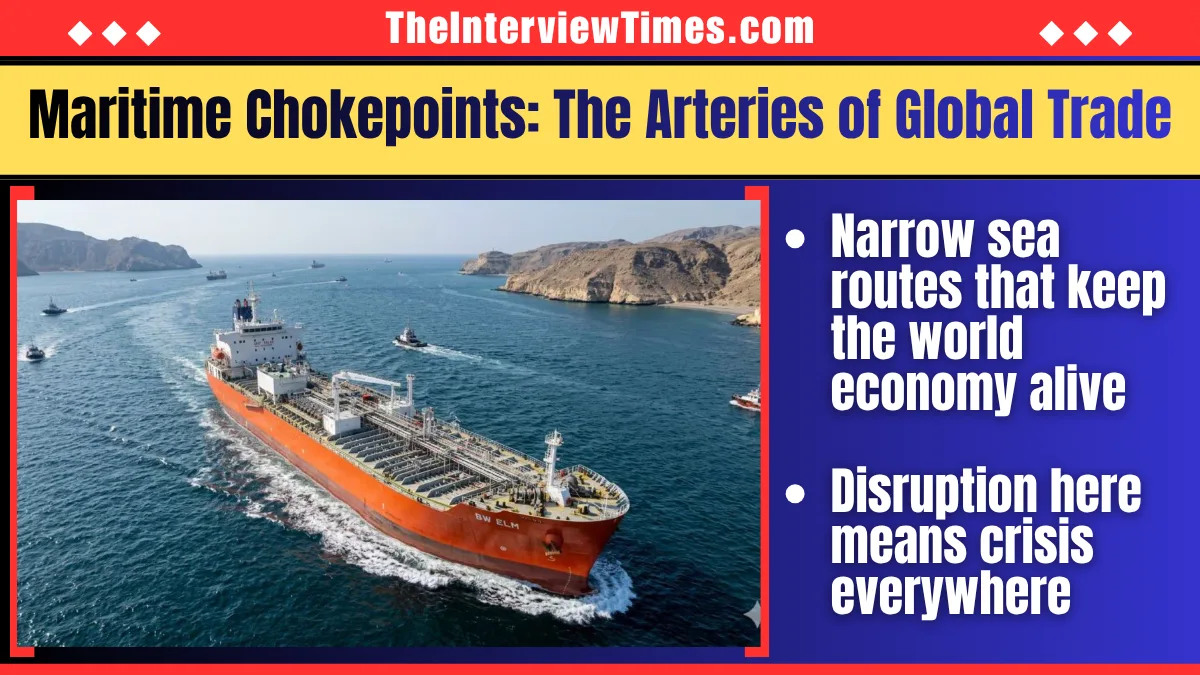
Discover the world’s vital maritime chokepoints like the Strait of Hormuz, Strait of Malacca, Gibraltar Strait, Bab al-Mandeb, Suez Canal and Panama Canal are the arteries of global trade. Learn how these narrow sea routes transport 70-80% of oil, gas and goods worldwide, why disruptions spark global crises.
Maritime Chokepoints: Narrow Routes, Massive Impact
It would not be wrong to say that the world’s trade runs on the oceans. Just look at what happened when there was a slight disruption in the Strait of Hormuz; panic spread across the globe. Do you know how many such critical straits exist in the world like the Strait of Hormuz? If any of them are disrupted, our daily lives would come to a halt. The entire world economy could collapse. That is because 70–80% of goods are transported through these sea routes. From oil, gas, and medicines to everyday essentials, most goods move through these maritime pathways.
These routes are known as maritime chokepoints. They are narrow sea corridors. Any disruption in them breaks the global supply chain and shakes the economy.
In 2026, the chokepoint most in the spotlight is the Strait of Hormuz. Due to the Iran conflict, it has been partially or fully blocked at times. Currently, Iran has even started collecting tolls here. Because of the Hormuz blockade, the world is facing a major oil and gas crisis.
There are several such maritime chokepoints across global sea routes. Apart from the Strait of Hormuz, the major ones include the Strait of Malacca, Strait of Gibraltar, Bab el-Mandeb Strait, Suez Canal, and Panama Canal. These are often called the arteries of global trade.
This year, piracy incidents have surged in the Strait of Malacca. A new agreement between the UK and the EU is set to open borders around Gibraltar. Bab el-Mandeb remains unstable due to Houthi attacks from Yemen. The Strait of Hormuz is nearly closed due to the Iran conflict.
In this article, you will find detailed information about these major maritime arteries, including Hormuz, Gibraltar, Malacca, Bab el-Mandeb, Suez, and Panama. You will learn how many ships pass through them, how much trade flows through them, and why they are so important.
1. Strait of Gibraltar: Britain’s “Rock” and Europe’s Gateway
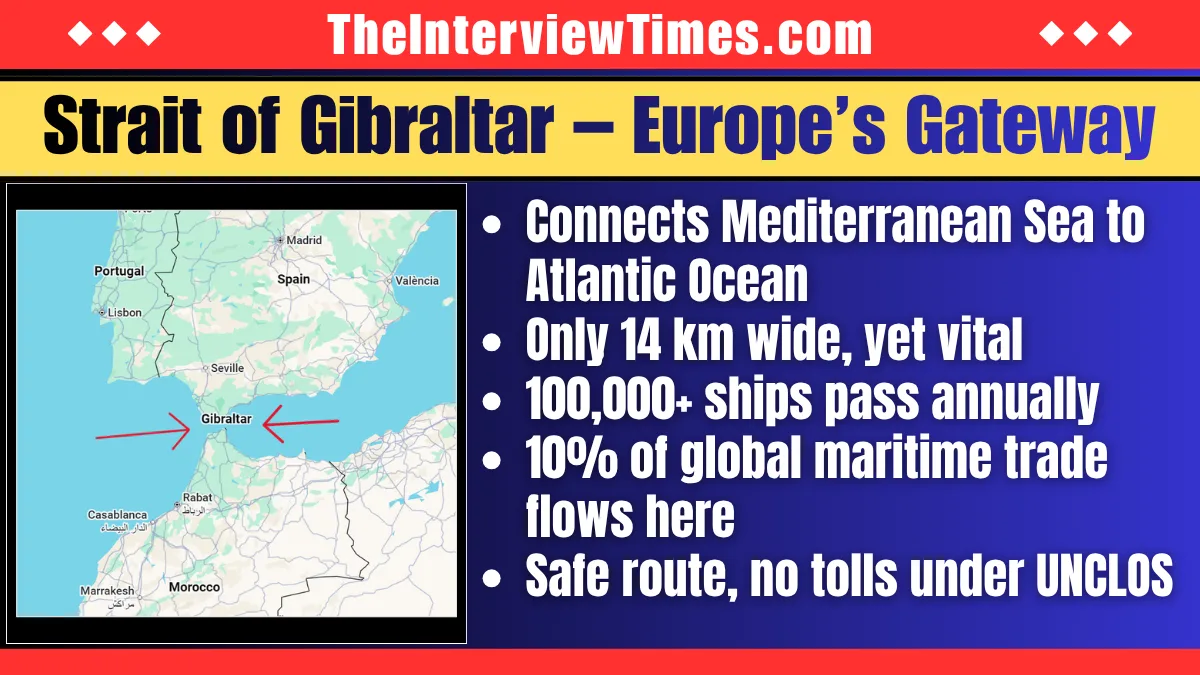
The Strait of Gibraltar lies between Spain and Morocco. It is one of the most important straits in the world, connecting the Mediterranean Sea to the Atlantic Ocean. It is also known as the “Pillars of Hercules.”
Although it is only 14 km wide, more than 100,000 ships pass through it every year. Over 10% of global maritime trade flows through this route. It is also the largest hub for bunkering (refueling ships).
Under UNCLOS (United Nations Convention on the Law of the Sea), transit through this strait is completely free. There is no toll. It is also considered one of the safest maritime routes, with minimal geopolitical tension.
2. Strait of Hormuz: The World’s Biggest Energy Chokepoint
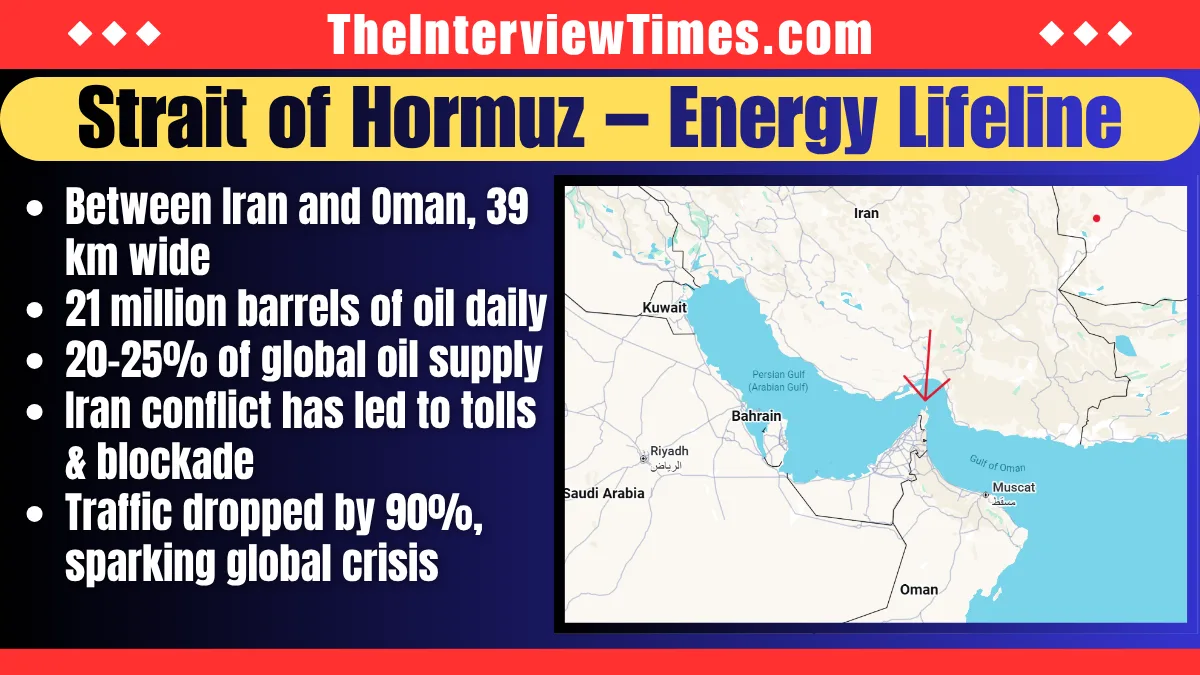
The Strait of Hormuz is currently in the spotlight. It lies between Iran and Oman, connecting the Persian Gulf to the Gulf of Oman. It is about 39 km wide and has 3–4 navigation lanes.
Its importance can be understood from the fact that around 21 million barrels of oil pass through it daily, which is about 20–25% of the world’s oil supply, along with nearly 20% of global LNG.
Major Asian countries like China, India, and Japan depend on this route for 80–85% of their energy needs.
Although transit is free under UNCLOS, Iran has currently imposed tolls due to the ongoing conflict. Iran has effectively taken control of the strait and imposed a blockade. Thousands of ships are stuck, and traffic has dropped by 90%. Only vessels from friendly nations are allowed to pass.
This has triggered a global oil crisis and raised fears of a worldwide economic slowdown.
3. Strait of Malacca: The Busiest Route with Piracy Risks
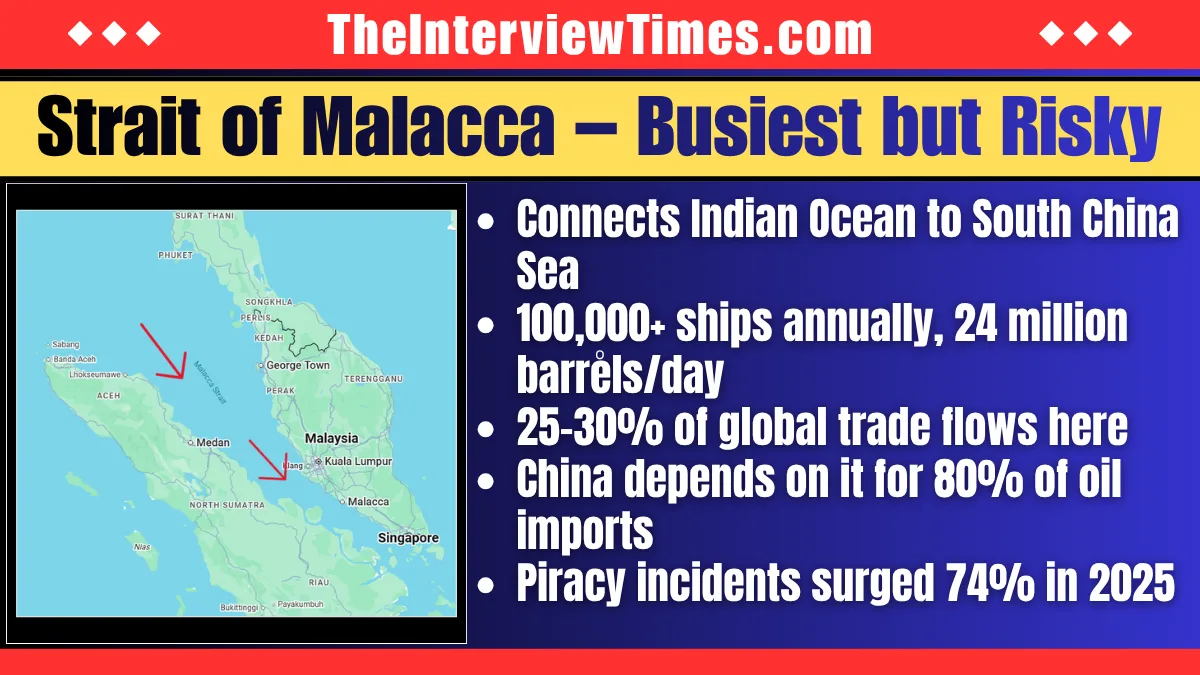
The Strait of Malacca lies between Indonesia, Malaysia, and Singapore. It connects the Indian Ocean to the South China Sea. It is extremely narrow, just 2–3 km wide, yet one of the busiest and most important shipping lanes.
More than 100,000 ships pass through it annually, carrying about 24 million barrels of oil per day. Around 25–30% of global trade flows through this route. China alone depends on it for 80% of its oil imports.
There is no toll for transit here. However, piracy remains a major concern. According to the 2025 ReCAAP ISC report, 108 piracy incidents were reported in the Malacca and Singapore Strait region, a 74% increase from 2024.
Most incidents involve non-violent theft (fuel, stores, spare parts), and crew members are generally unharmed. The narrowness of the route forces ships to move slowly, making them easy targets for coastal groups and organized syndicates.
4. Suez Canal
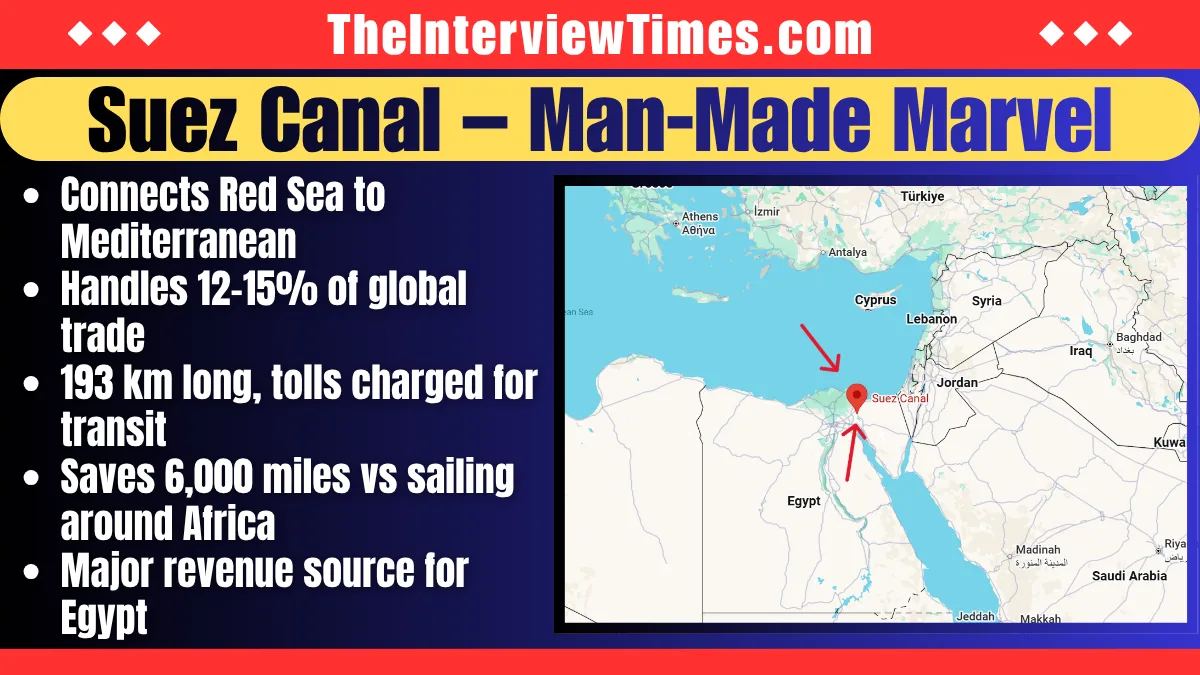
The Suez Canal is located in Egypt. It connects the Red Sea to the Mediterranean Sea. Unlike straits, it is a man-made canal.
It handles around 12–15% of global trade. Unlike natural straits, transit here is not free and tolls are charged. A significant portion of Egypt’s revenue comes from these tolls.
The canal is 193.3 km long, 205–225 meters wide, and about 24 meters deep. It was inaugurated on November 17, 1869.
The Suez Canal reduced the distance between Europe and Asia by nearly 6,000 miles, eliminating the need to sail around Africa. It remains one of the busiest maritime routes in the world.
5. Bab el-Mandeb Strait
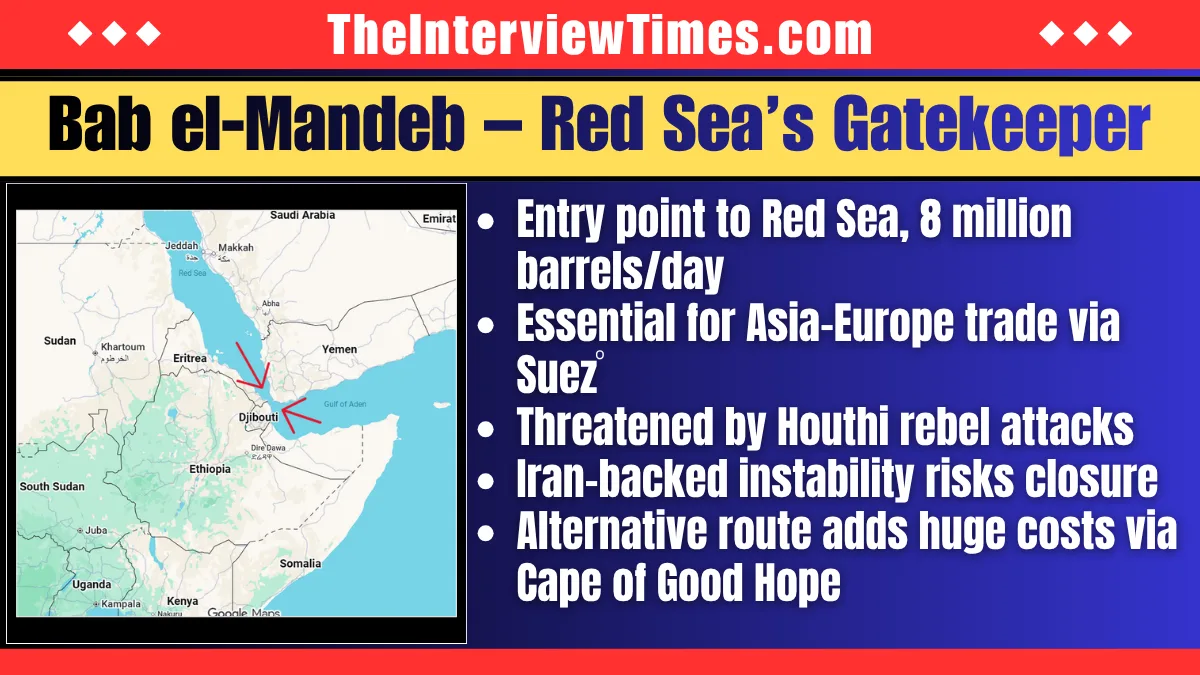
The Bab el-Mandeb Strait is the entry point to the Red Sea. Around 8 million barrels of oil pass through it daily.
Countries trading via the Suez Canal must pass through Bab el-Mandeb, making it extremely important for Asia-Europe trade.
Iran has threatened to block this route through its support for Houthi rebels in Yemen. The Houthis control large parts of Yemen and frequently attack ships.
If this route is blocked, ships must take a longer route around the Cape of Good Hope in South Africa.
6. Panama Canal
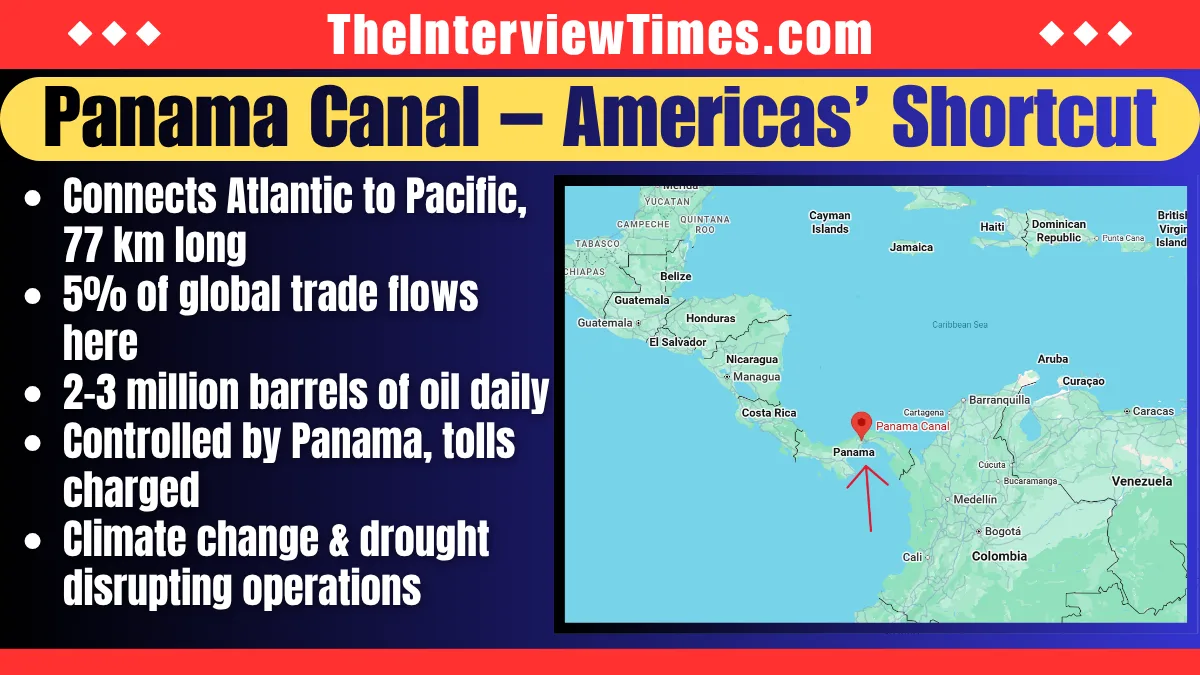
The Panama Canal is a man-made waterway located in Central America. It connects the Atlantic Ocean to the Pacific Ocean, significantly shortening global trade routes.
The canal is about 77 km long. Before its construction, ships had to travel around Cape Horn in South America.
It accounts for about 5% of global trade. Around 2–3 million barrels of oil and petroleum products pass through it daily, along with large volumes of LNG and LPG.
Transit here is not free, and tolls are charged. The canal is controlled by Panama, and it plays a crucial role in the country’s economy.
Climate change is now impacting this route. Drought conditions are affecting water levels, disrupting ship movement.
Comparison and Impact on India
Among all these chokepoints, the Strait of Malacca is the busiest. Currently, the Strait of Hormuz and Bab el-Mandeb are the most vulnerable, while the Strait of Gibraltar is the safest.
For India, the situation is critical. About 60% of India’s oil imports come through the Persian Gulf via the Strait of Hormuz. This poses a risk to the country’s energy security, although imports from Russia have increased in recent years.
Piracy in the Strait of Malacca affects supply chains, while stable conditions in Gibraltar ensure smooth trade with Europe.
Conclusion
For the global economy to function smoothly, it is essential that maritime traffic through these chokepoints remains uninterrupted. These narrow sea routes are the backbone of international trade.
They are not just waterways; they are the arteries that keep the world running.
