

TheInterviewTimes.com | March 01, 2026 | 06:12 PM IST | New Delhi
Global markets react to Operation Epic Fury as gold surges, Gulf stocks sink, oil risks spike, and Nifty 50 braces for volatility amid rising Middle East tensions.
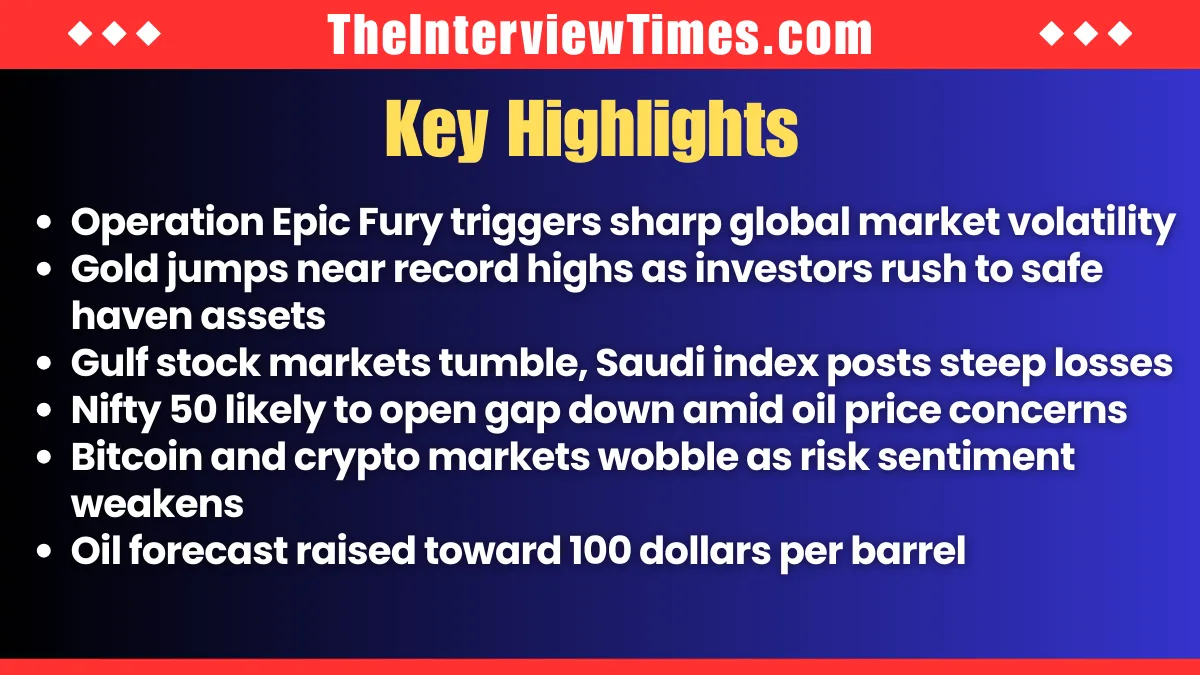
Global financial markets are preparing for heightened volatility after Operation Epic Fury escalated tensions in the Middle East. The reported joint United States and Israeli strikes on Iran that killed Ayatollah Ali Khamenei have triggered a broad risk off reaction across equities, commodities, currencies, and cryptocurrencies.
Iran has declared 40 days of mourning and vowed retaliation. The White House has warned of further action if Tehran escalates the conflict. Investors now see this event as a defining geopolitical risk for the first quarter of 2026.
Gold Surges as Safe Haven Demand Spikes
Gold prices rallied sharply as investors moved capital into traditional safe haven assets. Spot gold climbed to around 5,278 dollars per ounce and briefly approached the 5,300 level in early trading.
Analysts cite three major drivers behind the rally:
- Escalating geopolitical uncertainty
- Expectations of prolonged regional instability
- Continued central bank buying
Several investment banks have raised long term gold price forecasts, citing lower real interest rate expectations and rising geopolitical fragmentation. If tensions continue, technical analysts see the next psychological resistance zone between 5,500 and 6,000 dollars per ounce.
Gulf Stock Markets Sink on Regional Tensions
Middle East equity markets reacted immediately to the developments.
The Tadawul All Share Index fell as much as 4.6 percent in early Sunday trading, marking one of its sharpest intraday declines in recent months. Saudi authorities reported Iranian attacks targeting Riyadh and the kingdom’s eastern region, intensifying investor anxiety.
Other regional markets also declined:
- Oman’s Muscat index dropped more than 3 percent before trimming losses
- Bahrain’s benchmark slipped around 0.6 percent
- Qatar’s exchange remained closed for a bank holiday
Gulf markets often provide the first indication of how global investors are pricing geopolitical risk before Wall Street opens.
Nifty 50 Braces for Gap Down Opening
In India, traders expect significant volatility when markets reopen on Monday. The Nifty 50 ended last week near 25,180 but slipped below its 20 day, 50 day, and 200 day moving averages, signaling technical weakness.
Key levels to monitor include:
- Immediate support near 25,000
- Deeper support between 24,700 and 24,500
India imports more than 80 percent of its crude oil requirements. If Brent crude moves toward 90 to 100 dollars per barrel, inflation pressures could rise. A sustained oil rally may also widen the current account deficit and weigh on the rupee.
Foreign institutional investors remain sensitive to global risk episodes, making the Nifty’s opening range crucial for setting the tone for early March trading.
Bitcoin and Ethereum Face Volatility
Cryptocurrency markets also experienced turbulence. Bitcoin dropped to around 63,000 dollars before recovering toward 67,000. The decline highlights ongoing debate about whether digital assets can act as reliable safe havens during geopolitical shocks.
Options data show strong downside hedging demand near the 60,000 level.
Ethereum followed a similar path, sliding near 1,840 dollars before rebounding close to 2,000.
Unlike gold, cryptocurrencies continue to trade largely as risk assets during periods of acute global stress.
Oil Price Risks Rise Toward 100 Dollars
Energy markets remain at the center of investor concern. Barclays has lifted its Brent crude forecast toward 100 dollars per barrel from an earlier 80 dollar estimate, citing potential supply disruptions.
The Strait of Hormuz remains a critical chokepoint, handling roughly one fifth of global oil flows. Any escalation affecting shipping routes or energy infrastructure could trigger further price spikes.
Benchmark Brent crude had already closed near 72.48 dollars per barrel late last week. A sustained move above 90 dollars would increase inflation risks for oil importing nations such as India.
Defense Stocks Seen as Beneficiaries
While broader markets tilt risk off, defense companies could benefit from rising geopolitical tensions. Major United States contractors such as Lockheed Martin, RTX Corporation, and Northrop Grumman have already gained momentum in early 2026.
Investors expect higher military spending and sustained global security commitments. As a result, defense equities may attract capital rotation even if broader indices weaken.
What Global Markets Will Watch Next
When Wall Street reopens, investors will focus on several critical indicators:
- Movement in the US dollar and Treasury yields
- Further price action in gold and crude oil
- Nifty 50’s ability to hold above 25,000
- Signs of escalation or diplomatic de escalation in the Middle East
The market reaction to Operation Epic Fury highlights how quickly geopolitical shocks can reshape global risk sentiment. Despite advanced financial instruments and technology driven trading systems, traditional drivers such as energy security, safe haven assets, and military conflict remain dominant forces in shaping market narratives in 2026.
Top News: Foreign Tourist Arrivals in India Drop 9.4% in 2025 Amid Bangladesh Tensions and Visa Curbs
